
Housekeeping and facility management services that hold their standard on day ninety.
Any vendor can make a floor shine in week one. Housekeeping and facility management services are judged by month three — whether the roster still has a reliever, whether the supervisor still checks the washroom log, whether consumables arrive before they run out. Godstone deploys supervised soft-services teams on our own payroll with defined scopes of work, checklists, machines and consumables, and a facility executive who signs the log.
Area in square feet, shift pattern and premises type give us enough to price.

Soft services, pantry, technical helpers and front of house.
Facility work is priced by area, footfall and shift pattern, not by headcount alone. We build the roster from the scope of work, then hold it with a supervisor, a reliever factor and a monthly quality audit.
- ✓Housekeeping, deep cleaning and washroom hygiene
- ✓Pantry, cafeteria support and office boys
- ✓Front desk, reception and visitor management
- ✓Technical helpers for plumbing, electrical and HVAC, working under a licensed contractor or your engineering team
- ✓Gardening, waste segregation and pest control coordination
Why housekeeping contracts drift after the first quarter
The scope is written once and the roster erodes quietly from there.
Two people leave, the reliever covers permanently, and a nine-person scope is being done by seven. Nobody reports it until a client walkthrough or an audit finds it.
Washrooms in a hospital or a plant canteen are what auditors and visitors notice first. Consumables running out becomes an emergency purchase at retail price.
Attendance against the sanctioned roster, checklist compliance and a monthly quality score shared with you, with consumables planned rather than reacted to.
Get a site quote →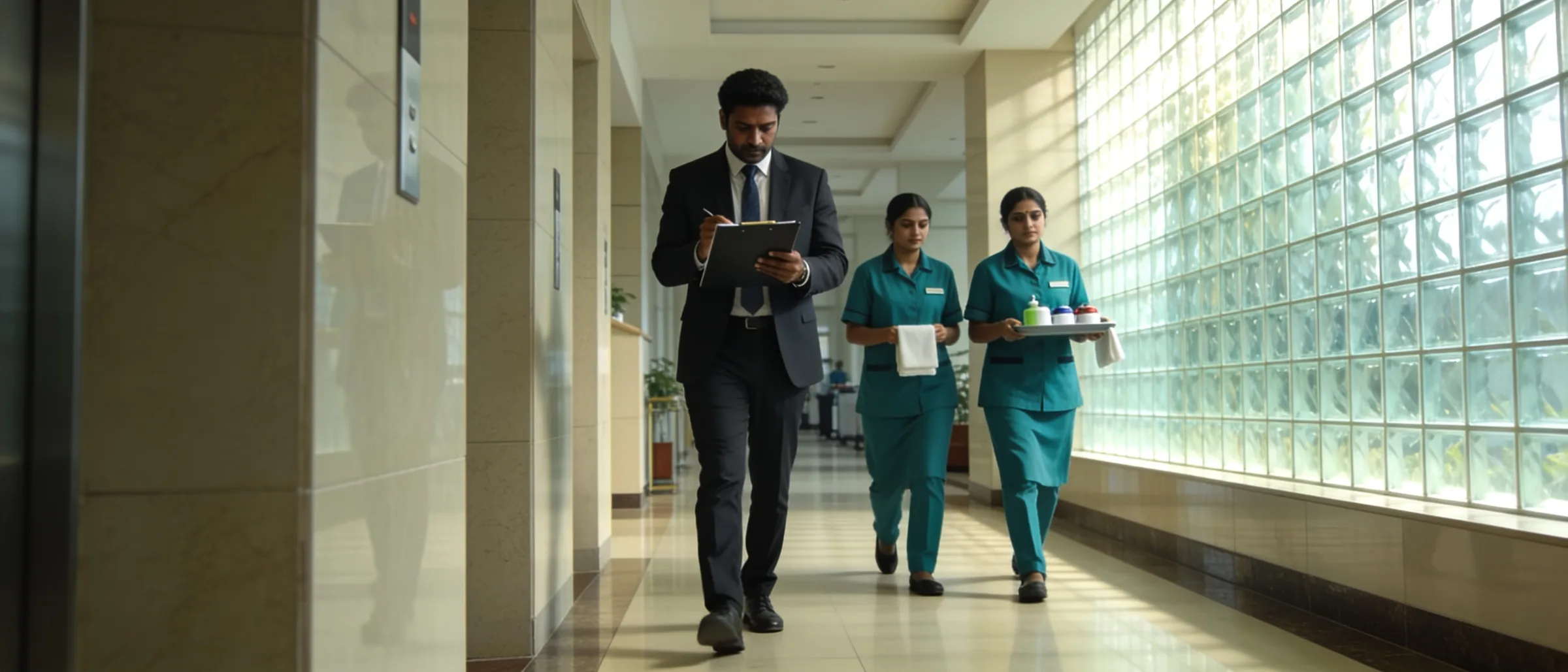
What a facility contract includes
Slider gives an indicative monthly bill for the deployed team — wages, statutory cost and an illustrative 12% markup — before consumables, machines and GST.
No ambiguity about who does what, how often.
Cost-plus, per square foot or fixed monthly: which pricing fits your site?
Facility management in India is bought on three commercial models. Each puts the risk in a different place, so the right one depends on how stable your scope is.
| Model | How the price is built | Works best when | Watch out for |
|---|---|---|---|
| Cost-plus manpower | Sanctioned headcount × wage (at or above the State minimum) + statutory cost + service markup; consumables and machines separate | Scope and footfall change often; you want to see every rupee | Paying for bodies rather than outcomes — needs attendance and quality audit |
| Output-based (per sq ft or per area) | Rate per square foot or per zone for a defined cleaning standard and frequency | Stable offices and campuses with predictable use | Vendor under-staffing to protect margin; wage revisions eating the rate |
| Fixed monthly lump sum | One price for the full scope including manpower, supervision, consumables and machines | Small sites wanting one line on the invoice | Scope creep with no change mechanism; quality drift |
| Hybrid | Fixed base for core cleaning plus per-head or per-event charges for extras | Plants and hospitals with events, shutdowns or seasonal peaks | Clear definitions of what counts as extra |
Whichever model you choose, minimum-wage revisions (usually twice a year through variable DA in many States) should pass through transparently. A fixed rate that ignores them is a rate the vendor will recover by cutting staff.
Roster maths: why a 24×7 post needs about four people
Most housekeeping disputes start with a roster that was sized without reliever cover. This is the arithmetic we show you before you sign, for 8-hour shifts and a weekly off.
Shifts to cover
One post round the clock = 3 shifts × 7 days = 21 shifts a week.
Shifts one person can work
Six shifts a week, with one weekly off. 21 ÷ 6 = 3.5 people just to cover weekly offs.
Leave and absence reserve
Earned leave, festival holidays and unplanned absence add roughly 8–12%. 3.5 × 1.1 ≈ 3.9 people per 24×7 post.
Sanctioned roster, not just posts
A site with 3 round-the-clock posts and 6 day-shift posts (six days a week) needs about 12 + 7 = 19 people on the sanctioned roster. A quote for 15 is a quote for short-staffing.
12-hour shifts reduce headcount but create four hours of overtime a day, payable at twice the ordinary rate under the Code on Wages and subject to the working-hour limits of the OSH Code — often a false economy.
KPIs worth writing into a facility contract
Typical targets we propose for a soft-services contract. The exact numbers are agreed site by site; what matters is that each one is measured the same way every month.
| KPI | Typical target | How it is measured |
|---|---|---|
| Roster fill | 98% or more of sanctioned shifts filled | Biometric or register attendance against the sanctioned roster |
| Washroom hygiene | Checked at the agreed interval (hourly in high-footfall areas) | Signed washroom log, spot checks by the facility executive |
| Complaint response | Critical issues attended within 30 minutes | Complaint register or helpdesk ticket timestamps |
| Consumables | No stock-outs | Monthly consumption report against the plan |
| Quality audit | Agreed score, for example 85% or more | Joint monthly audit on a fixed checklist |
| Statutory compliance | Wages by the 7th; PF and ESI paid by the 15th | Monthly compliance pack with challans and wage register |
Licences and legal checks for a facility contract
Facility teams are contract labour at your site, so part of the compliance risk stays with you as principal employer. The checks to make before and during the contract:
For every soft-services contract
- ✓Contractor licence under the OSH Code (formerly the CLRA) once 50 or more contract workers are engaged
- ✓Wages at or above the State minimum for the category and zone, revised on each notification
- ✓PF (now on wages up to ₹25,000 for mandatory cover) and ESI for every eligible worker
- ✓Appointment letters, wage slips and attendance in the prescribed formats
- ✓Drinking water, toilets, rest area and first aid for contract staff — the principal employer's duty under the OSH Code
- ✓Chemical safety data sheets, PPE and induction for cleaning staff
- ✓Written consent and transport and safety arrangements for women on night shifts
For specialised services
- ✓Security guarding: agency licence under PSARA 2005 from the State Controlling Authority, trained guards, supervisor ratio
- ✓Electrical work: a licensed electrical contractor with supervisors holding a competency certificate under the CEA safety regulations
- ✓STP and WTP operation: trained operators and the pollution control board's operating conditions
- ✓Pest control: licensed operators and approved chemicals only
- ✓Fire systems: maintenance by competent agencies, with records for the fire NOC
Godstone deploys soft-services and technical-support teams. For licensed specialist work we staff qualified trades — electricians, HVAC technicians, plumbers and maintenance engineers — under the licensed contractor or your engineering team. Before signing any vendor, run a contractor compliance check.
Build the team role by role
Each role has its own page with screening, wage and roster detail:
Housekeeping staff
Floor, washroom and deep-clean teams with supervisors.
Sweepers and cleaners
Plant, yard and common-area cleaning.
Pantry staff
Tea, coffee and meeting-room service.
Office boys
Dispatch, errands and office support.
Facility executives
The supervisor who signs the log.
Receptionists
Front desk and visitor management.
Facility management FAQs
Scope, pricing basis, consumables and how quality is measured.
Get a site quote →What is included in facility management services?+
Soft services — housekeeping, deep cleaning, washroom hygiene, pantry and cafeteria support, office boys, front desk and visitor management — plus technical helpers, waste segregation and coordination of pest control, with supervision, machines and consumables as agreed in the scope of work.
How are housekeeping services priced?+
On the sanctioned headcount required for the area and shift pattern, at or above the state minimum wage for the category, plus statutory contributions and a service markup. Consumables and machines are quoted separately or bundled at a fixed monthly rate, whichever you prefer.
Do you provide machines and consumables?+
Yes. Scrubbers, vacuums, single-disc machines, mops, chemicals and washroom consumables can all be managed by us on a planned schedule, which is usually cheaper than emergency local purchase.
How is quality monitored?+
Daily task checklists and washroom logs, a weekly supervisor round with sign-off, and a monthly quality score shared with you. Escalations have defined response times written into the agreement.
Can you cover multiple sites in different cities?+
Yes. Multiple sites can run on one agreement with site-wise rosters, invoicing and quality reporting, and a single point of contact for escalations across all locations.
What is the difference between facility management and manpower supply?+
Manpower supply provides people; facility management delivers an outcome — a scope of work with frequencies, supervision, consumables, machines and quality audits — and is paid against that standard. Many contracts are a mix, which is why the scope document matters more than the label.
How many housekeeping staff does my site need?+
Start from the scope: areas, cleaning frequency, footfall and shift pattern. Then add reliever cover — a 24×7 post on 8-hour shifts needs about 3.9 people once weekly offs and leave are covered. We share this calculation with the quote.
Who provides welfare facilities for contract housekeeping staff?+
Under the OSH Code, the principal employer must ensure that contract workers at its site have access to welfare facilities such as drinking water, toilets, rest rooms, canteen where applicable and first aid. The contractor remains responsible for wages, PF, ESI and records.
Do facility contracts include security guards?+
They can, but guarding is a licensed activity under the Private Security Agencies (Regulation) Act, 2005: the agency must hold a licence from the State's Controlling Authority and deploy trained guards. Ask any vendor for the licence copy for your State before including guarding in the scope.
Related services and hubs
Facility contract up for renewal?
Send the area, premises type and shift pattern. We aim to send a scope of work and a monthly quote within one working day.