
CNC operator staffing, gated on a trade test rather than a CV.
An operator who cannot read a drawing or set an offset will cost you more in scrap than the wage saved by hiring quickly. Our CNC operator staffing runs a trade test before an offer goes out — drawing reading, GD&T basics, offset setting, tool change, inspection with vernier and micrometer — then deploys on our payroll with a supervisor on the floor from day one.
Controls, components and shift pattern let us match operators properly.
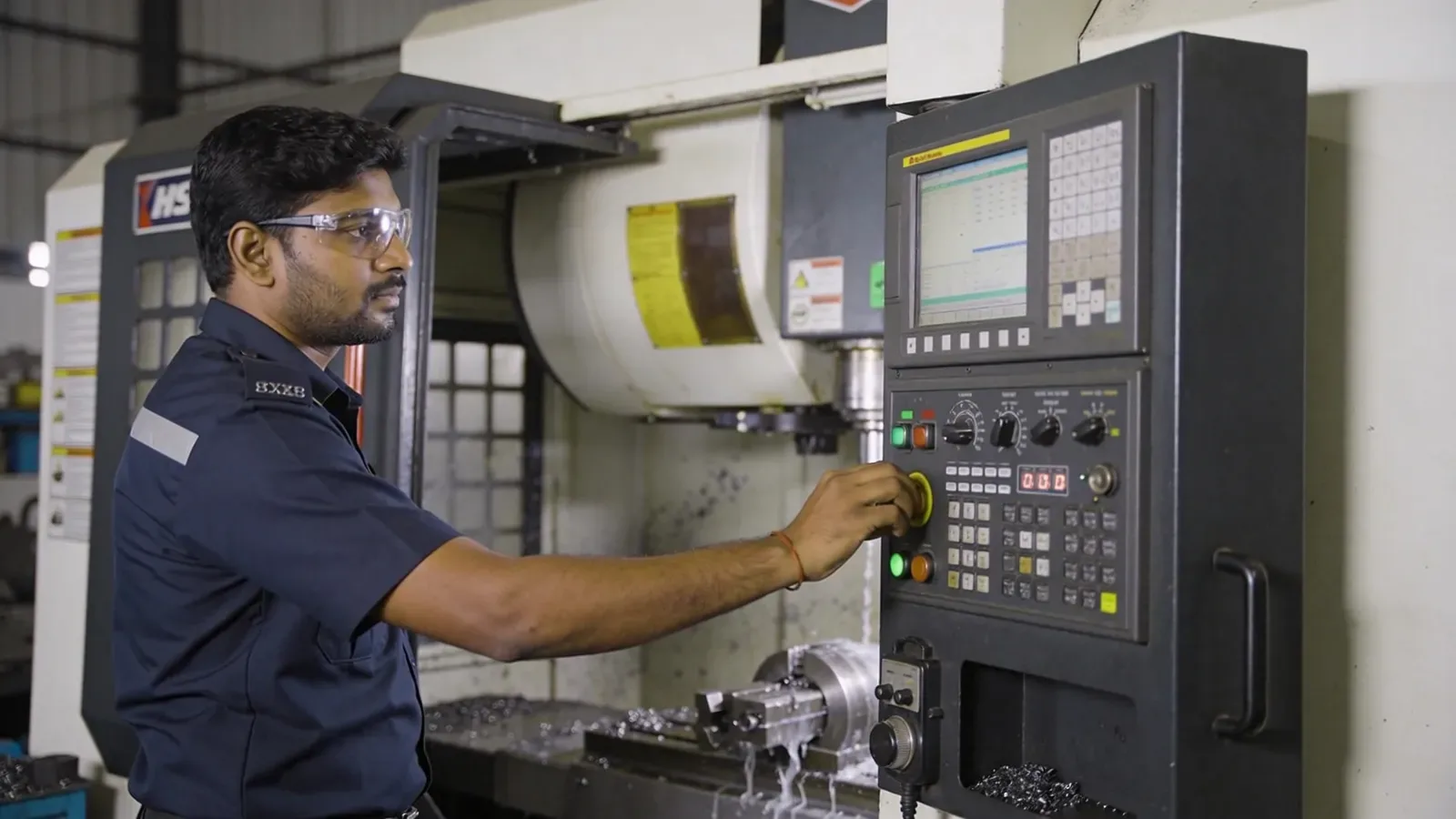
Operators, setters, programmers and inspection.
A machine shop needs a mix, not a headcount. We staff the mix — operators for volume, setters for changeovers, programmers for new components, and inspection to keep first-off approvals moving.
- ✓CNC turning and VMC milling operators
- ✓CNC setters and changeover specialists
- ✓CAM programmers for new components
- ✓Quality inspectors: vernier, micrometer, CMM support
- ✓Grinding, EDM, VTL and special-purpose machine operators
Scrap, rework and a first-off that never clears
Untested operators are the most expensive way to fill a shift quickly.
Two years of experience on paper turns into a crash, a broken tool or a batch out of tolerance in the first week.
Scrap, rework, overtime to recover the plan, and a customer audit finding an untrained operator on a critical station.
Practical test on the control you actually run, wave-wise mobilisation against your ramp, and a supervisor on the floor from day one.
Get a rate card →
How CNC operators are screened and deployed
Move the slider for an indicative monthly bill for L2 operators at a ₹23,000 gross wage, statutory costs and an illustrative 12% service fee (your actual fee is set out in the rate card). Setters and programmers are quoted separately.
No offer before the test is cleared.
What a CNC operator does on an Indian shop floor
On most Indian shop floors a CNC operator runs a proven programme rather than writing one: loading and clamping the job, touching off tools, setting work and tool offsets, submitting the first piece for inspection approval, then holding size through the batch by adjusting wear offsets and changing inserts before they fail. A setter proves new setups and changeovers. A programmer writes and optimises the programme, at the control or in CAM. Testing, pricing and wage category differ for each, so we staff them as separate roles.
This page focuses on CNC turning — lathes, turning centres, turn-mill machines and VTLs — and the setter and programmer grades above them. Vertical machining and conventional machines have their own tests:
VMC operators
Milling on vertical machining centres: fixtures, work coordinate systems, tool-length offsets and probing.
VMC operator staffing →Machine operators
Conventional lathes, drilling, grinding and special-purpose machines, where hand skill replaces the control.
Machine operator staffing →QC inspectors
First-off and in-process inspection, gauges, CMM and PPAP records, kept independent of the operator.
QC inspector staffing →CNC grades we staff, and what each can do alone
Ask for a grade, not just a headcount. The grade decides the test, the wage and how much supervision the person needs.
| Grade | Typical background | Works independently on | Usual minimum-wage category |
|---|---|---|---|
| L1 operator | ITI Machinist or Turner (DGT craftsmen scheme, NSQF level 4, two years) or a NAPS apprentice; up to 1 year | Loading, cycle start, deburring and gauge checks against the control plan, under a setter | Semi-skilled or skilled, depending on the State schedule |
| L2 operator | ITI or diploma with 1–3 years on the same control family | Tool touch-off, work and wear offsets, insert change, first-off submission, basic alarm recovery | Skilled |
| Setter | Diploma in mechanical or tool and die, or ITI with 4+ years | New setups, soft-jaw boring, fixture and tailstock setting, programme prove-out, cycle-time trimming | Skilled or highly skilled |
| Programmer | Diploma or degree plus CAM (Mastercam, NX, Fusion or similar) | Writing and editing G/M-code, canned cycles, simple macros and process sheets for new parts | Highly skilled; usually paid well above the floor |
Skill categories come from each State's minimum-wage notification under the Code on Wages, 2019; the mapping above is typical, not universal. ITI trade levels are from the DGT CTS 2.0 curricula for Machinist and Turner.
The CNC trade test, station by station
Run on a machine you nominate, or an equivalent one, with the control family you actually use. A failed station means no offer for that grade; a near-miss may be offered the grade below.
Drawing reading
Read a production drawing: dimensions and tolerances, surface finish symbols and GD&T callouts such as runout, concentricity and position. Name the features the first-off must prove.
Control and codes
On Fanuc 0i-series, Siemens Sinumerik or your control: navigate the screens, read G00/G01/G02/G03, G96/G97, the G71/G70 roughing and finishing cycles (or Siemens equivalents), M03/M05/M08, and restart from the right block after an alarm.
Offsets
Touch off tools, set the work offset (G54 or equivalent), correct a diameter running 0.02 mm oversize through the wear offset, and explain geometry versus wear offsets.
Insert and tool change
Change an insert, confirm nose radius and grade, reset tool-life counters, then prove out with single block and feed override before running at full rate.
Measurement
Measure with vernier, outside micrometer, bore gauge and thread ring or plug gauge, and record the readings on an inspection report.
Safety and 5S
Door interlocks never bypassed, chuck-key and bar-feeder hazards, chips cleared with a hook and not by hand, coolant and PPE discipline.
Setters also prove a setup from a process sheet within an agreed time. Programmers write a part programme from a drawing and simulate it before any metal is cut.
PPE, guarding and the paperwork behind each operator
PPE issued and checked
- ✓Safety shoes
- ✓Safety glasses with side shields for flying chips
- ✓Cut-resistant gloves for handling parts only — never near a rotating chuck
- ✓Hearing protection where your noise survey requires it
- ✓Close-fitting uniform, no loose sleeves or jewellery
Machine rules we brief
- ✓Doors and interlocks stay active; running with a door open is treated as a serious breach
- ✓Lock-out before jaw changes or clearing a chip conveyor
- ✓Coolant handling and skin care — dermatitis is a common CNC complaint
- ✓Guarding dangerous machinery is a duty under the OSH Code, 2020 and State factory rules
Compliance we carry as employer
- ✓EPF and ESI enrolment before day one; ESI covers gross wages up to ₹21,000 a month, and employees' compensation cover applies above that
- ✓Wages at or above the State minimum for the skill category, paid by the 7th of the following month (Code on Wages, 2019)
- ✓Overtime at twice the ordinary wage rate (OSH Code, section 27)
- ✓Contract-labour registers under the OSH Code (which replaced the CLRA Act, 1970), shared with you monthly
Shift patterns and the wage basis we quote on
Most CNC turning cells run two or three 8-hour shifts. The OSH Code caps ordinary hours at eight a day, with spread-over and weekly limits set by each State, and hours beyond that are paid as overtime at twice the ordinary rate. A two-shift, 12-hour pattern therefore carries overtime on every shift unless your State allows a compressed week, so cost it in before you choose it. Night shifts still need someone who can clear an alarm and hold size, not just press cycle start.
| Basis | Figure | Source and notes |
|---|---|---|
| Legal floor (example) | Haryana: skilled ₹18,501 a month, highly skilled ₹19,426 a month | Haryana notification effective 1 April 2026. Your State, zone and scheduled employment decide the real floor. |
| Karnataka | Skill-and-zone structure with steep increases, notified 22 May 2026 | Its legal validity is being contested; check the current position before budgeting a Bengaluru-area site. |
| Market reference | CNC operator average ₹19,498 a month; typical range ₹11,615–₹32,730 | Indeed India salary data, 274 reports, updated June 2026. Nashik and Sriperumbudur list among the higher-paying locations. |
| Our estimator | ₹23,000 gross a month for an L2 operator | Planning figure for an industrial belt. Setters and programmers are quoted separately. |
Indicative only, not an offer or a legal rate. A national floor wage under the Code on Wages is still being fixed; until then State rates apply. At least half of total remuneration must count as “wages” for PF and gratuity. Use the minimum wage calculator to check your State's rate.
What to hold a CNC operator, and us, to
First-off approval rate
Share of setups where the first piece clears inspection without a re-cut, tracked by operator and shift.
Rejection and rework
Parts scrapped or reworked per million, split into operator-caused and process-caused.
Insert consumption
Inserts per 100 parts against the standard. Early breakage usually points to feed, offset or clamping errors.
Operator-side downtime
Availability lost to late cycle starts, waiting on first-off approval and unplanned setup time.
Our service targets
We aim to send a trade-test plan and rate card within one working day, deploy tested operators in 7–12 working days, and have a tested replacement on the floor within 15 days of an exit. These go into the SLA schedule.
Three mistakes that make CNC contract staffing fail
Testing on the wrong control
A strong Fanuc operator can take weeks to get comfortable on a Siemens conversational screen. Test on the control you run.
Buying operators when you need a setter
If changeovers happen every shift, one setter covering a group of machines usually saves more than extra operators.
Pricing at the minimum wage
Operators paid at the floor leave for a small raise at the next plant. Quote at the market rate for your belt; attrition costs more.
CNC operator staffing FAQs
Testing, controls, qualifications, shifts and cost basis.
Get a rate card →Are CNC operators trade-tested before deployment?+
Yes. Every operator clears a practical test covering drawing reading, GD&T basics, offsets, insert change and measurement with vernier and micrometer, on the control family you run, before an offer is issued.
Which CNC controls do your operators know?+
Fanuc and Siemens Sinumerik are widely used in Indian turning shops, alongside Mitsubishi and others. We test on the control you actually run, because screen layouts and cycles differ enough to matter.
What qualification should a CNC operator have?+
Usually an ITI certificate (NCVT or SCVT) in Machinist, Turner or Operator Advanced Machine Tool, or a diploma in mechanical or tool and die engineering. The certificate shows training; our trade test shows what the person can do on your machine.
What is the difference between a CNC operator, setter and programmer?+
An operator runs a proven programme and holds size with offsets. A setter proves new setups and changeovers. A programmer writes and optimises the programme. Each is tested and priced separately.
How long does it take to deploy CNC operators?+
We aim for 7–12 working days including the trade test, with larger ramps mobilised in waves. Setters and programmers can take longer, depending on how scarce they are in that industrial belt.
What does a contract CNC operator cost?+
The gross wage (market rate for your belt, never below the State minimum for the skill category), plus employer PF at 12% of PF wages, EDLI and admin charges, ESI at 3.25% where gross is up to ₹21,000, bonus and gratuity provisions, and the service fee. See how staffing fees are calculated.
Can CNC operators work 12-hour shifts?+
Only with overtime paid at twice the ordinary rate for hours beyond the daily limit, or a compressed week where your State's rules allow it. We cost both options in the rate card so you can compare them with a three-shift pattern.
Can operators be converted to our rolls?+
Yes, under a temp-to-hire clause agreed in the contract. Attendance, output and quality history travel with the conversion.
Related roles and industries
Machines waiting on operators?
Send the machine list and shift pattern. We aim to send a trade-test plan and rate card within one working day.