
Forklift operator staffing where the test happens before the pallet does.
A forklift incident is a safety report, a damaged rack, a stopped aisle and an insurance conversation — usually caused by an operator who was never tested on your equipment. Our forklift operator staffing verifies training and experience, runs a practical test on the truck class you actually use, checks load-chart understanding, and deploys on our payroll with safety induction and PPE before the first shift.
Truck classes, shift pattern and load profile let us match operators properly.
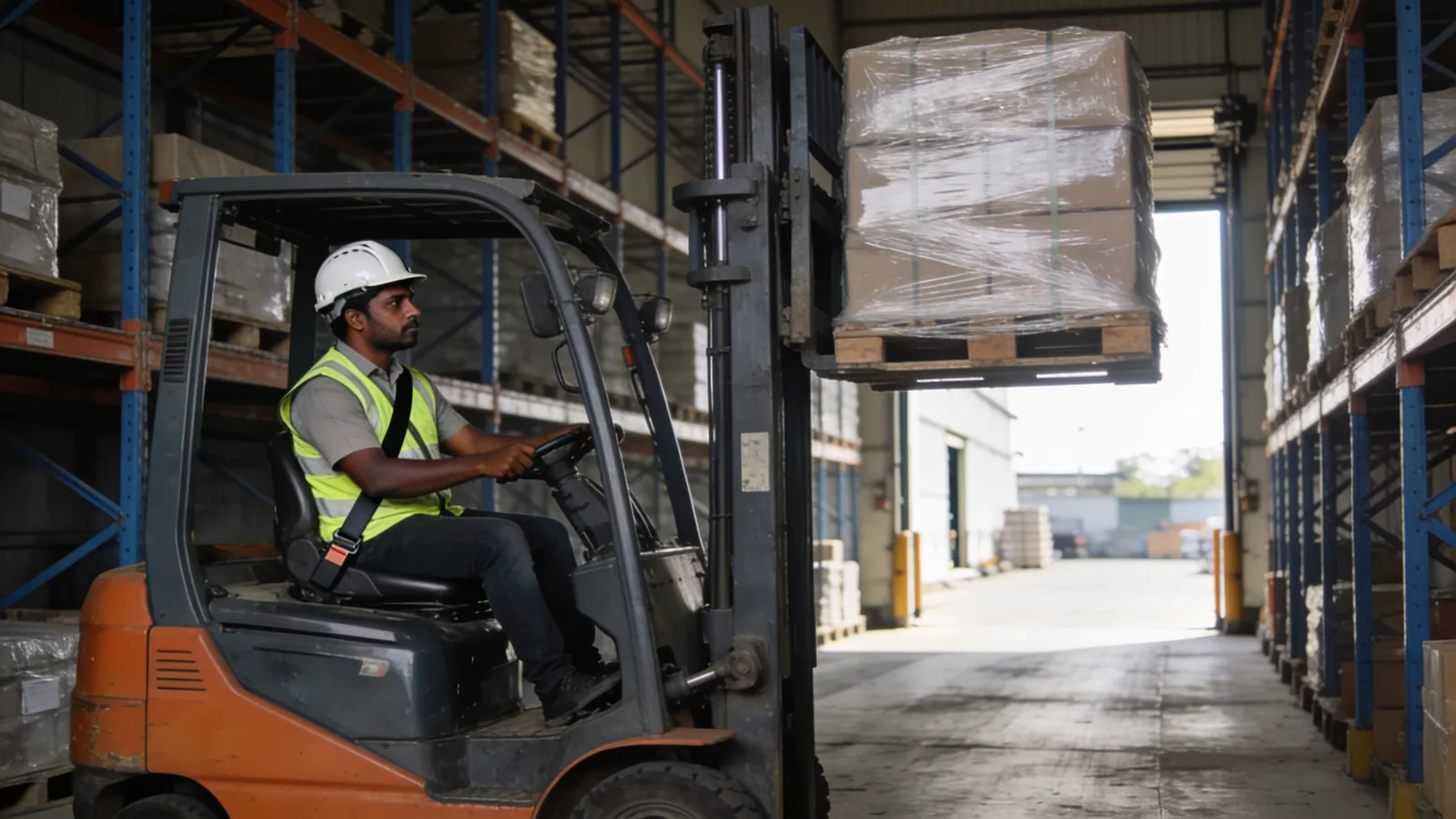
Forklift, reach truck, stacker, crane and heavy equipment.
Equipment class decides the skill and the risk. We screen against the truck and the load profile, not a generic operator title, and we keep the training and test record on file for your audits.
- ✓Diesel and electric forklift operators
- ✓Reach truck and high-rise stacker operators
- ✓EOT and mobile crane operators with rigger support
- ✓Pallet truck, BOPT and hand stacker operators
- ✓Heavy equipment operators for yard and plant handling
Aisle incidents are staffing decisions in hindsight
Almost every material-handling incident traces back to an untested operator or a missing induction.
Reach truck handling at eight metres is a different skill from a counterbalance forklift on flat ground. A generic licence does not distinguish them.
A single mast collision costs rack repair, product write-off, an aisle out of use and a safety report that follows you into the next audit.
Practical test per truck class, load-chart screening, safety induction with PPE, and the training and test record kept on file.
Get a rate card →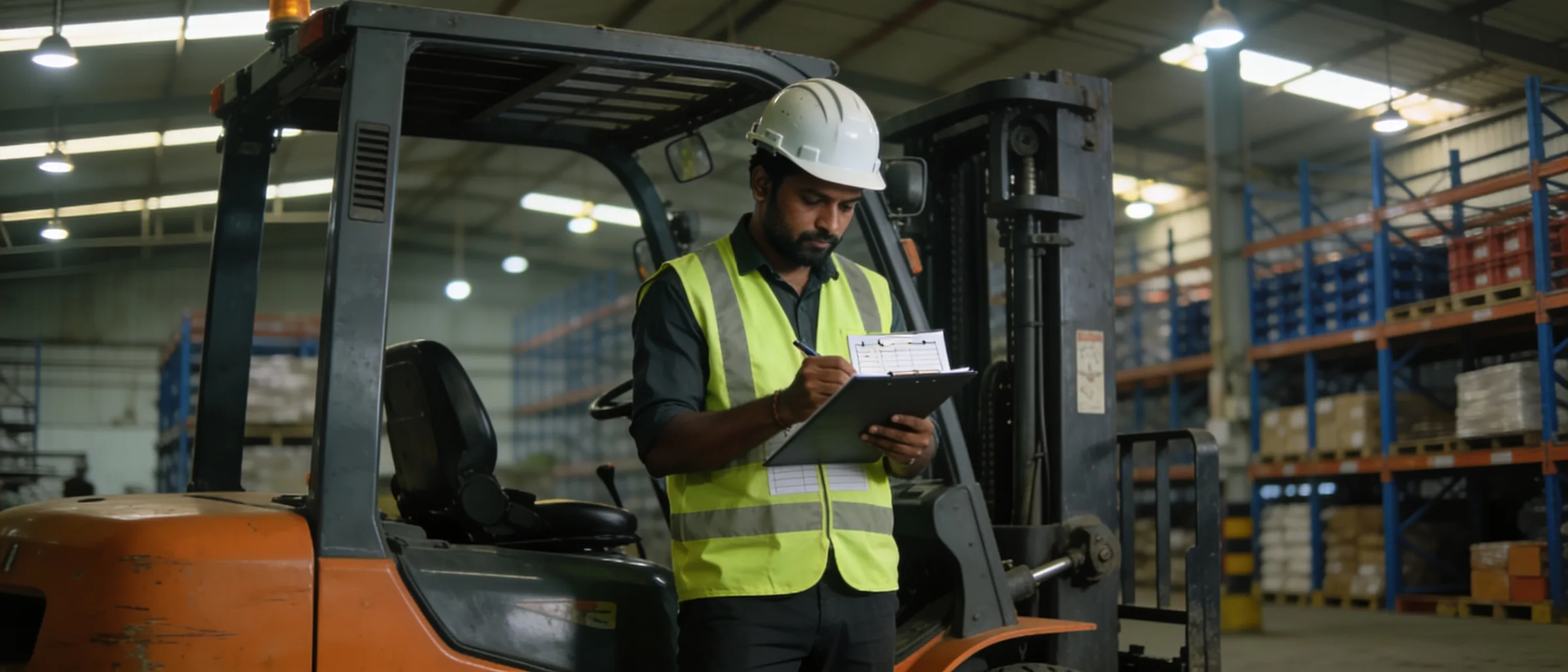
How operators are screened and deployed
Slider gives an illustrative monthly bill assuming a ₹22,000 gross wage and a 12% service fee; your actual fee is set out in the rate card. Crane and high-rise reach truck operators price above counterbalance forklift.
No deployment without a cleared practical.
Forklift classes and what each operator must prove
“Forklift operator” covers several machines with different risks. We test against the truck you run:
| Truck class | Typical use | What the operator must show |
|---|---|---|
| Diesel or LPG counterbalance | Yards, docks, outdoor loading | Stability on slopes and uneven ground, LPG cylinder change procedure, no idling indoors |
| Electric counterbalance | Indoor stores and production | Battery charging and watering routine, smooth control near people |
| Pallet trucks and stackers (BOPT) | Short moves, low racking, dock loading | Walk-behind control, ramp and dock-plate discipline |
| Attachments — side-shift, clamp, rotator | Paper rolls, white goods, drums | Capacity loss with the attachment, reading the derated capacity plate |
Narrow-aisle work at height needs reach truck operators; container handlers and loaders are covered by heavy equipment operator staffing.
What a forklift “licence” really means in India
Most job posts ask for a “forklift licence”. The legal picture is more specific — and knowing it avoids hiring on the wrong document.
| Question | What applies |
|---|---|
| Inside your premises | No single national operator licence. Competence is shown by a training certificate (OEM or NSQF-aligned skill-council course), a practical test on your truck class and your written authorisation |
| On a public road | Forklifts are construction equipment vehicles under the Central Motor Vehicles Rules: registration and a licensed driver are required |
| The truck itself | Mast, chains and lifting parts examined by a competent person at the interval your State's factory rules set (annual thorough examination is the long-standing norm), with the certificate on site |
| Design and safety standard | ISO 3691-1 sets industrial-truck safety requirements — overhead guard, seat belt, capacity plate — which your equipment supplier should confirm |
| Age and fitness | Operators aged 18 or above, with eyesight and medical fitness on record |
| Law in transition | Factory and lifting-machine rules now sit under the OSH Code 2020; where State rules under it are pending, the earlier rules continue |
The forklift practical test we run before deployment
Every candidate completes the test on the truck class they will drive, with the result kept on file for your audits.
| Stage | What we look for |
|---|---|
| Pre-use check | Forks, chains, mast, hydraulics, brakes, horn, lights, tyres, battery or LPG — checklist completed unprompted |
| Reading the capacity plate | Correct load at the load centre and lift height; derating with attachments |
| Picking and placing | Square approach, forks fully under the pallet, mast tilted back, smooth placement at height |
| Travelling | Forks low, load uphill on ramps, reversing when the load blocks the view, horn at blind corners |
| Around people | Pedestrian routes respected, stops when someone enters the working zone |
| Parking | Forks lowered, controls neutral, brake on, key removed |
Forklift operator wages in 2026
Forklift operators are usually placed in the skilled grade. Indicative figures:
| Basis | Amount | Date | Notes |
|---|---|---|---|
| Haryana — skilled | ₹18,500.81 a month | 1 Apr 2026 | Statutory floor for skilled work |
| Central sphere — skilled, Area A | ₹1,008 a day (about ₹26,208 for 26 days) | 1 Apr 2026 | Central-sphere sites such as ports; VDA revises 1 Oct 2026 |
| Market pay — forklift operator (Indeed India) | Average ₹18,275; range ₹8,086–₹57,107 | 50 reports, Feb 2026 | Highest reported in Sriperumbudur (₹22,050) and other Tamil Nadu belts |
Sources: Haryana revision of 1 Apr 2026; Chief Labour Commissioner (Central) VDA order effective 1 Apr 2026; Indeed India. Check the current notification for your State and zone before comparing quotes.
SLAs and what your site provides
Forklift safety is shared: we supply tested operators, and the site supplies safe trucks and layouts. Numbers are agreed per site.
Service levels we commit to
- ✓Only tested, authorised operators on your trucks
- ✓Standby cover for absence; we aim to replace within 48 hours
- ✓Signed pre-use checklist every shift
- ✓Refresher training every six months
- ✓Near-miss and incident reports the same day
What your site provides
- ✓Maintained trucks with legible capacity plates
- ✓Current examination certificates for lifting parts
- ✓Marked pedestrian routes and speed limits
- ✓A ventilated charging or LPG-change area
- ✓Your site authorisation card for each operator
Forklift operator staffing FAQs
Licensing, testing, equipment classes and replacement.
Get a rate card →Are operators tested on our specific equipment?+
Yes. The practical test is run on the truck class you use — counterbalance, reach truck, stacker or crane — including load-chart understanding and stability handling.
Which equipment classes do you staff?+
Diesel and electric forklifts, reach trucks and high-rise stackers, EOT and mobile cranes with rigger support, pallet trucks and BOPT, and heavy yard-handling equipment.
How quickly can an operator be replaced?+
A standby operator covers the shift where one is available, and we aim to deploy a permanent replacement within 48 hours so material movement does not stop.
Is safety training included?+
Yes. Site-specific induction, PPE, the pre-shift inspection checklist and near-miss reporting are part of deployment, with refresher training every six months and whenever the truck type or site layout changes.
Does a forklift operator need a driving licence in India?+
Not for work inside your premises — there is no single national forklift operator licence. What proves competence is a training certificate, a practical test on the truck class and your written site authorisation. A forklift is a “construction equipment vehicle” under the Central Motor Vehicles Rules, so if it moves on a public road it must be registered and driven by a licensed driver.
What records should we keep for forklift operators?+
For each operator: ID and age proof (18 or above), training certificate, practical-test result for the truck class, medical and eyesight fitness, site authorisation and refresher dates. For each truck: the daily pre-use checklists and the latest examination certificate for the mast, chains and lifting parts.
Should forklift and reach truck operators be hired separately?+
Yes, if you run both. A counterbalance forklift operator on flat ground and a reach truck operator in an eight-metre narrow aisle need different skills, so we test them separately — see our reach truck operator staffing page.
Aisles waiting on operators?
Send the equipment list and shift pattern. We aim to send a test plan and rate card within one working day.