
Electrician manpower supply for plants that cannot afford a guess.
Electrical work is the one trade where an unqualified hire is a safety event waiting for a date. Our electrician manpower supply verifies the State wireman permit or supervisor certificate of competency, tests practical skill on the systems you run — panels, drives, PLC-adjacent wiring, HT and LT distribution — and deploys on our payroll with LOTO and electrical-safety induction recorded before the first shift.
Systems, voltage levels and shift pattern let us match the right trade band.
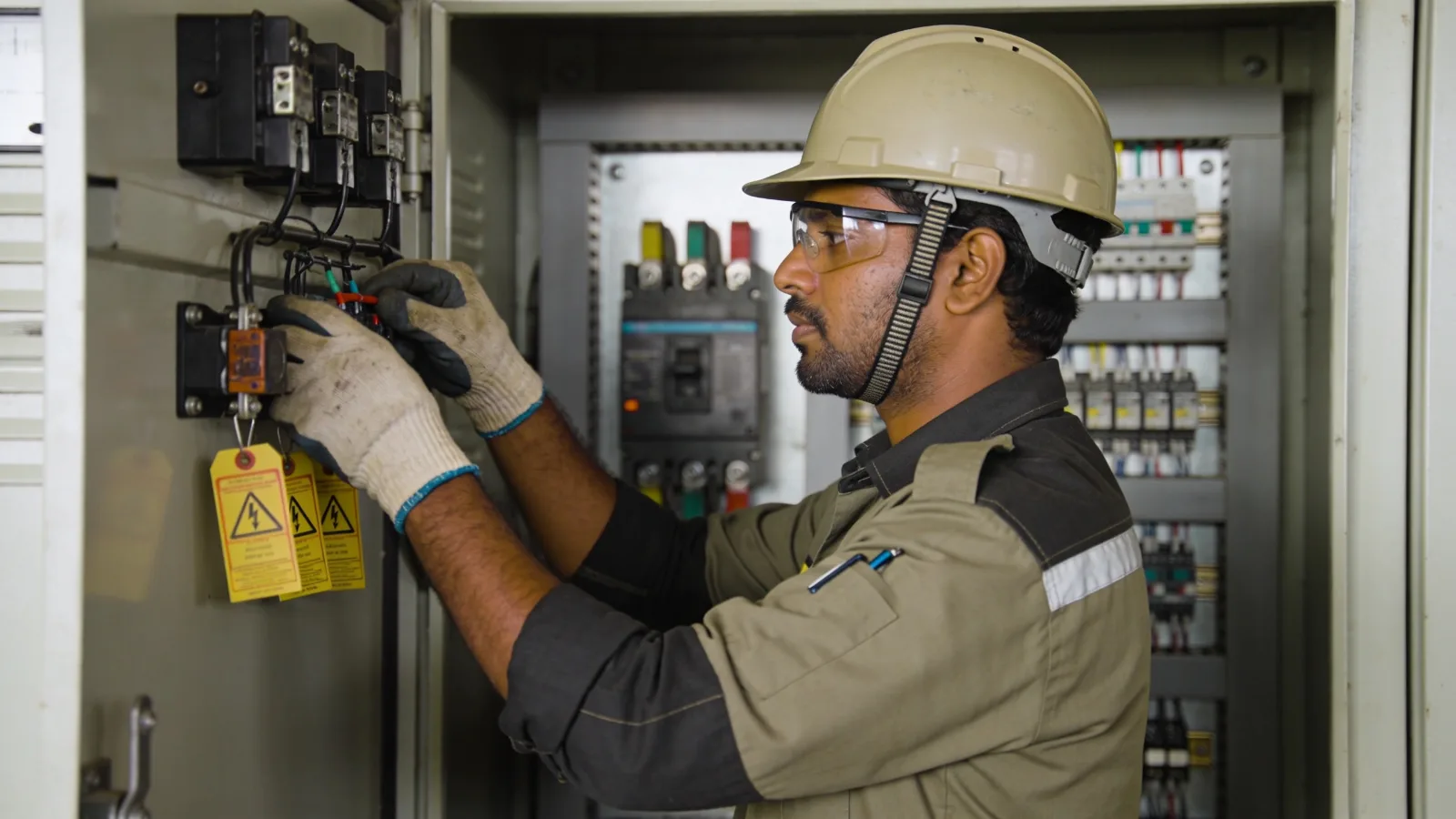
Wiremen to maintenance engineers, one contract.
Electrical staffing is banded by licence and by system exposure. We screen against the equipment you actually run, and keep the licence and induction records on file for safety audits.
- ✓Permit-holding wiremen and electricians, LT distribution
- ✓HT and substation technicians with switching experience
- ✓Panel, drive and control-wiring technicians
- ✓HVAC, chiller and refrigeration technicians
- ✓Maintenance engineers and shift electrical in-charge
Electrical breakdowns are staffed for, or paid for
The gap between a trained electrician and an available one is measured in downtime.
A helper doing an electrician's work is common, undocumented and indefensible in a safety audit or an insurance claim.
A wrong termination takes out a drive or a line. Worse, it takes out a person — and every enquiry asks who was qualified to do the work.
Licence verified, practical skill tested on your systems, LOTO and safety induction recorded, and breakdown response rostered across shifts.
Get a rate card →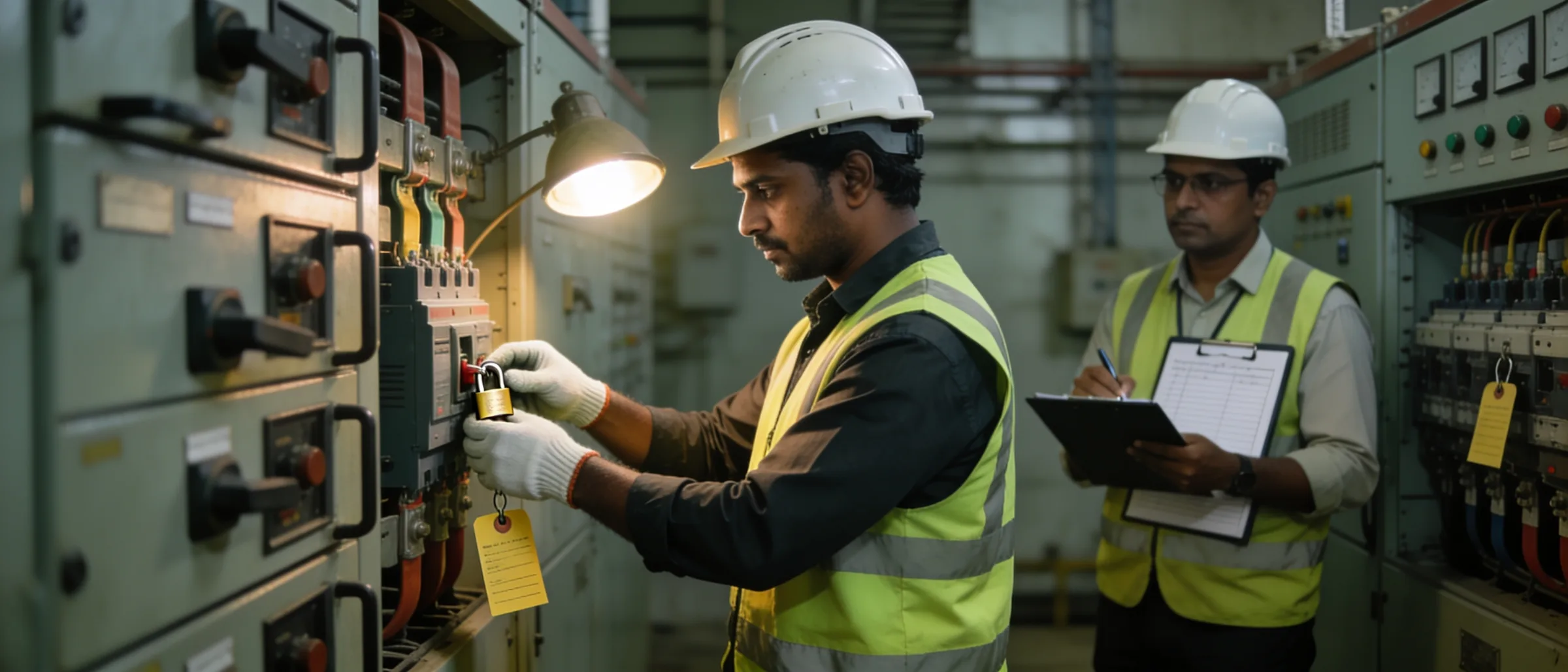
How electrical trades are screened
Move the slider for an indicative monthly bill for LT electricians at a ₹22,000 gross wage, statutory costs and an illustrative 12% service fee (your actual fee is set out in the rate card). HT, panel and supervisor bands price higher.
No deployment on a certificate alone.
What a plant electrician does, and what the law requires
A plant electrician keeps power and controls running: LT distribution panels, ACBs and MCCBs, motors and their starters (DOL, star-delta, soft starters, VFDs), cable terminations, lighting and earthing, DG and UPS changeovers, and the control circuits that stop a machine when a sensor fails. HT electricians add switching on the plant's own substation under a permit. The job is fault-finding under time pressure, done safely.
Two rules from the CEA (Measures relating to Safety and Electric Supply) Regulations, 2023 shape how contract electricians can be used. Anyone you designate to operate or work on electrical lines and apparatus must hold a certificate of competency or electrical work permit issued by the appropriate Government, and be entered in your register of designated persons (regulation 3). And new installation work, additions, alterations and repairs — beyond replacing lamps, fans, fuses, switches and similar fittings — must be carried out by an electrical contractor licensed by the State, under a certificate-of-competency holder, by permit-holding workers (regulation 31). So we supply permit-holding electricians for operation and maintenance, and they work on installation projects under your licensed electrical contractor.
Maintenance engineers
Engineers who own electrical reliability, root cause and PM planning.
Maintenance engineer staffing →HVAC technicians
Chillers, AHUs and precision cooling, screened on refrigerants and equipment.
HVAC technician staffing →Project manpower
Cable-laying and termination crews for new lines and expansions.
Project manpower supply →Electrical trade bands we supply
Ask for the band, the voltage level and the systems. Certificate names and grades vary by State; we verify against your State's licensing board.
| Band | Typical background | Works independently on | Usual minimum-wage category |
|---|---|---|---|
| Electrical helper | 10th pass or ITI trainee; no designation | Carrying, cable pulling, cleaning — never live work, always under an electrician | Semi-skilled |
| LT electrician / wireman | ITI Electrician or Wireman (DGT craftsmen scheme; Electrician is NSQF level 4, two years) plus State wireman permit | Panel maintenance, motors and starters, terminations, lighting and earthing checks | Skilled |
| Panel and controls electrician | ITI plus 3+ years on MCCs, VFDs and PLC I/O | Control-circuit fault-finding, drive parameters and fault codes, sensor and interlock checks | Skilled or highly skilled |
| HT electrician / substation operator | ITI or diploma with HT switching experience and the required authorisation | Switching sequences, breaker racking, transformer checks under permit | Highly skilled |
| Electrical supervisor / shift in-charge | Diploma with a supervisor certificate of competency | Supervising installation and maintenance work, permits, shift records | Highly skilled; usually paid above the floor |
Skill categories come from each State's minimum-wage notification under the Code on Wages, 2019; the mapping is typical, not universal.
The electrician trade test, station by station
A certificate proves training, not current competence. Every candidate also clears a practical test on equipment like yours.
Drawings
Read a single-line diagram and a motor control drawing; trace a fault path from the drawing before touching the panel.
Starters
Wire and fault-find a DOL and a star-delta starter, including overload setting and interlocks.
Terminations and testing
Gland, crimp and terminate a cable; check continuity and insulation resistance with a megger, and record the readings.
Test before touch
Apply lock-out/tag-out, then prove dead with an approved tester — test the tester, test the circuit, test the tester again.
Drives and controls
Read VFD fault codes, check key parameters and trace a failed sensor or interlock in the control circuit.
HT switching (HT band only)
Explain the switching sequence, earthing of isolated equipment and the permit steps for a feeder shutdown.
Electrical PPE, permits and the compliance behind each electrician
PPE issued and checked
- ✓Insulating gloves rated for the voltage worked on, inspected before each use
- ✓Arc-rated clothing and face shield where your arc-flash assessment calls for it
- ✓Electrical-hazard safety shoes and insulating mats in front of panels
- ✓Approved voltage tester and insulated tools
Rules we brief and enforce
- ✓Only designated, permit-holding electricians work on live systems or switch HT
- ✓Lock-out/tag-out and prove-dead on every job, no exceptions
- ✓Permit-to-work for HT, confined spaces and work at height
- ✓Installation and alteration work only under a State-licensed electrical contractor
Compliance we carry as employer
- ✓EPF and ESI enrolment before day one; ESI covers gross wages up to ₹21,000 a month, and employees' compensation cover applies above that
- ✓Wages at or above the State minimum for the category, paid by the 7th of the following month
- ✓Permit and certificate copies with expiry dates, shared for your designated-persons register
- ✓Contract-labour registers under the OSH Code (which replaced the CLRA Act, 1970), shared monthly
Shift and breakdown cover, and the wage basis
Continuous plants need an electrician on every running shift, and an escalation path to a supervisor for HT or major faults. Day-shift plants usually combine one shift electrician with on-call breakdown cover. The OSH Code caps ordinary hours at eight a day; call-outs and hours beyond that are overtime at twice the ordinary rate.
| Basis | Figure | Source and notes |
|---|---|---|
| Legal floor (example) | Haryana: skilled ₹18,501 a month, highly skilled ₹19,426 a month | Haryana notification effective 1 April 2026. Your State, zone and scheduled employment decide the real floor. |
| Karnataka | Skill-and-zone structure with steep increases, notified 22 May 2026 | Its legal validity is being contested; check before budgeting a site in Karnataka. |
| Market reference | Electrician average ₹17,748 a month; typical range ₹8,086–₹40,620; senior electricians about ₹29,500 | Indeed India, 626 reports, updated August 2026. The series includes building electricians, so plant electricians usually sit above the average. |
| Our estimator | ₹22,000 gross a month for a permit-holding LT electrician | Planning figure. Panel, HT and supervisor bands are quoted separately. |
Indicative only, not an offer or a legal rate. A national floor wage under the Code on Wages is still being fixed; until then State rates apply. Check your State's rate with the minimum wage calculator.
What to hold electricians, and us, to
Breakdown response time
Minutes from call to electrician at the machine, per shift, against the window in the escalation matrix.
Electrical MTTR
Mean time to restore after an electrical fault, and repeat trips on the same feeder or motor.
PM compliance
Scheduled insulation tests, tightness checks, earthing tests and thermography completed on time.
Permit and LOTO discipline
Audited jobs without a LOTO or permit breach. The target is zero breaches.
Our service targets
We aim to send trade bands and a rate card within one working day, deploy verified electricians in 7–12 working days, and replace an exit within 15 days. Targets are written into the SLA schedule.
Electrician supply FAQs
Permits, installation rules, skill bands, safety records and cost basis.
Get a rate card →Are your electricians licensed?+
Every electrician's State wireman permit or supervisor certificate of competency is verified before deployment, and copies with expiry dates are shared for your register of designated persons. Each candidate also clears a practical test on panels, starters and terminations.
Can a contract electrician do installation work at our plant?+
Operation and maintenance, yes, once you designate them. New installation work, additions and alterations must be done by a State-licensed electrical contractor under a certificate-of-competency holder (CEA Safety Regulations, 2023, regulation 31). Our electricians can work under your licensed contractor on such jobs.
What qualification should an industrial electrician have?+
An ITI certificate in Electrician or Wireman plus the State permit is the usual base. Panel, drive and HT work needs documented experience on those systems, which we test.
Do you supply HT and substation technicians?+
Yes. HT technicians with switching experience are screened separately from LT electricians, and substation work is deployed only with documented experience, the required authorisation and permit discipline.
Is electrical safety training included?+
Yes. LOTO and permit-to-work induction, electrical PPE issue, toolbox talks and near-miss reporting are part of deployment, with refresher training logged for your audits.
Can you cover breakdown response outside shift hours?+
Yes. Breakdown standby is rostered with a written escalation matrix and response windows, including night and holiday cover where the contract requires it. Call-outs beyond normal hours are paid as overtime.
Do you also supply HVAC technicians?+
Yes, as a separate role screened on equipment types and refrigerants. See HVAC technician staffing.
How is electrician manpower priced?+
The gross wage for the band (at or above the State minimum), plus employer PF, EDLI and admin charges, ESI where gross is up to ₹21,000, bonus and gratuity provisions, overtime for call-outs, and the service fee. See how staffing fees are calculated.
Related roles and services
Maintenance team short-handed?
Send the systems and shift pattern. We aim to send trade bands and a rate card within one working day.