
Security guard staffing services, with the post never left empty.
A gate covered by a guard who did not come, whose reliever is not on any roster, is not security — it is a liability with a uniform. Godstone Consultech plans security guard staffing post by post: trained and verified guards, head guards on larger sites, logged night checks, and a reliever factor built into the headcount so weekly offs never open a post. Guards must be supplied by an agency licensed under PSARA 2005 in your State — ask for the licence copy before any guard is deployed.
Post-wise pricing with wages, statutory dues and service fee shown separately. No obligation.
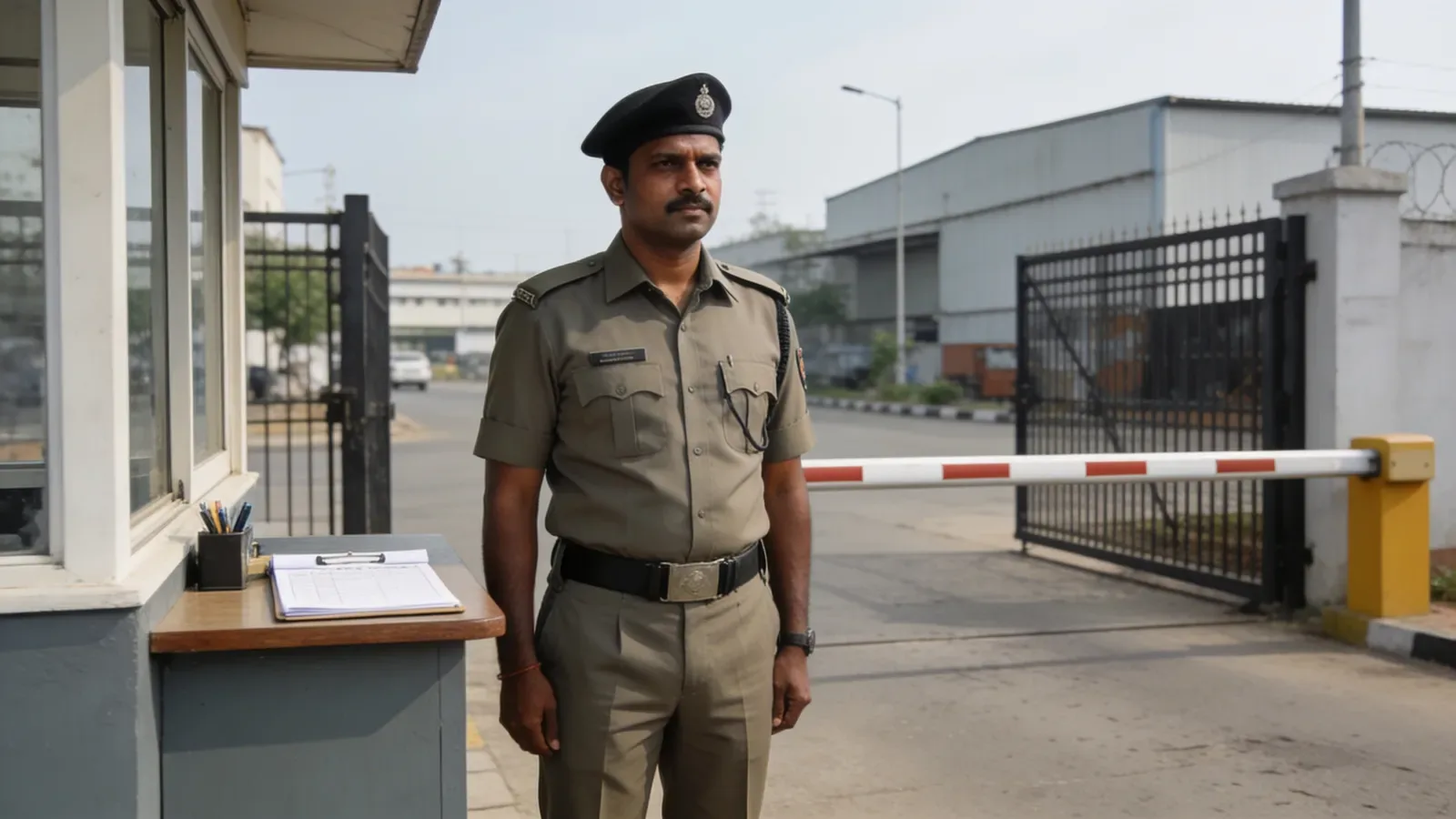
From a single night post to a multi-post industrial site.
Security manpower is priced and rostered post by post. We set the guard category against what the post actually does — access control, material gate, frisking, patrolling, CCTV monitoring or fire watch — and staff it with the reliever factor already counted.
- ✓Unarmed guards, head guards and security supervisors
- ✓Women guards for frisking, reception and hospital wards
- ✓Gunmen and armed escorts, licence-verified
- ✓CCTV control-room operators and gate-pass clerks
- ✓Fire and safety officers for factory premises
Why cheap guarding contracts fail in month three
The lowest quote usually wins by leaving the reliever out of the headcount and the statutory dues out of the wage slip.
A 24×7 gate quoted with three guards instead of four-plus means someone works the weekly off. Alertness drops, attrition climbs, and the post goes dark the week two guards quit together.
An unverified guard on your gate is your risk to explain — to insurers after a loss, and to the licensing authority if antecedent records do not exist. Unpaid PF for guards on your premises travels back to the principal employer.
We quote the reliever in, keep a verification and training record per guard, and log every supervisory night check.
Get an honest post quote →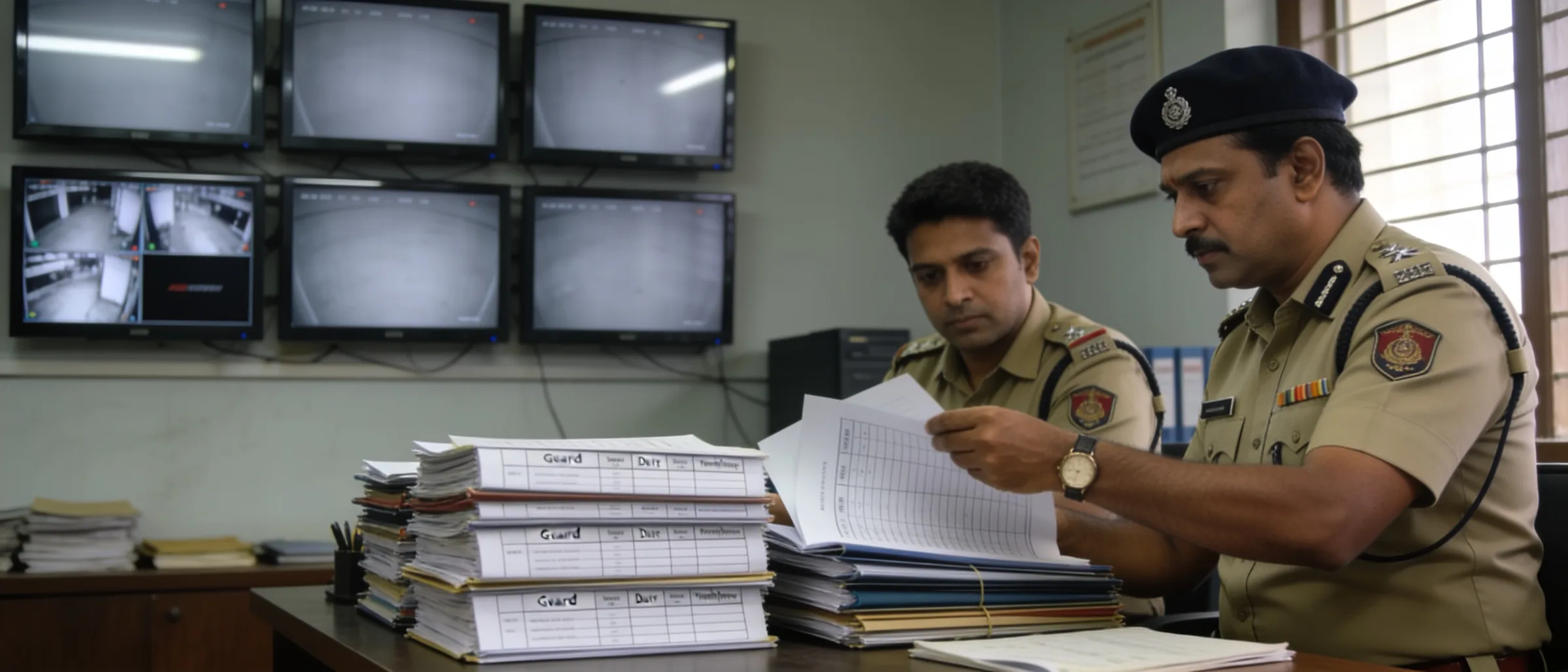
How many guards does your site actually need?
Set the posts and the shift pattern. A post staffed round the clock on 8-hour shifts needs about 4.2 guards once weekly offs, leave and absence relief are counted — the number most quotes quietly round down. On 12-hour shifts it needs about 2.8, but each guard is paid four hours of overtime a day at twice the wage rate.
Illustrative only: assumes about ₹21,500 a month per 8-hour guard (₹31,000 on 12-hour shifts, overtime included), ₹28,000 per supervisor and a 12% service fee — assumptions, not our rate card. Firm rates follow the State minimum wage for the guard category — send your post list for exact numbers.
What a security guard actually does, post by post
Each post is a different job. We write post orders for every post before deployment, because screening and guard category depend on what the post does.
Main gate and access control
Checks IDs and gate passes, logs visitors and vehicles, and escalates unknown entrants. Needs literacy and a firm, courteous manner.
Material gate
Matches material against invoices, challans and returnable gate passes. The post where most pilferage is caught — or missed.
Patrolling and night beats
Walks a fixed route, checks locks, lights, fire points and the fence, and logs each checkpoint. Fatigue is the risk at night.
Frisking and reception
Frisking women employees and visitors needs women guards; reception adds phone, courier and parking duties.
CCTV and control room
Watches camera feeds, keeps the incident and key registers, and directs the patrol by radio.
Fire watch and emergencies
Raises the alarm, uses the right extinguisher, guides evacuation and meets the fire service at the gate.
PSARA and Labour Code rules for guards on your premises
Guarding has its own licensing law on top of the Labour Codes. Here is what applies in 2026, and what to ask your agency for.
| Rule | What it requires | What to ask for |
|---|---|---|
| PSARA 2005 licence | The supplying agency needs a licence from the Controlling Authority of each State where guards are deployed, valid for five years (s.8). | Licence copy for your State, with validity date |
| Guard eligibility | Indian citizen who has completed 18 and is under 65 (s.10), meeting the State's physical and medical standards. | Age proof and medical certificate per guard |
| Training | Under the MHA Central Model Rules 2020 (States adopt their own rules): 100 hours classroom plus 60 hours field training over at least 20 working days; ex-servicemen and ex-police take a condensed 40 + 16 hour course. | Training certificate from a recognised institute |
| Antecedent verification | Character and antecedents verified before employment, in practice through the police. | Police verification report or reference |
| Uniform | Must not resemble police or armed-forces uniform. | Uniform sample and photo ID card |
| Contract labour | The OSH Code 2020 (which replaced the CLRA 1970) requires contractor licensing at 50+ contract workers. Watch and ward is a support (non-core) activity for establishments not set up for security work, so it can be contracted; the principal employer owes welfare facilities and any unpaid wages. | Contractor licence where the threshold applies; monthly wage and PF/ESI proof |
| Hours and overtime | 8 hours a day, 6 days a week; overtime only with consent, at twice the wage rate. | Roster with overtime as a separate line |
| Women on night shifts | Allowed with consent before 6 a.m. and after 7 p.m., under State safety conditions (OSH Code, s.43). | Written consent and transport plan |
Maharashtra also has Security Guards Boards in notified areas under its 1981 Act. The Jan Vishwas (Amendment of Provisions) Act 2026 decriminalised a procedural PSARA lapse (display of the licence); the licensing requirement itself is unchanged. Where State rules under the Labour Codes are pending, older rules continue to the extent they are consistent.
Roster models and the reliever maths behind them
Headcount per post decides whether a guarding contract holds. These are the three patterns most sites use.
About 4.2 guards per post
21 shifts a week ÷ 6 shifts per guard = 3.5 guards; leave, holidays and absence take it to about 4.2. No overtime, and the best alertness at night.
About 2.8 guards per post
Fewer people, but four hours of overtime a day per guard at twice the wage rate. Cheaper only when the quote leaves the overtime out.
About 1.2 guards per post
One 8-hour shift plus relief for the weekly off and leave. Typical for offices, schools and retail.
How we quote it
- →Reliever counted into every post
- →Overtime shown as its own line
- →One head guard for roughly every 12 guards
- →Night beats checked by a supervisor
Security guard minimum wages and market pay, 2026
A guard's cost starts at the minimum wage notified for your State, zone and category. These figures are indicative — always check the notification in force for your site.
| State / category | Minimum wage (monthly) | In force from | Notes |
|---|---|---|---|
| Tamil Nadu — shops & commercial establishments, security guard | ₹14,120 (Zone A) to ₹13,906 (Zone D) | 1 Apr 2026 | Basic plus VDA of ₹7,353; 8-hour day |
| Haryana — unskilled / semi-skilled | ₹15,220.71 / ₹16,780.74 | 1 Apr 2026 | Guards are paid at the grade the notification assigns |
| Central sphere — watch & ward without arms, Area A | ₹1,008 a day (about ₹26,208 for 26 days) | 1 Apr 2026 | Central PSUs, banks, railways, ports, airports; VDA revises 1 Oct 2026 |
| Central sphere — watch & ward with arms, Area A | ₹1,094 a day (about ₹28,444 for 26 days) | 1 Apr 2026 | Gunmen at central-sphere sites |
| Karnataka and Delhi | Check before quoting | — | Both States revised or reviewed rates recently — confirm the notification (and any court order) in force for your site |
| Market pay (Indeed India) | Average ₹15,240; range ₹10,570–₹21,974 | 248 reports, May 2026 | Some reported pay is below the statutory minimum — the notification sets the floor |
Sources: Tamil Nadu notification of 18 Feb 2026; Haryana revision of 1 Apr 2026; Chief Labour Commissioner (Central) order of 30 Mar 2026; Indeed India salary data. Minimum wage is not cost — add PF, ESI, bonus, leave and gratuity with our minimum wage calculator or CTC breakup calculator.
SLAs to hold us to, and what your site provides
A guarding contract works when both sides' obligations are written down. These are the terms we propose; the numbers are agreed per site and written into your contract.
Service levels we propose
- ✓No post left unmanned: a reliever or standby covers the shift
- ✓We aim to replace a guard within 48 hours of your written request
- ✓Supervisory night checks at an agreed frequency, logged
- ✓Written incident report by the next working day
- ✓Monthly pack: attendance, wage proof, PF and ESI challans
What your site provides
- ✓Signed post orders and an emergency contact list
- ✓A guard cabin or shelter with light, fan and drinking water
- ✓Toilet and rest-room access on every shift — a principal-employer duty under the OSH Code
- ✓Registers or visitor-system access, and perimeter lighting
- ✓Transport and a safe rest area if women guards work nights
Red flags in a guarding quote
- ✕Three guards quoted for a 24×7 post
- ✕12-hour shifts priced at an 8-hour wage
- ✕No PSARA licence copy for your State
- ✕Wages in cash, or no PF and ESI challans
- ✕No training certificates or verification reports on file
Security guard staffing FAQs
PSARA, guard costs, verification and night cover — answered plainly.
Send your post list →How do I hire security guards for my factory or office?+
Share the number of posts, the shift pattern and the site city. We aim to send a guard rate card within 24 hours. Guards must be supplied by an agency licensed under PSARA 2005 in your State — ask for the licence copy before deployment — and larger sites get a head guard or supervisor over each group of posts.
What does a security guard cost per month in India?+
Start from the State minimum wage for the guard's category — for example ₹14,120 a month in Tamil Nadu Zone A from 1 April 2026, for an 8-hour day. Add employer PF and admin (about 13% of PF wages), ESI at 3.25% where gross pay is up to ₹21,000, bonus of at least 8.33%, leave and gratuity provision and uniform: an 8-hour guard at that floor costs roughly ₹19,000–₹19,500 a month before the service fee. A 12-hour guard is also owed four hours of overtime a day at twice the wage rate, which roughly doubles the wage line.
Is a PSARA licence mandatory for a security agency?+
Yes. Under the Private Security Agencies (Regulation) Act 2005, any agency supplying guards needs a licence from the Controlling Authority of each State where the guards work. The licence is valid for five years, and the agency must verify each guard's antecedents and train them to the State's standard. Ask for the licence copy for your State and check its validity before signing.
Are your guards trained and background verified?+
Every guard completes induction on access control, visitor and material gate procedure, fire response, evacuation and incident reporting before deployment. Verification covers Aadhaar, address, previous employer and police verification where the state requires it. Ex-servicemen are preferred for head guard and supervisor posts.
Can you provide women guards and night-shift cover?+
Yes. Women guards cover frisking points, reception, hospitals, retail and hostels. Under Section 43 of the OSH Code 2020, women may work before 6 a.m. and after 7 p.m. only with their consent and under the safety and transport conditions the State notifies, so we agree transport and rest-area arrangements with you before rostering nights. Night beats are logged and checked by a supervisor.
How many hours can a security guard work in a day?+
The OSH Code 2020 caps ordinary hours at eight a day and six days a week. Anything longer is overtime: it needs the guard's consent, is paid at twice the wage rate and must stay within your State's overtime limit. An honest 12-hour roster shows it as its own line.
Do security guards need police verification?+
Yes. PSARA requires the agency to verify every guard's antecedents before deployment, usually through the police. Each guard file should hold ID and age proof, permanent and present address, the police verification report or its reference, the training certificate, a medical fitness certificate and the signed site induction record.
Who is liable if the agency does not pay the guards?+
You can be. Under Section 55 of the OSH Code 2020, if a contractor fails to pay wages on time or short-pays, the principal employer must pay the balance and recover it from the contractor. Ask for monthly proof of wage payment by bank transfer, with PF and ESI challans for the guards on your site.
Related services, industries and jobs
Need guards on the gate this week?
We aim to put emergency cover on the gate within 48 hours, with each guard's verification file shared the same day.