
HVAC technician staffing for premises where cooling is not optional.
Server rooms, cleanrooms, wards and cold rooms do not tolerate downtime, and the technician on call is the whole contingency plan. HVAC technician staffing decides whether a chiller trip is a two-hour event or a two-day one. Godstone Consultech trade-tests every technician on refrigerant recovery and charging, flammable-refrigerant safety, electrical fault finding and preventive service practice on the equipment class you run, employs every worker on our own payroll, and keeps PF, ESI and contract-labour records with us — so the person on your floor is documented, replaceable and accountable from day one.
Equipment list, tonnage and shift pattern are enough to price.
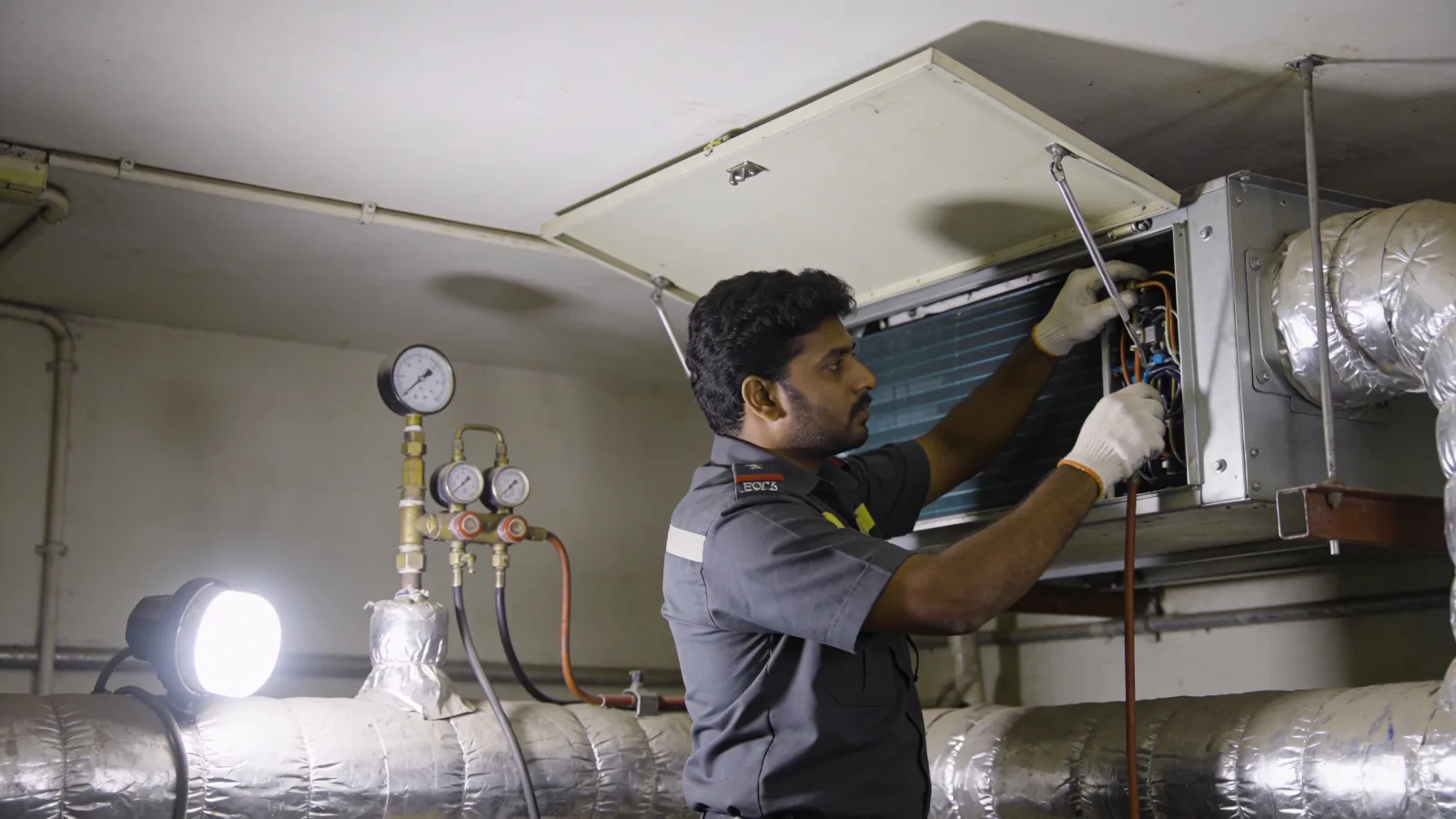
Split and package units, AHUs, chillers and cold rooms.
HVAC skill is equipment-specific. We screen against your plant — splits and packages, AHUs and ducting, chillers, cold rooms and precision units — and keep the competence record per technician.
- ✓Split, cassette and package unit service and repair
- ✓AHU, ducting, filter and belt maintenance
- ✓Chiller operation, log-keeping and fault response
- ✓Cold room and refrigeration unit upkeep
- ✓Refrigerant handling, charging and leak testing
Cooling failures escalate faster than any other utility
Temperature-critical areas give you minutes, not hours.
A technician with window-AC experience is put on a chiller plant, and diagnoses a low-pressure trip by guesswork.
A cleanroom out of specification, a server room shutting down, spoiled stock in a cold room, and a compressor damaged by an incorrect charge.
Competence tested against your equipment before deployment, refrigerant handling verified, preventive schedules maintained and breakdown standby rostered with response windows.
Get a rate card →How we trade-test HVAC technicians before deployment
Job-portal listings for AC technicians rarely say more than “1–3 years’ experience”. Experience on window units tells you nothing about a VRF system or a chiller plant, so every candidate is tested practically against the equipment class you actually run. A candidate who fails the refrigerant-safety test is not deployed on R-32 or R-290 equipment, whatever the CV says.
| Test | What the candidate has to show | Why it matters on your site |
|---|---|---|
| Refrigerant identification | Reads the nameplate and names the gas and its safety class — HCFC-22, R-410A, R-32 (mildly flammable, A2L) or R-290 (flammable, A3) — and the tools and precautions each needs. | A wrong top-up or a brazing torch near a flammable charge is a fire risk, not just a performance issue. |
| Recovery, evacuation and charging | Recovers gas into a cylinder instead of venting it, pulls and holds vacuum, and charges by weight against the nameplate figure. | Over- or under-charging is the most common cause of compressor damage and poor cooling. |
| Leak testing | Nitrogen pressure test and electronic or soap-solution leak detection before recharging. | Topping up without finding the leak just schedules the next breakdown. |
| Electrical fault finding | Safe isolation and lock-out, multimeter use, capacitor, contactor, sensor and compressor-winding checks. | Most “AC not cooling” calls are electrical, and live work is where injuries happen. |
| Plant and AHU (for plant roles) | Reads a chiller log, spots a drifting approach temperature or pressure trend, and follows the trip-reset and escalation protocol. | A technician who resets a trip without diagnosing it can turn a warning into a failure. |
| Credentials and references | ITI in Refrigeration & Air-Conditioning or a diploma, any RAC servicing certificate held, and a reference from the last site supervisor. | Paper does not prove skill, but it confirms identity, training history and employment record. |
Why refrigerant handling decides who you should hire in 2026
Most hiring pages skip this, but it is where the real risk sits. The gases in your equipment are changing, and the technician you hire has to be competent on the ones you run today and the ones you will install next.
HCFC-22 is on its way out
India’s HCFC Phase-out Management Plan (Stage III) is working towards completing the HCFC phase-out by 2030. Older R-22 units still need servicing, but replacements and retrofits bring new gases your team must handle correctly.
Flammable refrigerants are now mainstream
Most new room ACs use R-32, and hydrocarbon (R-290) systems are growing in commercial refrigeration. Both need ventilation, ignition-source control and the right recovery equipment — skills older technicians may never have been taught.
HFCs are next
Under the Kigali Amendment, India freezes HFC consumption from 1 January 2028 against a 2024–26 baseline. Gas will get scarcer and dearer, so a leak that is topped up every month becomes a real cost line.
Certification exists — ask for it
The MoEFCC Ozone Cell runs training and certification for RAC service technicians with ESSCI and partner agencies under the HPMP. We record whether a candidate holds it and prefer certified technicians for plant roles.
Sources: MoEFCC Ozone Cell (ozonecell.nic.in) — HPMP Stage III and RAC technician training & certification; Kigali Amendment schedule for India (freeze 2028, baseline 2024–26). Details in our research notes.
What a contract HVAC team costs, and how it is run
Move the slider for an illustrative monthly bill at an assumed 12% service fee (your actual fee is set out in the rate card), built on a typical gross wage of ₹22,000 a month for an experienced technician. Firm rates follow the State minimum wage for the skill class, the shift pattern and any night or standby allowance.
What clears before the worker reaches your gate.
What HVAC technicians earn: an indicative wage basis
Pay varies with city, equipment and shift, so treat these as indicative starting points, not quotes. City averages reported on Indeed India in July 2026 were ₹26,351 in Kochi, ₹25,535 in Hyderabad, ₹21,285 in Pune and ₹19,591 in Chennai. Whatever the market rate, the floor is the State minimum wage for the skill class, which most States revise through dearness allowance twice a year.
| Band | Typical scope | Indicative gross wage basis |
|---|---|---|
| AC service technician (0–2 years) | Split and cassette units: cleaning, gas check, basic electrical faults, installation support. | At or a little above the State minimum wage for the skilled category in your zone. |
| HVAC technician (2–5 years) | VRF/VRV and package units, AHUs and ducting, preventive maintenance schedules, leak repair. | Around the national job-portal average of ₹22,172 a month (Indeed India, 208 salaries, July 2026). |
| Chiller / plant technician or shift in-charge (5+ years) | Chiller plant operation and logs, cooling towers, pumps, BMS alarms, leading a shift. | Towards the upper end of the reported range, which runs up to about ₹42,775 a month. |
Indicative only. Figures are gross monthly wages before PF and ESI deductions, from Indeed India’s HVAC technician salary page (updated 15 July 2026). Night-shift, standby and overtime pay are extra. Check the floor for your State with our minimum wage calculator.
KPIs and backfill SLAs you can hold us to
An HVAC contract is only as good as what gets measured. These are the numbers we suggest reporting monthly, and the cover terms we agree in writing before the first technician joins.
KPIs to hold a technician to
- →Preventive maintenance done on schedule — share of planned PM tasks closed on time each month
- →Breakdown response and restore time, measured from call to cooling restored
- →Repeat faults — the same unit failing again within 30 days
- →Refrigerant charged per unit per quarter — a rising figure means leaks are being topped up, not fixed
- →Log completeness for chillers and critical rooms, with temperature or humidity excursions explained
Backfill SLAs to write into the contract
- →Replacement of a technician who leaves or does not fit: we aim to replace within 15 days
- →Planned leave: a trained reliever named in the roster before the leave starts
- →Unplanned absence: a cover window agreed per site — same shift for chiller plants and server rooms, next day for comfort cooling
- →Handover: log sheets, pending jobs and gas stock signed over at every change of technician
- →Monthly report: PM completion, breakdowns, gas used and attendance, alongside the compliance pack
Common mistakes when hiring HVAC technicians on contract
Hiring an “AC mechanic” for a chiller plant
Room-AC experience does not transfer to centrifugal or screw chillers. Specify the equipment and tonnage and test for it.
No gas accountability
If nobody logs refrigerant issued and charged, leaks stay hidden and cylinders go missing. Make gas stock part of every handover.
12-hour shifts treated as normal
Under the OSH Code the normal working day is eight hours, and the Code on Wages requires overtime at twice the ordinary rate. Price the roster honestly.
Ignoring height and electrical safety
Outdoor-unit work often happens on ledges and ladders. Insist on harness use, lock-out and a permit-to-work where your site requires it.
Comparing quotes on markup alone
A low markup on a wage below the State minimum is a liability you inherit as principal employer. Ask for the wage build-up.
Contract staff where an AMC fits better
If you have only a few split units and no plant, an annual maintenance contract with the OEM or a service firm may be cheaper than a full-time technician.
AC & HVAC technician staffing FAQs
Screening, cost basis, replacement and deployment speed.
Get a rate card →What HVAC equipment can your technicians handle?+
Split, cassette and package units, AHUs and ducting, chiller plants, cold rooms and refrigeration units, and precision units for server rooms — screened per equipment type rather than assumed.
Is refrigerant handling competence verified?+
Yes. Charging, recovery and leak testing practice is assessed before deployment, along with fault diagnosis on the equipment class you run.
Do you provide breakdown standby?+
Yes, with written response windows including nights and holidays where the contract requires it, because temperature-critical areas cannot wait for a morning shift.
Is preventive maintenance part of the scope?+
Yes. Filter, belt, coil and log-keeping schedules are maintained, which is what actually reduces emergency call-outs and compressor damage.
How is HVAC technician staffing priced?+
On the gross wage for the skill band and shift pattern, plus the employer’s PF and ESI contributions, bonus and leave provisions, and a service fee. Chiller-plant competence prices above general AC service, and night or standby cover adds an allowance.
What qualifications should an HVAC technician have?+
Usually an ITI in Refrigeration & Air-Conditioning or a diploma in mechanical or electrical engineering, plus hands-on experience on the equipment you run. An RAC servicing certificate from the Ozone Cell’s training programme is a plus. We verify certificates, but the practical test decides the placement.
Can your technicians work on R-32 and R-290 equipment?+
Only technicians who pass our flammable-refrigerant safety and recovery test are deployed on R-32 or R-290 equipment. The test covers ventilation, ignition-source control, recovery and charging by weight.
How much does an HVAC technician earn in India?+
Indeed India reported an average of about ₹22,000 a month in July 2026, with most figures between roughly ₹11,500 and ₹42,800 depending on city, experience and equipment. The State minimum wage for the skill class is the legal floor. These are indicative figures, not a quote.
Should I use contract technicians or an annual maintenance contract?+
Contract technicians suit sites with a plant room, many units or temperature-critical areas that need someone on site every shift. For a handful of split units, an AMC with the OEM or a service firm is often cheaper. We will tell you if an AMC fits better.
Cooling plant without cover?
Send the role, headcount and site city. We aim to send an itemised rate card and deployment date within one working day.