
Restaurant and QSR staffing rostered to the lunch rush, not to the month
A QSR store lives or dies on peak-hour throughput. Two crew short between 12 and 3 means longer queues, walkouts and a delivery aggregator rating that takes months to recover. We staff QSR chains, casual-dining restaurants and cafés with kitchen, counter and support crew store by store, rostered against dayparts, with hygiene training done before the first shift.
Roles, headcount and site city. We aim to send a costed proposal within one working day.
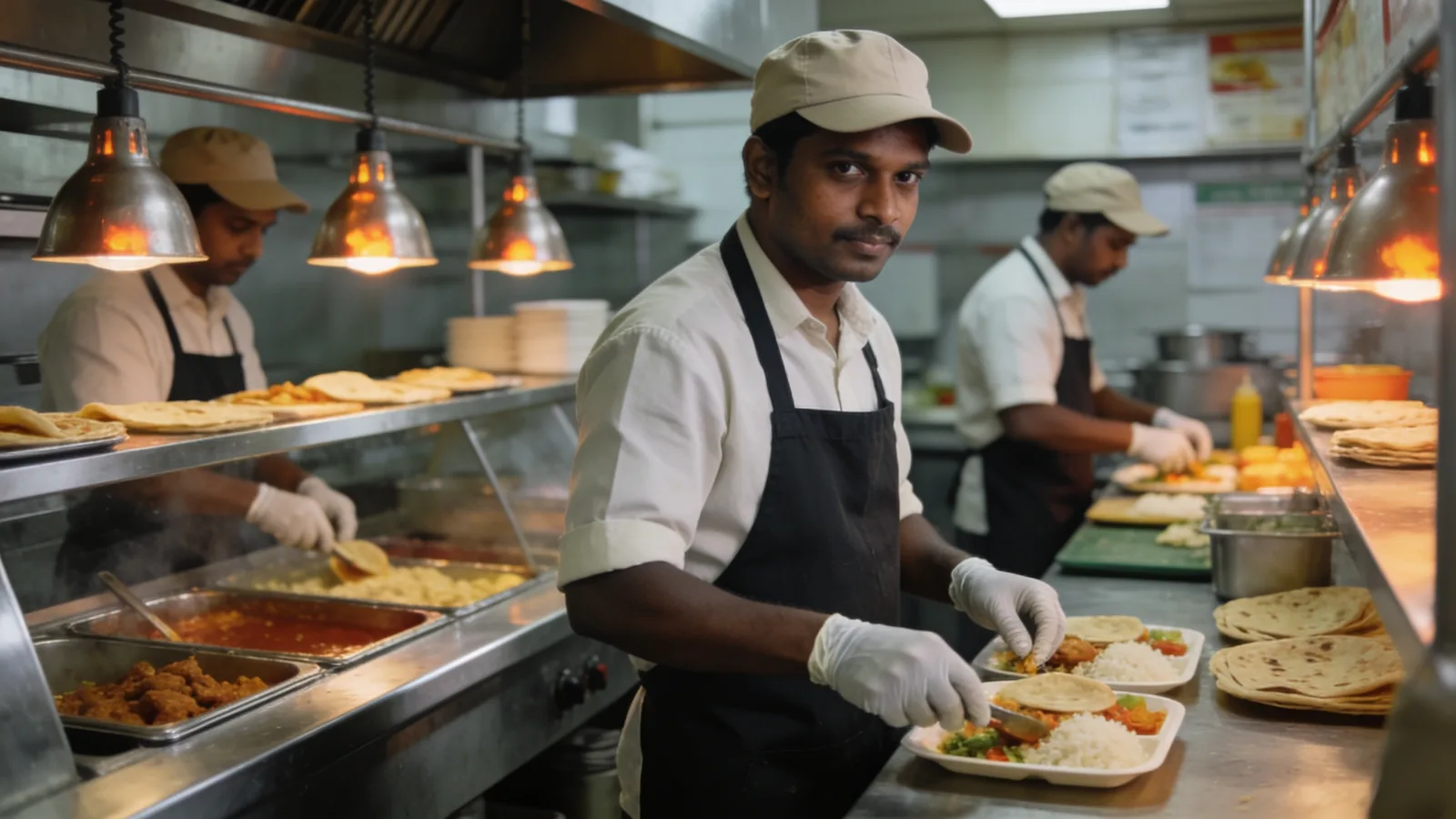
Roles across a store
Store crews are small and interdependent. One missing station changes the whole flow, so deployment is planned by position rather than by headcount.
- ✓Kitchen: prep crew, fry and grill stations, assembly, commis and cooks
- ✓Counter: order taking, billing, packing, drive-through and kiosk support
- ✓Service: stewards, servers, hosts, bussers for dine-in formats
- ✓Support: dishwashing and utility, store cleaning, waste management
- ✓Supervision: shift in-charge, store manager, area coordinator
- ✓Delivery side: rider coordination, packing and dispatch during peak
- ✓Central kitchen: prep production, portioning, packing, cold storage handling
The peak hour is the business, and it is three hours long
Food service revenue concentrates into a few hours a day. Staffing designed around full shifts pays for idle mid-afternoon capacity and still runs short at 1pm.
So the store is overstaffed at 4pm and short at lunch and dinner, while absenteeism at exactly those hours goes uncovered because there is no local floating pool.
Plus crew burnout that raises attrition, which in a sector known for short tenures means constant retraining on a live line.
Four and six-hour blocks matched to each store's demand shape, a floating pool per cluster of stores, and hygiene-trained crew who can hold a station on day one.
Get a quote →Restaurant and QSR roles: what they do, how we screen, what they earn
Plan by station, not by headcount. Pay bands are indicative monthly gross wages; your State’s minimum wage is the floor, and metro high-street and mall stores usually sit at the upper end.
| Role | Where | What they do | Screening before deployment | Indicative gross / month |
|---|---|---|---|---|
| Crew member (counter, drive-thru, kiosk) | Front counter | Order taking, POS billing, upselling, order assembly and packing | POS and numeracy test, communication, grooming | ₹12,000–18,000 |
| Kitchen crew (fry, grill, assembly, prep) | Back of house | Cooking to SOP timers, holding times, build charts, station cleaning | Station trial, hygiene induction, medical fitness record | ₹12,000–18,000 |
| Cook / commis (casual dining) | Kitchen | À la carte cooking, mise-en-place, portion control | Cuisine trial with your head chef, medical fitness record | ₹12,000–25,000 |
| Server / host / busser | Dining room, cafés | Seating, order taking, service, table turns | Service-sequence test, language screen | ₹10,000–20,000 |
| Cashier | Counter | Billing, cash and UPI reconciliation, shift cash-up | Cash-handling test, background verification | ₹11,000–20,000 |
| Delivery handover / packer | Dispatch counter | Order check against KOT, sealing, rider handover, aggregator tablet | Accuracy drill on your packaging and add-ons | ₹12,000–20,000 |
| Dishwash / utility | Back of house | Dish and pot wash, cleaning schedule, waste segregation | Chemical-safety and hygiene induction | ₹10,000–17,000 |
| Shift manager / supervisor | Store | Runs the shift, cash, roster, food-safety checks and crew briefings | Interview with your area manager; FoSTaC certificate preferred | ₹18,000–28,000 |
Basis: Indeed India salary data for cashier, server, cook, packer, kitchen helper and shift manager (2026), and QSR crew and supervisor bands published in the Kaam QSR hiring playbook (May 2026). Indicative only; check your State’s floor on our minimum wage calculator.
A worked daypart roster for one store
An illustrative pattern for a high-street QSR trading from late morning to late night. Map yours from POS hourly sales, then build shift blocks around the peaks instead of eight-hour shifts around the clock.
| Daypart | Example hours | What the store needs | How we roster it |
|---|---|---|---|
| Open and prep | 9:00 – 11:30 | Prep, thawing, stock-up, opening checks | Opening crew on a full shift with the shift manager |
| Lunch peak | 12:00 – 15:00 | Counter, kitchen and packing at full strength | Four-hour peak block added on top of the core crew |
| Afternoon lull | 15:00 – 18:30 | Reduced counter, deep clean, restock | Core crew only; breaks scheduled here |
| Dinner and late night | 19:00 – close | Dine-in and delivery peak together | Four- to six-hour evening block; packer at dispatch |
| Close | After last order | Cleaning, cash-up, waste log, lock-up | Closing crew of at least two with a supervisor |
Part-shift crew are paid pro-rata at or above the State minimum rate. State Shops and Establishments Acts cap the spread-over of a working day, so split shifts must fit inside that limit.
Late-night and 24×7 outlets: the rules behind the roster
Opening hours are a State matter
Restaurant hours come from your State’s Shops and Establishments Act. Tamil Nadu, for example, allows shops and establishments with ten or more employees to open 24×7 for three years from 5 June 2025, subject to conditions. Check your State’s notification before extending hours.
Women on closing shifts
Under the OSH Code and State conditions, women can work late shifts only with written consent and adequate safety measures. In Tamil Nadu’s 24×7 notice that means consent, safety and dignity, and transport for work between 8 pm and 6 am.
Overtime and weekly off
Hours beyond 8 a day or 48 a week are overtime at twice the ordinary wage rate. Every crew member still needs the weekly holiday the State Act gives; a store open seven days runs on staggered offs.
Closing-shift safety
Never a single-person close. Two crew minimum, cash-up under CCTV, a set drop-off plan, and a supervisor who confirms everyone has left.
Opening stores in a new city: the crew plan
For a single store in a city where we already have an active candidate pool we aim to have crew ready in about seven days. A multi-store roll-out needs a longer runway; this is the plan we work to.
Crew attrition will stay high. Empty stations don’t have to.
TeamLease’s research on the QSR workforce points to short tenures, limited career paths and incentive structures that do little to hold crew. We cannot change the sector, but we can keep your stations filled.
Honest role preview
Candidates see the real shift pattern, closing times, station and pay breakdown before they accept, which cuts first-week drop-outs.
Cluster floating pool
Trained crew shared across nearby stores, so one absence doesn’t leave the fry station empty at 1 pm. We aim to backfill regular roles within 48 hours.
30, 60 and 90-day check-ins
Short calls with every new crew member and their shift manager to catch problems while they can still be fixed.
Pay-mix advice
A modest fixed wage plus a weekly incentive on one measurable metric often holds crew better than fixed pay alone. We suggest trialling it at one store before rolling it out.
Rosters, hygiene, openings
Billed on loaded wage plus service fee, with part-shift blocks costed hourly so idle capacity is not on your invoice. The slider assumes a blended crew gross of ₹16,500 a month and an illustrative 12% service fee; your actual fee is set out in the rate card.
Every store has its own curve; a mall food court and a highway outlet share nothing.
What a restaurant chain must get right with contract crew
Core activity under the OSH Code
For a restaurant, cooking and serving are core activities. Section 57 allows contract labour there only where work is not full-time for most of the day or reflects a sudden increase in volume, or is normally done through contractors. Peak-hour blocks and store openings usually fit; year-round full-time contract crew needs legal advice, and fixed-term employment on your own payroll is the alternative.
FSSAI on every outlet
Each outlet needs its own FSSAI licence or registration, Schedule 4 hygiene practices, an annual medical examination for food handlers and FoSTaC-trained Food Safety Supervisors — FSSAI guidance is one per 25 food handlers. Contract crew count as food handlers.
Wages and statutory cover
Pay at least the State minimum wage, including for part shifts, with PF (12% + 12% up to the ₹25,000 wage ceiling in force from 17 September 2026) and ESI (0.75% + 3.25% up to ₹21,000 gross). TeamLease has reported gaps in minimum wage, bonus and ESIC adherence across QSRs, so ask any vendor for challans.
Contractor licence
Contractor licensing now sits under the OSH Code (formerly CLRA): a contractor with 50 or more contract workers in the preceding 12 months needs a licence, valid for five years. Chains spread across States should check it for each one.
Related: statutory compliance services and our contract labour compliance audit. General guidance, not legal advice.
Store-level service levels
| Measure | How it is measured | What we aim for |
|---|---|---|
| Peak station fill | Stations staffed at the lunch and dinner peak, per store | No peak station unfilled; gaps reported the same day |
| Backfill time | Absence reported to replacement on shift | Within 48 hours for regular crew |
| 90-day retention | New crew still on roster at day 90 | Tracked per store and shared monthly |
| Hygiene findings | Audit findings attributable to our crew | Each one closed with retraining and a record |
| Statutory proof | PF and ESI challans, wage register | Shared monthly with the invoice |
Restaurant and QSR staffing FAQs
Part shifts, openings, attrition, wages and the OSH Code — written down so you can compare vendors on the same terms.
Get a quote →Can you staff part shifts rather than full shifts?+
Yes, and in QSR it is usually the right structure — four- and six-hour blocks rostered against each store’s daypart curve, with wages paid pro-rata at or above the State minimum rate and statutory cover applied as due.
Do crew receive food safety training before deployment?+
Yes: personal hygiene, hand-wash protocol, temperature and holding discipline, FIFO and allergen awareness, plus a medical fitness record for every food handler. Records are kept for your FSSAI and brand audits.
How fast can you staff a new store opening?+
For a single store in a city where we have an active candidate pool, we aim for about seven days, with buddy shifts at a nearby live store before launch. For a multi-store roll-out, brief us around six weeks ahead.
How do you handle the sector’s high attrition?+
Honest role previews at selection, a floating pool shared across a cluster of stores, 30/60/90-day check-ins and a 48-hour backfill target. Attrition in food service will stay high; your fill rate does not have to follow it.
Is it legal to use contract crew in a restaurant under the OSH Code?+
Within limits. Cooking and service are core activities for a restaurant, and Section 57 allows contract labour in core work mainly for part-time requirements or a sudden increase in volume, such as peak-hour blocks, festivals and openings. For year-round full-time crew, take legal advice or use fixed-term employment on your own payroll.
What should we pay QSR crew?+
At least your State’s minimum wage for the relevant schedule, and in practice enough to compete with delivery and quick-commerce jobs in the same catchment. Most chain crew fall in the ₹12,000–18,000 band shown above. Our guide to staffing fees shows how the bill is built.
Can women crew work closing shifts?+
Yes, with written consent and the safety conditions your State prescribes — typically transport home and adequate security for late hours. We build the drop plan into the roster rather than leaving it to the closing manager.
Do you staff central kitchens as well as stores?+
Yes — prep production, portioning, packing and cold-storage handling, on the same hygiene-trained basis as store crew. Delivery-only brands are covered on our cloud kitchen staffing page.
Related roles and services
Send the store list and the daypart curve
We come back with a shift-block roster per store, a cluster pool size and the cost per staffed hour.