
Pre-employment training, so the first shift is production and not orientation
A worker's first week decides whether they stay. Thrown onto a line with no safety grounding, no machine familiarity and no idea how the shift works, many leave inside a month. Pre-employment training front-loads all of it — safety, 5S, quality basics, shift discipline, documentation — before the worker reaches your floor.
Trades, batch size and start month. We aim to send a costed programme plan within one working day.
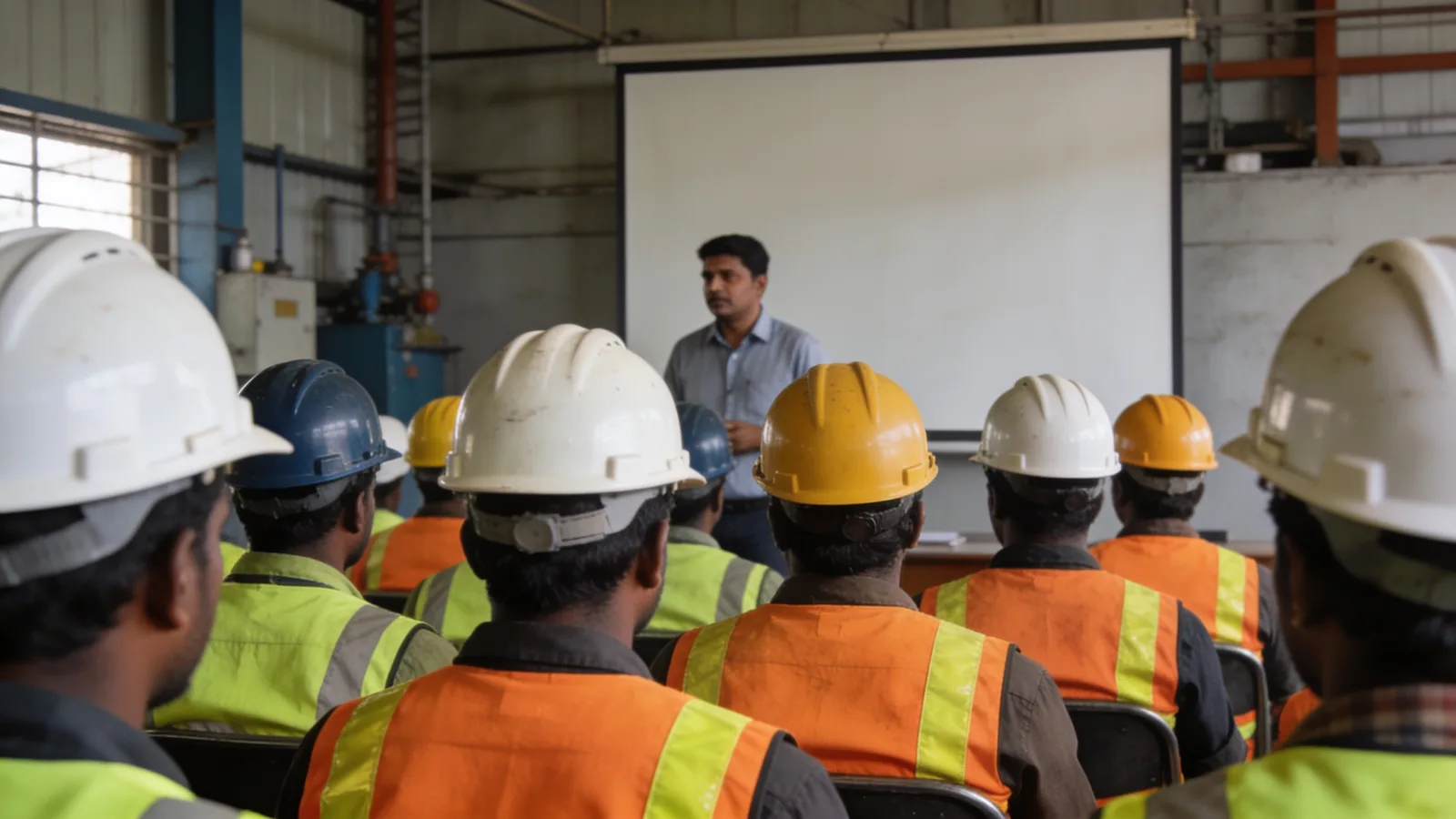
What the batch covers before joining
This is not classroom theory. It is the specific set of things a new worker gets wrong in week one, taught in advance.
- ✓Safety fundamentals: PPE discipline, machine guarding, LOTO awareness, emergency response
- ✓5S, housekeeping and material handling behaviour
- ✓Machine and process familiarisation for the deploying unit
- ✓Quality basics: what a defect is, why rejection matters, who to stop for
- ✓Shift discipline: attendance, punctuality, breaks, leave process
- ✓Documentation: attendance systems, log sheets, shift handover
- ✓Wage literacy: payslip, PF, ESI and permitted deductions explained honestly
- ✓Grievance route and who to escalate to on site
Much first-month attrition is an onboarding failure, not a wage problem
Workers leave in week two because they felt lost, unsafe or humiliated in front of a supervisor — rarely because a competing plant offered two hundred rupees more.
No safety grounding, no machine context, no explanation of the payslip. Then a supervisor under output pressure is expected to teach the job during a running shift.
Every exit is a re-sourced worker, a repeated medical and documentation cycle, and a line that keeps starting over on the learning curve.
Three to ten days of safety, 5S, machine familiarisation, quality basics and shift discipline, with documentation completed — so day one is a productive shift with a supervisor who is not teaching from scratch.
Plan a batch →
Modules, delivery, handover
Priced per trainee for a defined module length. The per-trainee rate, and whether any of it is offset where the intake is deployed on our payroll, is set out in the rate card. The slider below uses an illustrative assumption, not our rate.
A packing helper and a power press operator do not need the same week.
How long each role needs before the first shift
The module is sized to what can hurt the worker, the product or the machine in week one. Typical designs used as a starting point:
| Role group | Typical length | Role-specific content | Pass gate before deployment |
|---|---|---|---|
| Helpers, packers, loaders | 3 days | Manual handling, lifting technique, pallet and trolley use, packing standards | Safety quiz and observed lifting |
| Warehouse pickers | 3–4 days | Scanner and WMS basics, bin logic, pick accuracy, dock safety | Timed pick test with accuracy target |
| Machine operators (press, moulding, CNC) | 5–7 days | Guarding, two-hand controls, lock-out/tag-out awareness, first-piece checks, rejection logging | Supervised machine task; zero safety violations |
| Forklift and reach-truck operators | 7–10 days | Pre-use checks, load charts, aisle and ramp rules, pedestrian zones | Practical driving test; valid driving licence verified |
| Food and pharma production | 4–6 days | Personal hygiene, gowning, contamination control, GMP basics, documentation | Hygiene practical and documentation test |
Licensed food businesses must also have trained food safety supervisors under FSSAI rules (the FoSTaC programme); forklift operators should hold a valid driving licence and site authorisation. Role pages with screening detail: forklift operators, power press operators, warehouse staff.
Sample 5-day module for machine-shop intake
Mornings are practical, afternoons are practice and assessment. Nothing is taught that the worker will not use in the first month.
Joining file and safety basics
Documents, consent and bank details closed; PPE issued and fit-checked; plant hazards, emergency exits and first aid.
5S and material handling
Workstation layout, red-tagging, lifting and moving material, trolley and bin discipline.
Machine familiarisation
Guards, controls, emergency stops, lock-out/tag-out awareness on the machine type the worker will run.
Quality and shift discipline
What a defect looks like, first-piece and in-process checks, when to stop and who to call; attendance, breaks, handover and leave process.
Wage literacy, grievance route and pass gate
Payslip, PF, ESI and deductions explained; who to go to with a problem; final practical assessment and a per-worker note for the supervisor.
Getting the money and the paperwork right
Pre-employment training sits between recruitment and employment, which is exactly where disputes start. The rules we apply:
Do
- ✓Decide in writing whether trainees are appointed employees or candidates still under selection
- ✓Pay appointed trainees at least the State minimum wage for training days — training at your direction is work
- ✓Provide safety training, PPE and supervision free of charge, as the OSH Code requires
- ✓Cover trainees with accident insurance while on site
- ✓Record consent for document checks and background verification
Do not
- ✕Charge candidates any fee for training or placement
- ✕Deduct training cost from wages — it is not among the deductions the Code on Wages allows
- ✕Put trainees on production targets or night shifts during the module
- ✕Hold back original certificates or documents as security
Candidates never pay Godstone a fee. If anyone asks a candidate for money in our name, report it using the contact details on this page.
How the effect on retention is measured
We do not quote a universal attrition number, because first-month attrition depends heavily on the site, the wage and the commute. Instead we measure against your own baseline:
Your baseline
First-month exits from your last two or three untrained intakes, from your attendance records.
Trained batch
The same measure for trained batches, tracked by the supervisor note and joining date.
Exit reasons
A short exit call for every early leaver, coded into safety, supervision, wage, commute or personal reasons.
Day-one readiness
Supervisor rating of each worker at the end of week one against the module's pass gate.
For longer programmes that build new supply from scratch, see skill development programmes; for large intakes, see bulk hiring.
Questions employers ask before starting a batch
Answers we give in the first call, written down so you can compare providers on the same terms.
Plan a batch →How long is pre-employment training?+
Three to ten days depending on role risk and machine complexity. Helpers and packers sit at the short end; press, CNC and material-handling equipment operators need the longer module.
Does this replace our own induction?+
No, it front-loads it. Your statutory induction, site-specific rules and department orientation still happen on joining — but the worker arrives already grounded in safety, 5S, documentation and shift behaviour.
Is the worker paid during training?+
It depends on status. Once a person has been appointed and attends training at your direction, the training days are working days and at least the State minimum wage is payable. Where candidates are still under selection, a training stipend is good practice and helps retention. Candidates must never be charged for the training.
Can this run alongside bulk hiring?+
Yes, and it is where it pays best. For batch intake we run training immediately after the drive and before the joining date, so documentation, medicals and training all close before day one.
What does it do to attrition?+
It usually reduces early exits caused by confusion — about safety, the payslip or who to go to with a problem. The size of the effect depends on the site, the wage and the commute, so we measure it against your own previous intakes rather than quoting a universal figure.
Can new hires be asked to pay for their training?+
No. Safety training and equipment must be provided free under the OSH Code, training cost is not a permitted deduction from wages under the Code on Wages, and charging job seekers for placement or training is a common exploitation risk. Candidates should never pay.
Is induction training mandatory under the OSH Code?+
The OSH Code requires employers to keep the workplace safe and, in factories, docks, mines, construction and plantations, to provide the information, instruction, training and supervision needed for health and safety at work. A structured pre-employment module is a practical way to meet that duty before the first shift, but site-specific induction on joining is still needed.
Train the batch before it costs you the line
Tell us the intake size, the roles and the joining date. We will propose the module, the length and the per-joiner cost.