
Blue-collar staffing built around attendance, not around a candidate database
Blue-collar staffing fails on the second month, not the first. Anyone can send twenty workers on Monday. Keeping twenty on the floor through night shifts, festival weeks and a better offer down the road is the actual service, and it needs supervisors, wage discipline and a live backfill bench.
Scope, headcount and site city. We aim to send a costed proposal within one working day.
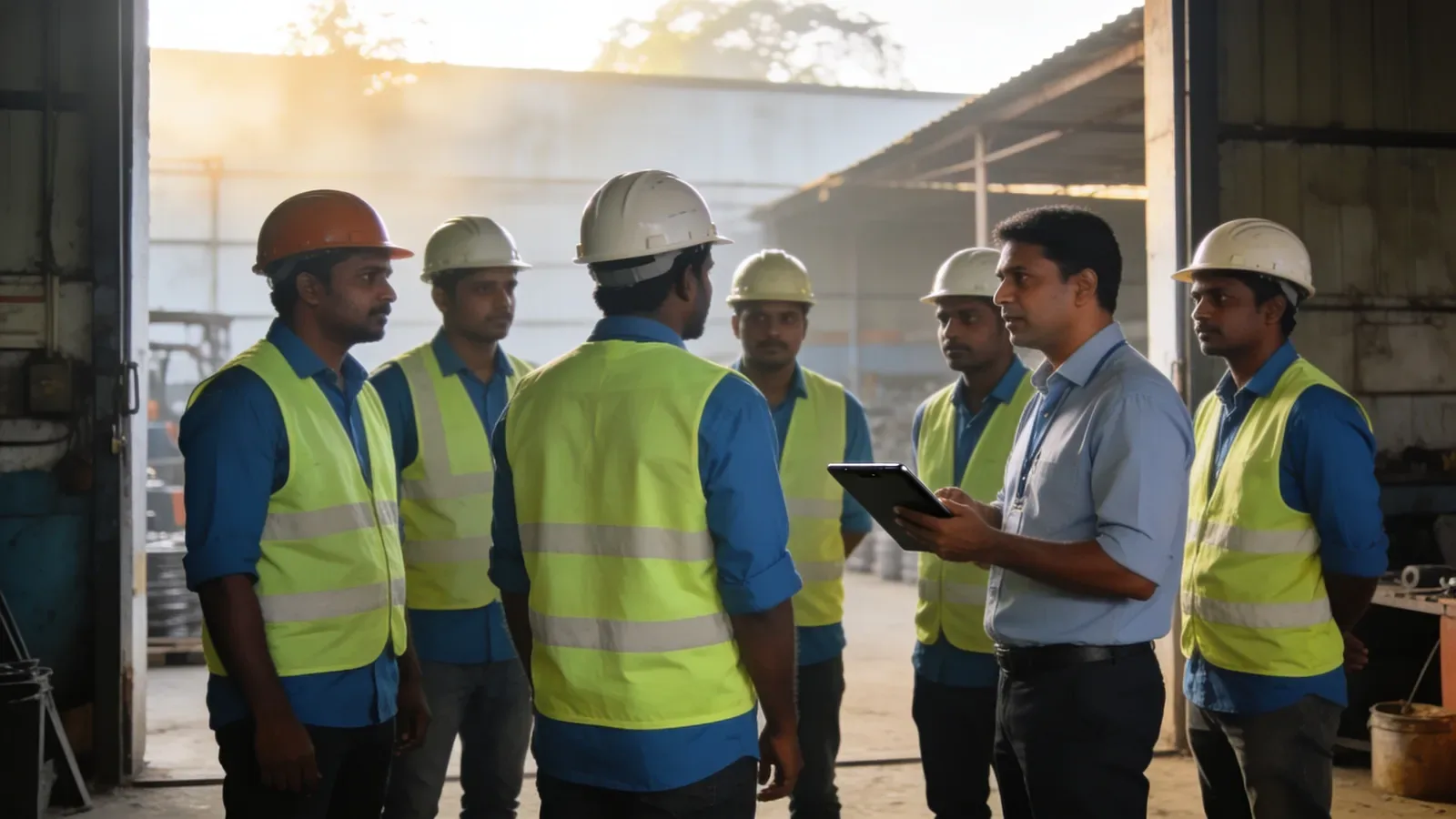
Every deployment carries a supervisor and a paper trail
Workers are employed by us as contract labour under the OSH Code, 2020 (which replaced the Contract Labour Act from November 2025), paid at or above the State minimum wage notification, and covered by PF and ESI from day one of deployment.
- ✓Roles from helper and loader to 6G welder and CNC setter
- ✓Wages at or above the state minimum wage notification for the skill grade
- ✓EPFO and ESIC remittance with monthly challan copies to you
- ✓Site supervisor for every 30 to 40 deployed workers
- ✓PPE issue, safety induction and toolbox talk records
- ✓Contract-labour registers and audit pack for your principal-employer file
The cost of a short shift is never on the invoice
When six of forty workers do not report, the line still has a target. Overtime, rework and a supervisor pulled into manning are paid by production, not by procurement.
No supervisor, no attendance visibility, no bench. You find out about absenteeism from your own line, at 7am, with the shift already short.
Covered by overtime at premium rates, or by running the line slower and paying for it in output and delivery commitments.
We agree a fill-rate target in the contract, staff a supervisor on your site, publish biometric attendance daily and keep a tested bench so we can aim for 48-hour backfill.
Get a quote →
Scope, wages and compliance on a blue-collar deployment
Billing is the loaded wage — basic, DA, PF, ESI, bonus, leave — plus a service fee on top, with no hidden per-head charges. The slider assumes a ₹21,000 gross wage per worker and an illustrative 12% fee, before GST; your actual fee is set out in the rate card.
Workers are tested, documented and inducted before they reach your line.
Skill categories and minimum wages for blue-collar roles
Blue-collar pay in India starts from the State minimum wage notification, which fixes a rate for each skill category, and often each zone and industry. Placing a role in the wrong category is one of the most common causes of underpayment.
| Category | Typical roles | What decides the category |
|---|---|---|
| Unskilled | Helpers, loaders, packers, cleaners, general workers | Work needing no previous experience or technical training |
| Semi-skilled | Machine and production operators, assembly workers, forklift helpers, store assistants | Some experience or on-the-job training, working to set routines |
| Skilled | Welders, fitters, electricians, CNC and VMC operators, forklift and crane operators, drivers | Trade training (ITI or equivalent) or proven independent competence |
| Highly skilled | CNC setters and programmers, 6G welders, tool-room machinists, senior technicians | Advanced skill, licences, or responsibility for others' work |
The rate also carries a variable dearness allowance (VDA) that most States revise once or twice a year, so a wage that was compliant last year may not be today. A statutory national floor wage under the Code on Wages is still being fixed. Check a role with our minimum wage calculator.
Trade tests and documents, by role family
A trade test on the actual task is the single best predictor of whether a blue-collar hire lasts the first month. These are the tests we run before anyone reaches your gate.
| Role family | Practical test | Documents and licences |
|---|---|---|
| Helpers, loaders, packers | Physical fitness, safe lifting, basic counting and reading of labels | Identity, bank account, age proof |
| Machine operators | Machine demonstration, use of vernier and gauges, reading a job card | ITI certificate where required |
| CNC and VMC operators | Program reading, offsets, first-piece inspection on the actual control | ITI or diploma, previous machine experience |
| Welders | Test coupon in the required position and process, with visual and bend checks | Qualification certificates where the job requires coded welders |
| Electricians | Wiring, testing and fault-finding task; lock-out/tag-out awareness | ITI (electrician/wireman) and the State electrical licence or permit where required |
| Fitters | Dismantling and assembly task, alignment, reading a drawing | ITI fitter certificate |
| Forklift operators | Driving and load-handling test on the site's equipment | Valid driving licence of the class the State requires, operator training record |
| Drivers | Road test on the vehicle class | Valid driving licence for the vehicle class and any badge the State requires |
How many workers a round-the-clock post really needs
The most common staffing mistake on a blue-collar contract is ordering one person per shift. Weekly offs, leave and absenteeism mean every post needs relievers.
Three 8-hour shifts, 7 days
Three shifts × 7 days ÷ 6 working days = 3.5 people per post before leave and absenteeism. Add a leave and absence reserve — commonly 5–10% — on top.
Two 12-hour shifts
Fewer handovers, but hours beyond the daily limit are overtime at twice the ordinary rate, subject to the limits your State allows, and fatigue risk rises. Budget the overtime before choosing it.
General shift, 6 days
One shift, one weekly off. 7 ÷ 6 cover is only needed if the post must be manned every day; otherwise one person per post plus an absence reserve.
Women on night shifts
Permitted with the worker's written consent and the safety, transport and facility conditions the appropriate Government sets — plan transport before rostering.
Site facilities and migrant-worker duties to plan for
Blue-collar deployments often bring headcount past the thresholds that trigger welfare facilities, and many workers come from other States.
- ✓Drinking water, washrooms, first aid and rest areas at every site
- ✓Canteen and crèche facilities once headcount crosses the thresholds in the OSH Code and the applicable rules
- ✓Inter-State migrant workers earning up to ₹18,000 a month: identified in records, and paid a yearly lump-sum fare for a return journey home
- ✓Safe transport and, where arranged, hostel accommodation meeting basic sanitation and safety standards
- ✓PPE suited to the task, issued and recorded, with toolbox talks before shifts
- ✓A grievance channel workers can use without going through their supervisor
The blue-collar KPIs to put in the contract
Measure the service by what reaches the floor. These are the numbers we report and that you should expect from any vendor.
| KPI | Definition |
|---|---|
| Shift fill rate | Workers present at shift start ÷ workers ordered for that shift |
| Absenteeism | Unplanned absences ÷ scheduled shifts, by week |
| Backfill time | Hours from an exit or no-show to a trained replacement on the floor |
| 30-day attrition | Workers who left within 30 days ÷ workers deployed |
| Overtime hours | Overtime per worker per week, against the agreed limit |
| Safety | Near misses and incidents reported, and PPE compliance at audits |
| Compliance | Wages paid before the 7th, PF and ESI remitted on time, registers complete |
Questions buyers ask before signing
Answers we give in the first call, written down so you can compare vendors on the same terms.
Get a quote →What does blue-collar staffing cost?+
Loaded wage plus a service fee set out in the rate card, plus GST. Loaded wage means basic and DA at or above the State notification, plus employer PF (12% of PF wages, with EDLI and admin charges, mandatory up to ₹25,000 a month from 17 September 2026), ESI at 3.25% where gross wages are up to ₹21,000, and bonus and leave provisioning. The fee moves with headcount, skill grade and city.
Which roles count as blue-collar here?+
Shop-floor, site and support roles: helpers, loaders, packers, machine and production operators, CNC and VMC operators, welders, fitters, electricians, plumbers, riggers, forklift and crane operators, drivers, housekeeping and security staff.
Who is liable if wages or PF go unpaid?+
As principal employer you carry residual liability under the OSH Code (which replaced the CLRA) and the Code on Social Security (which replaced the EPF Act): if the contractor does not pay wages or dues, you must pay and recover them. That is why the challan and register pack is delivered to you every month. If a contractor cannot produce it on demand, the exposure is yours.
How quickly can workers be deployed?+
We aim for seven to ten days for semi-skilled and unskilled roles in an established belt, longer for licensed or specialised trades. For urgent needs we aim to deploy a partial batch within 48 to 72 hours where screened candidates are available.
What is the minimum wage for a helper or machine operator?+
It depends on the State, the scheduled employment or industry, the zone and the skill category, and it moves with each VDA revision. A helper is usually unskilled and a machine operator semi-skilled or skilled. Use our minimum wage calculator for the current rate, or ask us for the notification that applies to your site.
Can contract workers work overtime?+
Yes, within the daily and weekly limits and with overtime paid at twice the ordinary rate of wages. Overtime has to be recorded in the overtime register and reconciled with the invoice; persistent overtime usually means the post needs another reliever.
Do you supervise the workers or do we?+
Both, at different levels. You direct the work and set output. We staff a site supervisor for every 30 to 40 workers to own attendance, discipline, roster, PPE and grievance handling.
Tell us the shift pattern and the headcount
You get the loaded cost per worker, the fill-rate target and the compliance pack list before you sign anything.