
Machine operator staffing for shops that need more than one machine covered.
A general engineering shop rarely needs a single-machine specialist; it needs someone who can move between a lathe, a drill and a grinder as the job mix changes. Machine operator staffing works best when the operator can cover two or three machines, not one. Godstone Consultech screens for multi-machine capability, measurement skill and safety discipline, employs every worker on our own payroll, and keeps the PF, ESI, wage and contract-labour records — so the person on your floor is documented, replaceable and accountable from day one.
Machine list, job mix and shift pattern are enough to price.
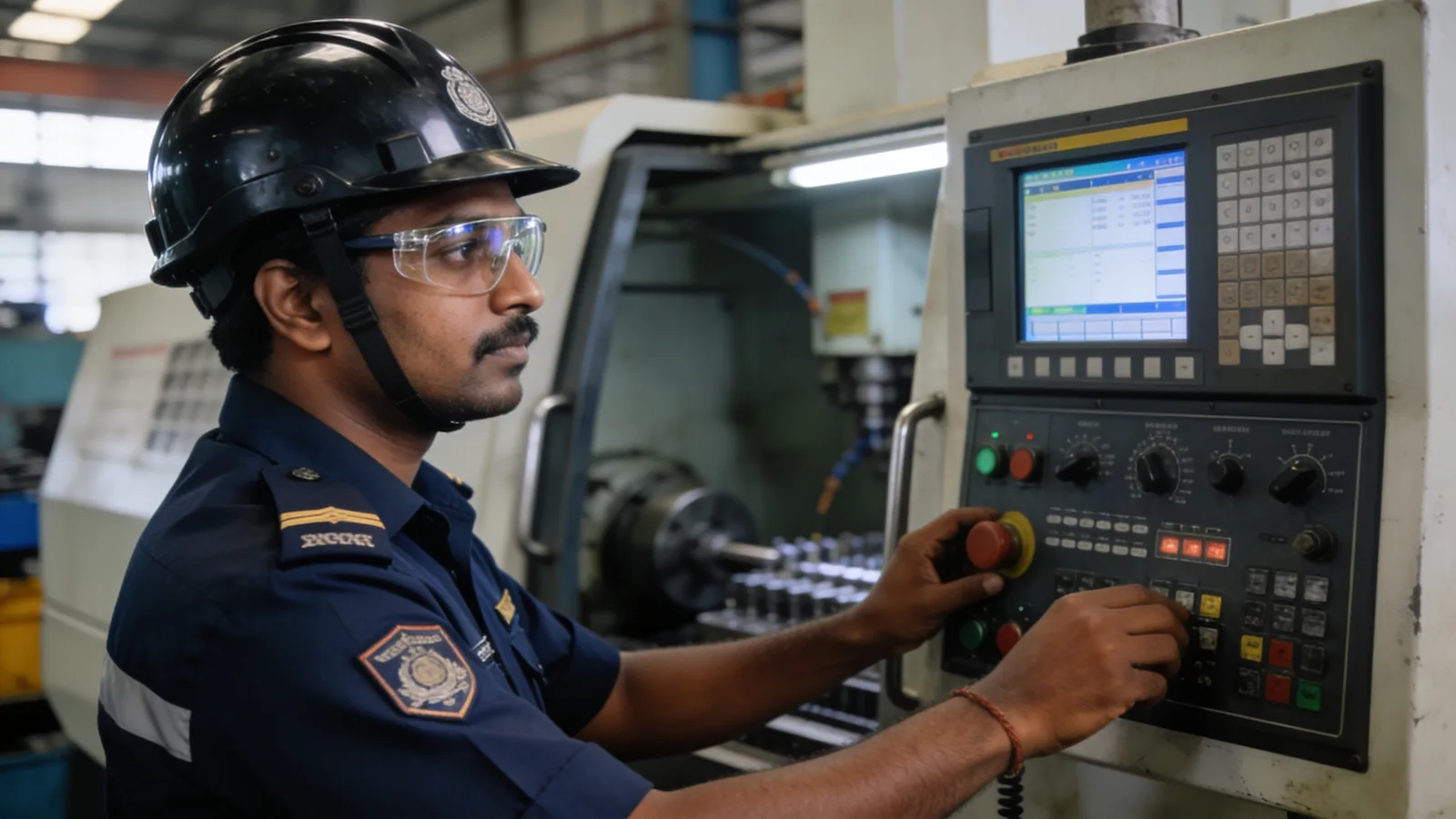
Conventional machines, SPMs and general engineering.
General shops run on flexibility. We screen for the machines you actually have — conventional lathes, milling machines, drills, grinders, gear cutters and SPMs — and record a skill band per operator so deployment is not guesswork.
- ✓Conventional lathe, drill and grinding operation
- ✓Special-purpose machine and fixture operation
- ✓Measurement with vernier, micrometer and gauges
- ✓Setting support and job loading
- ✓Preventive-maintenance support and 5S
Single-skill hiring makes a shop rigid
Job mix changes weekly; a one-machine operator idles half of it.
An operator hired for a lathe cannot be moved to a grinder when the job mix shifts, so the shop carries idle hands and overtime at the same time.
Idle capacity on one machine, overtime on another, and a supervisor spending the day negotiating who can do what.
Practical testing across your machine list, a recorded skill band per operator, and deployment flexibility written into the contract so the shop can move people legitimately.
Get a rate card →
Screening, deployment and compliance
Move the slider for an indicative monthly bill for machine operators at a ₹20,500 gross wage, statutory costs and an illustrative 12% service fee (your actual fee is set out in the rate card). Firm rates follow your State's minimum wage for the skill category, the skill band and the shift pattern.
What clears before the worker reaches your gate.
What a machine operator does in a general engineering shop
A machine operator runs conventional and special-purpose machines where hand skill and judgement replace a CNC programme: centre lathes, milling machines, radial and pillar drills, surface and cylindrical grinders, shapers, gear hobbers and SPMs built for one component. The operator sets the job, chooses speeds and feeds within the process sheet, machines to size and checks the part — often moving between two or three machines as the job mix changes.
If your machines have a CNC control, you need a different test. Related roles:
CNC operators
Turning centres and CNC lathes, tested on the control, codes and offsets.
CNC operator staffing →VMC operators
Vertical machining centres: fixtures, datums and tool-length offsets.
VMC operator staffing →Machine operator skill bands we staff
Send your machine list and the tolerance your parts hold. The band follows from both.
| Band | Typical background | Works independently on | Usual minimum-wage category |
|---|---|---|---|
| Machine tender | 10th pass or ITI; trained on site | Loading and unloading SPMs and drills on set jobs, gauge checks, deburring | Semi-skilled |
| Single-machine operator | ITI Turner, Machinist or Machinist Grinder; 1–3 years | Setting and running one machine type to drawing within the process sheet | Skilled |
| Multi-machine operator | ITI with 3+ years across machine types | Moving between lathe, milling, drilling and grinding as the job mix changes | Skilled |
| Precision grinder / gear-cutting operator | ITI Machinist Grinder or tool-room background, 4+ years | Grinding to micron-level size and finish, wheel dressing, hobbing and gear inspection | Skilled or highly skilled |
Skill categories come from each State's minimum-wage notification under the Code on Wages, 2019; the mapping is typical, not universal. Turner and Machinist are two-year DGT craftsmen trades at NSQF level 4.
The machine operator test, built from your machine list
Each candidate is tested only on the machines you run. Multi-machine candidates must clear at least two.
Lathe
Face, turn and step a bar to ±0.05 mm, cut a taper and an external thread, and check the thread with a ring gauge.
Milling
Square a block on all faces, mill a slot to width and depth, and set the job true in the vice.
Drilling and tapping
Mark out and drill a hole pattern to pitch on a radial drill, clamp the job securely, and tap without breaking the tap.
Grinding
Surface-grind to size and flatness, dress the wheel, and explain the wheel speed marking and magnetic chuck checks.
Measurement
Vernier, micrometer, dial gauge and bore gauge readings, recorded on an inspection sheet.
Safety
Chuck guards and wheel guards in place, no gloves near rotating spindles, chips cleared with a brush, workpieces clamped on drills.
PPE, machine rules and the compliance behind each operator
PPE issued and checked
- ✓Safety shoes and safety glasses on every machine
- ✓Face shield at grinders
- ✓Gloves for handling stock only — never near a rotating chuck, spindle or drill
- ✓Hearing protection where your noise survey requires it
Machine rules we brief
- ✓Chuck keys never left in the chuck
- ✓Grinding wheels checked for speed rating and damage before mounting, guards always fitted
- ✓Work clamped, never hand-held, on drilling machines
- ✓Guarding dangerous machinery is a duty under the OSH Code, 2020 and State factory rules
Compliance we carry as employer
- ✓EPF and ESI enrolment before day one; ESI covers gross wages up to ₹21,000 a month
- ✓Wages at or above the State minimum for the category, paid by the 7th of the following month
- ✓Overtime at twice the ordinary wage rate (OSH Code, section 27)
- ✓Contract-labour registers under the OSH Code (which replaced the CLRA Act, 1970), shared monthly
Shift patterns and the wage basis
General engineering and job shops usually run a general shift plus one or two production shifts. Multi-machine operators cut idle time on small batches, so band them and pay them accordingly. The OSH Code caps ordinary hours at eight a day; hours beyond that are overtime at twice the ordinary rate.
| Basis | Figure | Source and notes |
|---|---|---|
| Legal floor (example) | Haryana: semi-skilled ₹16,781 a month, skilled ₹18,501 a month | Haryana notification effective 1 April 2026. Your State, zone and scheduled employment decide the real floor. |
| Karnataka | Skill-and-zone structure with steep increases, notified 22 May 2026 | Reported to be under challenge in the Karnataka High Court; check the current position before budgeting a site in Karnataka. |
| Market reference | Machine operator average ₹18,113 a month; typical range ₹9,417–₹34,839 | Indeed India, 383 reports, updated May 2026. Ahmedabad, Sonipat and Pune list among higher-paying locations. |
| Our estimator | ₹20,500 gross a month for a skilled machine operator | Planning figure. Tenders price lower; precision grinders higher. |
Indicative only, not an offer or a legal rate. A national floor wage under the Code on Wages is still being fixed; until then State rates apply. Check your State's rate with the minimum wage calculator.
What to hold machine operators, and us, to
Output against standard hours
Parts produced against the standard time on the route card, per operator and machine.
Rejection and rework
Rejections by operation, so a drifting grinder or a worn tool is found before the batch is lost.
Machines covered
Number of machine types each operator is qualified on — the measure of how flexible your bench is.
Setup time
Time from job card to first good part on each machine, compared with your norm.
Our service targets
We aim to deploy tested operators in 7–12 working days and to replace exits within 15 days, with each operator's skill band on record. Targets are written into the SLA schedule.
Machine operator staffing FAQs
Machines covered, testing, multi-machine work, cost basis and CNC roles.
Get a rate card →What machines can your operators handle?+
Centre lathes, milling machines, radial and pillar drills, surface and cylindrical grinders, shapers, gear hobbers and special-purpose machines. Each operator carries a recorded skill band against your machine list.
Are machine operators tested before deployment?+
Yes. A practical test on the machines you run, plus measurement and drawing-reading basics and a safety check, before any offer is issued.
What is the difference between a machine operator and a CNC operator?+
A machine operator sets and runs conventional or special-purpose machines by hand skill. A CNC operator runs a programme on a CNC control and works with offsets and codes. The tests and wage bands differ, so we staff them separately.
Can one operator cover multiple machines?+
That is often the point in a job shop. Multi-machine capability is tested deliberately and written into the deployment plan, which keeps the shop flexible as the job mix changes.
What qualification should a machine operator have?+
Usually an ITI certificate in Turner, Machinist or Machinist Grinder, or equivalent experience. Tenders on set SPMs can be trained on site. The trade test decides the band.
Why no gloves near lathes and drills?+
A glove can be caught by a rotating chuck or drill and pull the hand in. Gloves are for handling stock and sharp parts, not for operating rotating machines.
How is machine operator staffing priced?+
The gross wage for the skill band (at or above the State minimum), plus employer PF, EDLI and admin charges, ESI where gross is up to ₹21,000, bonus and gratuity provisions, and the service fee. See how staffing fees are calculated.
Do you supply CNC and VMC operators too?+
Yes, as separate roles — they are tested on control-specific competence. See CNC operator staffing and VMC operator staffing.
Shop short of machine operators?
Send the role, headcount and site city. We aim to send an itemised rate card and deployment date within one working day.