
Welder manpower supply where the weld is tested before the welder is hired.
A failed weld is not a staffing problem until the radiography report arrives. Welder manpower supply from Godstone starts with a qualification test on the process and position you actually run — 6G pipe, MIG, TIG, ARC, structural — witnessed and recorded, with visual and where required destructive or radiographic checks, before the welder is deployed on our payroll with a fabrication supervisor over the crew.
Process, position, material and thickness are enough to shortlist properly.
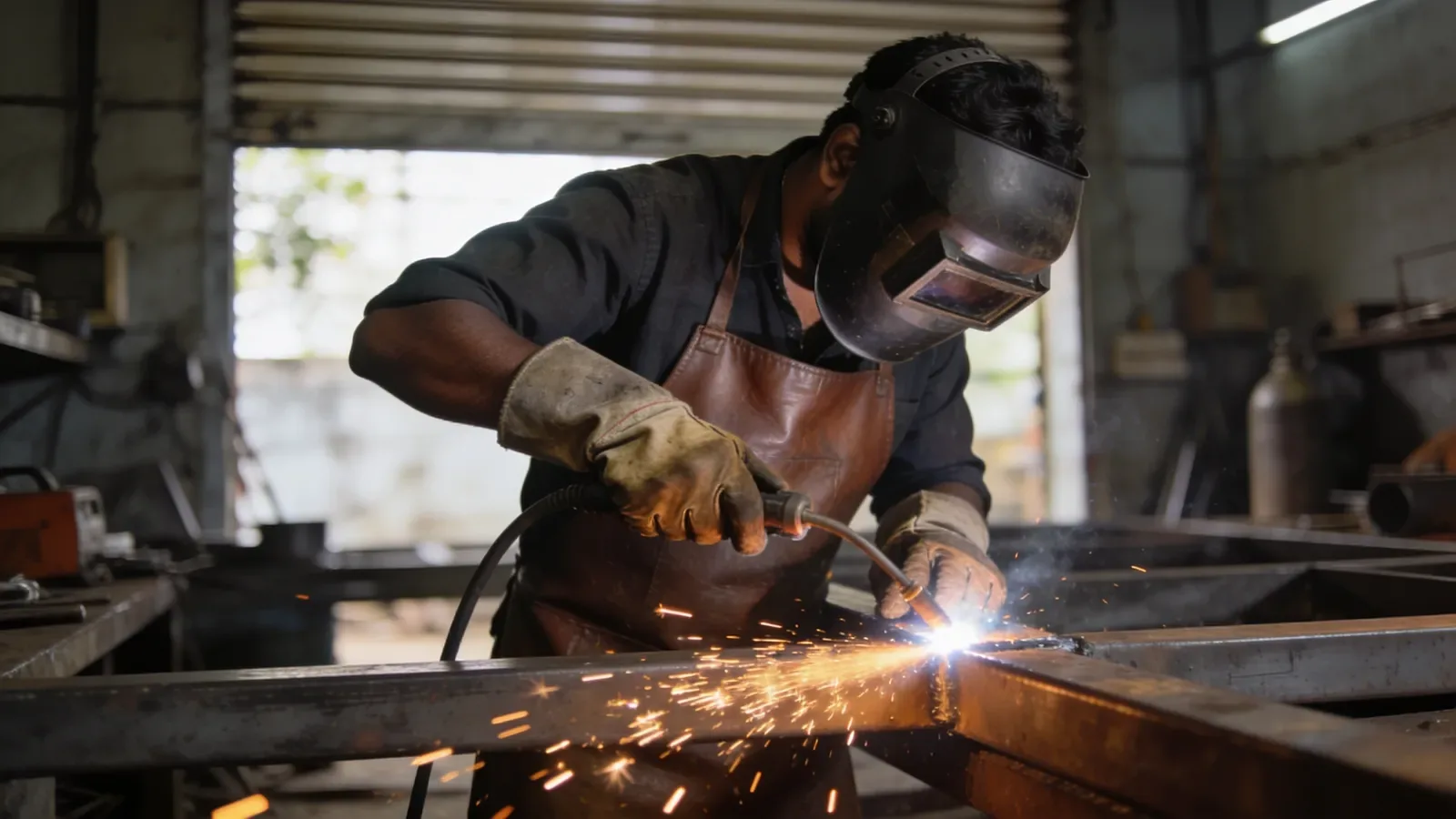
Pipe, plate, structural and precision fabrication.
Welding rates and availability move with process, position, material and certification. We shortlist against your WPS rather than a generic job title, and test before deployment.
- ✓6G pipe welders for process and utility lines
- ✓MIG and CO2 welders for volume fabrication
- ✓TIG welders for stainless and precision work
- ✓ARC and structural welders for heavy fabrication
- ✓Fitters, grinders, gas cutters and fabrication helpers
Where fabrication schedules actually break
Not in the drawing office. In the joint that fails inspection and the crew that walks off mid-project.
A welder qualified on plate is not qualified on 6G pipe. Paper certificates travel; skill on your position and material may not.
Every rejected joint is cut, ground, rewelded and re-tested. Schedules slip, inspection costs repeat, and liquidated damages start counting.
Witnessed qualification tests on your process and position, records on file, and a supervisor accountable for the crew's output daily.
Get a rate card →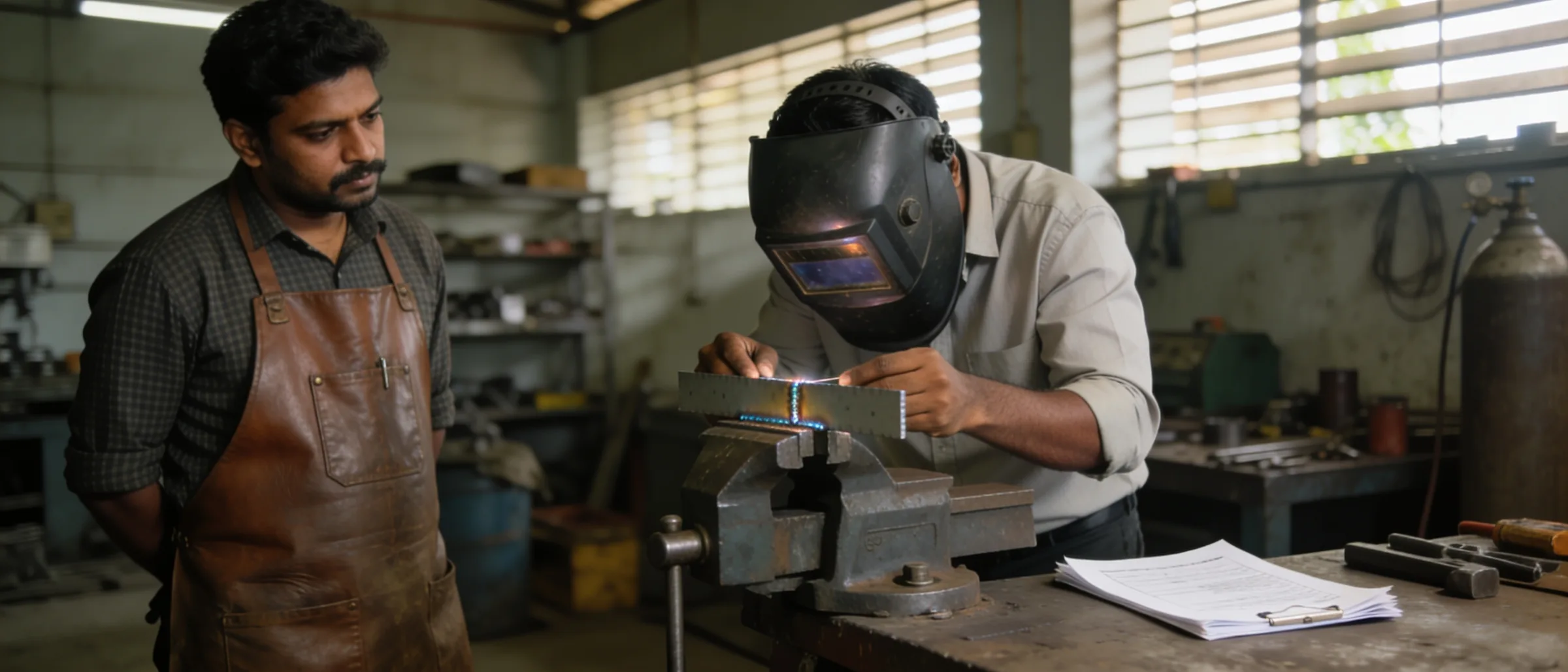
How welders are qualified and deployed
Move the slider for an indicative monthly bill for qualified plate welders at a ₹24,000 gross wage, statutory costs and an illustrative 12% service fee (an assumption for the estimate, not our rate; your fee is agreed in your contract). 6G pipe, TIG and IBR welders price higher.
No deployment without a cleared test.
What a welder qualification actually covers
A welder is qualified for a process, a position, a material group and a thickness and diameter range — not for “welding” in general. Under ASME Section IX, AWS D1.1 for structural steel, or IS 7310 (Part 1), which is identical to ISO 9606-1, the test coupon decides what the welder may weld on your job. Plate positions run from 1G (flat) to 4G (overhead); on pipe, 5G is horizontal-fixed and 6G is fixed at 45°, which under ASME IX qualifies groove welds in all positions. Fillet positions are 1F to 4F.
Two consequences matter to a buyer. First, under ASME IX the organisation responsible for the welding qualifies its welders to its own WPS, so a certificate from a previous employer is evidence, not a qualification for your work. Second, a qualification lapses if the welder has not used that process for six months, so continuity must be logged. The trades that work alongside welders are staffed separately:
Fitters
Fabrication and pipe fitters who cut, bevel, fit up and align before the welder arrives.
Fitter manpower supply →Riggers
Slinging, signalling and load handling for spools, structures and heavy assemblies.
Rigger manpower supply →Project crews
Fixed-window crews for shutdowns, expansions and site fabrication.
Project manpower supply →Welder categories we supply
Send the WPS, material, thickness and positions. The category — and the rate — follows from those, not from the job title.
| Category | Typical background | Qualified for | Usual minimum-wage category |
|---|---|---|---|
| Grinder / gas cutter / helper | Trained on site | Edge preparation, grinding, gas cutting, fire watch — no code welding | Semi-skilled |
| Structural welder (SMAW / FCAW) | ITI Welder (DGT craftsmen scheme, NSQF level 3, one year) plus 2+ years | Plate and structural joints, 1G–4G and fillets, typically to AWS D1.1 or IS 7310 | Skilled |
| MIG / MAG production welder | ITI Welder or Welder (GMAW & GTAW), 1–3 years | Volume fabrication, sheet metal and fillet welds, often robot-adjacent cells | Skilled |
| TIG welder | 3+ years on stainless or aluminium | Thin-wall stainless, aluminium, food and pharma piping with purge control | Skilled or highly skilled |
| Pipe welder (6G) | Welder (Pipe) or 5+ years on process piping | GTAW root with SMAW fill and cap on carbon and alloy pipe, radiography-quality | Highly skilled |
| IBR welder | Pipe welder with a current IBR welder certificate | Boiler pressure parts and IBR piping, as the boiler inspectorate requires | Highly skilled |
Skill categories come from each State's minimum-wage notification under the Code on Wages, 2019; the mapping is typical, not universal. ITI levels from the DGT CTS 2.0 curricula for Welder and its Pipe, Structural and GMAW & GTAW variants.
The welder test, from WPS to result
Run to your WPS, witnessed by your inspector or a third-party inspection agency where your code or customer requires it.
Read the WPS and symbols
Explain process, filler, preheat, interpass limits and joint design from the WPS, and read the welding symbols on the drawing.
Coupon preparation
Bevel, land and root gap to the WPS; tack and set the coupon in the specified position.
Root, fill and cap
Weld the coupon in position with the specified process, keeping heat input and interpass temperature within limits.
Visual examination
Check profile, undercut, porosity, spatter, root penetration and reinforcement against the acceptance criteria.
Bend test or radiography
Face, root or side bends, or radiography where the code allows it (ASME IX does not permit radiography for GMAW short-circuit transfer).
Hot-work safety
Permit, fire watch, cylinder and flashback-arrestor checks, fume extraction and confined-space rules.
Production MIG welders can be tested on fillet break or macro-etch samples instead of a groove coupon, where your product standard allows.
Welder records, PPE and the compliance behind each crew
Records we keep per welder
- ✓Welder performance qualification record with the variables qualified
- ✓Unique welder ID and stamp for traceability on your weld map
- ✓Continuity log — a process not used for six months means re-qualification
- ✓NDT results by welder, so repair rates are visible
PPE and hot-work rules
- ✓Welding helmet with the right shade, leather gloves, jacket or apron, FR clothing
- ✓Fume extraction or respiratory protection — especially for stainless, where fume contains hexavalent chromium
- ✓Face shield and hearing protection for grinding
- ✓Hot-work permit, fire watch and screens before any arc is struck
Compliance we carry as employer
- ✓EPF and ESI enrolment before day one; ESI covers gross wages up to ₹21,000 a month, and employees' compensation cover applies above that
- ✓Wages at or above the State minimum for the category, paid by the 7th of the following month
- ✓Overtime at twice the ordinary wage rate (OSH Code, section 27) on extended project days
- ✓Journey allowance for inter-State migrant workers under OSH Code section 61, as the appropriate Government prescribes
Crew patterns and the wage basis
Fabrication shops usually run one or two 8-hour shifts. Shutdowns and site projects often run longer days, which means overtime at twice the ordinary rate beyond eight hours — budget it rather than discovering it on the first bill. Outstation crews also need accommodation, travel and, for inter-State migrant workers, the annual journey allowance under the OSH Code.
| Basis | Figure | Source and notes |
|---|---|---|
| Legal floor (example) | Haryana: skilled ₹18,501 a month, highly skilled ₹19,426 a month | Haryana notification effective 1 April 2026. Your State, zone and scheduled employment decide the real floor. |
| Karnataka | Skill-and-zone structure with steep increases, notified 22 May 2026 | Its legal validity is being contested; check before budgeting a site in Karnataka. |
| Market reference | Welder average ₹19,037 a month; typical range ₹8,963–₹40,432 | Indeed India, 145 reports, updated May 2026. Bengaluru (about ₹24,700) and Chennai (about ₹22,200) list among higher-paying cities. |
| Our estimator | ₹24,000 gross a month for a qualified plate welder | Planning figure. 6G pipe, TIG and IBR welders are quoted separately and usually well above this. |
Indicative only, not an offer or a legal rate. State minimum wages apply and may not be set below the national floor wage the Central Government fixes under the Code on Wages. Check your State's rate with the minimum wage calculator.
What to hold welders, and us, to
Weld repair rate
Joints rejected at radiography or visual inspection, as a share of joints tested, tracked by welder ID.
Inches or joints per day
Output against the planned rate for the joint type, so slow crews are seen early.
Qualification currency
No welder working outside the variables or continuity of their qualification. The target is zero.
Hot-work incidents
Fires, burns and permit breaches. The target is zero, backed by fire watch and permit audits.
Our service targets
We aim to send a test plan and rate card within one working day, mobilise tested crews in 7–12 working days, and replace an exit within 15 days. Targets are written into the SLA schedule.
Welder supply FAQs
Qualification codes, processes, continuity, rates and mobilisation.
Get a rate card →Are welders qualification-tested before deployment?+
Yes. Each welder clears a coupon on the process, position, material and thickness in your WPS, with visual examination and bend tests or radiography as the code requires, witnessed by your inspector or a third-party agency where needed. Records are kept per welder.
Is a welder's old certificate valid for our job?+
It is evidence of skill, not a qualification for your work. Under ASME Section IX the organisation responsible for the welding qualifies its welders against its own WPS, and a qualification lapses after six months without using the process.
What do 3G and 6G mean?+
They are test positions. 3G is a vertical groove weld on plate; 6G is a groove weld on pipe fixed at 45°, the hardest standard position. Under ASME IX a 6G test qualifies groove welds in all positions, within the other variables tested.
Which welding processes do you cover?+
SMAW (stick), MIG/MAG and CO2, FCAW, TIG for stainless and aluminium, and 6G pipe welding, plus fitters, grinders, gas cutters and helpers to complete the crew.
Do you supply IBR-certified welders?+
Yes, for boiler pressure parts and IBR piping, where the welder holds a current certificate from the boiler inspectorate. We verify the certificate and its validity before deployment.
How quickly can a welding crew mobilise?+
We aim for 7–12 working days including testing. Large crews are mobilised in waves so testing keeps pace, and outstation deployment includes accommodation and travel planning.
Why do welder rates vary so much?+
Process, position, material and code drive scarcity. A 6G pipe welder with a clean radiography record commands well above a volume MIG welder, with stainless TIG work in between. The rate card prices each category separately.
Do you supply welders for shutdown and project work?+
Yes. Shutdown and turnaround crews are mobilised against a fixed window with hot-work permit discipline and released at the end. See project manpower supply.
Fabrication schedule at risk?
Send the WPS and crew size. We aim to send a test plan and rate card within one working day.