
Skill development programmes that end with a worker on a machine
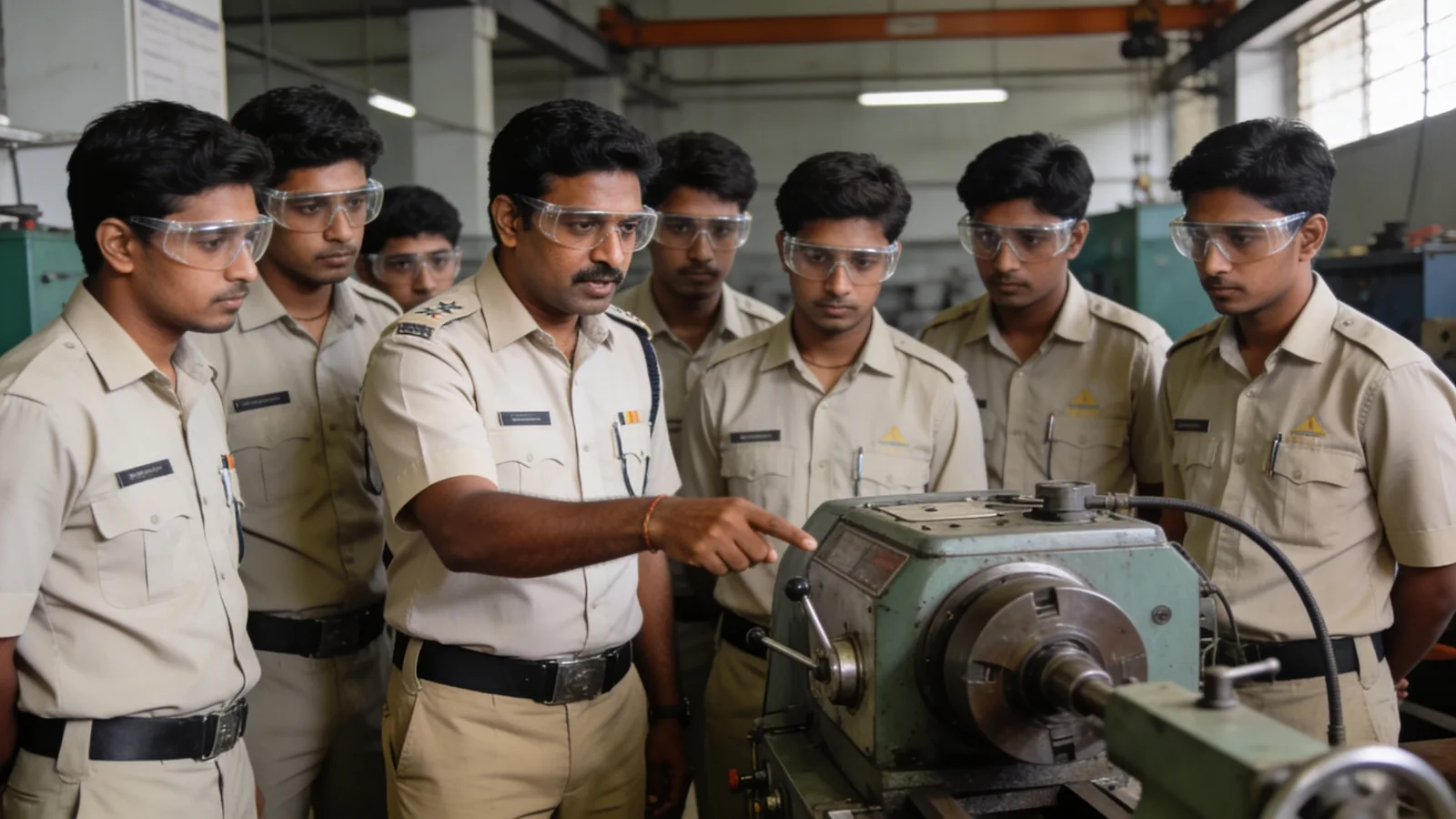
Most skilling in India ends with a certificate and no job. Employer-led skilling works the other way round: the job exists, the machine exists, and the programme is written backwards from the standard the line requires. We build and run those batches — in your plant or at an external training centre arranged for the batch.
Trades, batch size and start month. We aim to send a costed programme plan within one working day.
How a batch is designed
The design starts with the job standard — cycle time, quality tolerance, safety behaviour — and works backwards into modules, hours and assessments.
- ✓Job and skill gap analysis with your production and quality teams
- ✓Trade-wise curriculum: theory, simulation, machine hours, safety
- ✓Mapping to NSQF qualifications, with third-party assessment through the approved route where a qualification exists
- ✓Trainer deployment, or train-the-trainer for your own supervisors
- ✓In-plant training bay setup, or delivery at an external training centre
- ✓Assessment, certification and deployment into the requesting unit
- ✓Post-deployment tracking at 30, 60 and 90 days
Certificates do not run machines
Generic skilling batches teach a syllabus written years ago for machines nobody in your plant runs. The graduate still needs three months on your line before being productive.
So it is measured in candidates trained, not in workers deployed and retained. Nobody reconciles the batch output against a single production requirement.
Plus rejection and rework during the learning curve, plus a supervisor diverted from output to hand-holding, plus attrition of workers who never became competent.
Curriculum built on your machines and tolerances, trained by people who have run them, assessed against the job standard (and NSQF where a qualification exists), and deployed straight into the unit that asked for the workers.
Plan a batch →
Design, delivery, deployment
Programmes are priced per trainee, or as a fixed batch cost, with the rates set out in the rate card. Where government scheme funding applies, the employer-borne share can fall. The slider below uses an illustrative per-trainee assumption, not our rate.
The first workshop is with production and quality, not with HR.
Funding routes for employer-led skill development
The funding route shapes the programme: who can be trained, whether trainees are free to join other employers, and what has to be reported. Choosing it at the design stage avoids rebuilding the batch later.
| Route | How it works | Fits when | Watch-outs |
|---|---|---|---|
| Your training budget | You fund the batch for candidates you intend to deploy | The batch exists to fill your own vacancies | Training cost cannot later be deducted from wages |
| CSR (Companies Act, Schedule VII — employment-enhancing vocational skills) | Your CSR spend funds skilling of community youth through an eligible implementing agency | Open cohorts from your catchment, free to join any employer | The CSR Rules (rule 2(1)(d)) exclude activities in the normal course of business and activities benefiting your employees — a batch designed purely to fill your vacancies usually does not qualify |
| Central and State skilling schemes (e.g. PMKVY 4.0, State skill missions) | Accredited training centres deliver NSQF courses free to candidates; employers commit to placement or on-the-job training | Large, repeatable job roles with an existing qualification | Scheme windows, targets and centre accreditation are set by the government, not by you |
| Apprenticeship (NAPS / NATS) | Trainees learn on your floor under the Apprentices Act with a government stipend share | Longer, 6–12 month pipelines | Engagement band, stipend minimums and portal process apply — see NAPS and NATS |
| Recognition of Prior Learning (RPL) | Experienced but uncertified workers assessed and certified against NSQF | Existing workforce needing certificates for customer audits | Assessment only — gaps still need training; see reskilling and upskilling |
CSR eligibility depends on your CSR policy and the implementing agency; confirm with your CSR committee and auditors. Scheme availability changes with each budget cycle — the Skill India Programme (PMKVY 4.0, PM-NAPS and Jan Shikshan Sansthan) was approved in February 2025 for the period to 2025-26, and PIB reported PMKVY 4.0 and NAPS 2.0 still being implemented in April 2026. Confirm the current scheme window before planning a batch around it.
Sample curriculum: 45-day CNC turning operator batch
An illustrative design for new-intake trainees with ITI or Class 12 background, written backwards from the job standard: set up and run a CNC turning centre to drawing, within tolerance, safely, on shift. Around 60% of the hours are on the machine.
| Module | Hours | Assessed by |
|---|---|---|
| Safety, 5S, PPE and shop-floor discipline | 16 | Observation checklist; safety quiz |
| Engineering drawing and measurement (vernier, micrometer, gauges) | 40 | Practical measurement test |
| CNC basics: axes, controls, codes, offsets | 40 | Written and simulator test |
| Machine setting: tool loading, work offset, first-piece approval | 60 | Supervised setting task |
| Supervised production on the line | 150 | Cycle time and rejection rate vs the standard |
| Quality basics: in-process checks, rejection logging, escalation | 20 | Case exercise |
| Final assessment | 10 | Third-party NSQF assessment where a qualification exists, or documented in-plant competence test |
Total about 336 hours over 45 working days at around 7.5 hours a day. Hours per module change with the machine, the product and the trainees' starting level.
The numbers a skilling programme should report
A programme measured in 'candidates trained' will keep training candidates. These are the measures we report to the unit that asked for the workers — each defined before the batch starts:
Completion rate
Trainees finishing the programme out of those who started, with reasons for each drop-out.
Assessment pass rate
First-attempt pass against the agreed standard, by module.
Deployment rate
Certified trainees actually deployed into the requesting unit within an agreed window.
30-60-90 day retention
Deployed trainees still at work, compared with your usual intake.
Time to productivity
Weeks until a deployed trainee meets cycle-time and quality targets unsupervised.
Cost per productive worker
Programme cost divided by trainees still productive at 90 days — the number finance should see.
Training, wages and bonds under the Labour Codes
Skill programmes sit close to employment law. The points to settle before trainees start:
Settle before day one
- ✓Status of trainees: pre-hire trainees, apprentices under the Apprentices Act, or employees under training — each has different wage and benefit rules
- ✓If trainees are employees, minimum wages and social security apply from day one
- ✓Safety training, PPE and supervision must be provided free of charge (OSH Code)
- ✓Insurance cover for trainees on the shop floor
- ✓Written consent for any background verification or data sharing with the deploying unit
Avoid
- ✕Deducting training cost from wages — it is not a permitted deduction under the Code on Wages
- ✕Bonds that recover more than a genuine, documented training cost
- ✕Charging trainees fees for a programme that exists to fill your vacancies
- ✕Running trainees on production targets without supervision or insurance
Questions employers ask before starting a batch
Answers we give in the first call, written down so you can compare providers on the same terms.
Plan a batch →How is a skill development programme priced?+
Per trainee, or as a fixed cost for a defined batch. Cost depends on duration, machine time, consumables and whether delivery is in your plant or at an external centre; the rates are set out in the rate card. Scheme funding may cover part of the cost where the batch qualifies.
Can programmes be funded through CSR or government schemes?+
Sometimes. Government schemes such as PMKVY 4.0 and State skill missions fund NSQF courses at accredited centres, and CSR can fund open cohorts of community youth. CSR cannot normally fund a batch that exists only to fill your own vacancies, because the CSR Rules exclude normal-course-of-business activity. We map the funding route during design rather than after the batch is planned.
Do you train our existing workers or only new intake?+
Both. New-intake batches build supply; existing-worker batches usually target multi-skilling, machine upgrades or quality behaviour after a customer audit finding.
Is the certification recognised?+
Where an NSQF qualification exists, trainees can be assessed and certified through the approved route (an NCVET-recognised awarding body, usually via the Sector Skill Council), which matters for customer audits and for the worker's own mobility. Where no qualification fits, we issue a documented in-plant competence record instead of a hollow certificate.
Who owns the curriculum we build together?+
You do, for your machines and processes. We keep the generic trade modules; anything specific to your line, tolerances or products stays yours.
Can CSR funds be used to train our own future employees?+
Usually not directly. The CSR Rules exclude activities undertaken in the normal course of business and activities benefiting the company's employees. CSR suits open skilling cohorts from the community that are free to join any employer; batches built only to fill your vacancies are normally funded from the training budget.
Can we deduct training costs from wages or bind trainees with a bond?+
Training cost is not among the deductions the Code on Wages permits, so it cannot be recovered from wages. Some employers use training agreements, but courts generally allow recovery only of a reasonable, documented cost, not a penalty; take legal advice before relying on one.
What is NSQF certification and who issues it?+
The National Skills Qualifications Framework organises qualifications by level. Qualifications are approved through the national regulator, NCVET, usually developed by Sector Skill Councils, and trainees are assessed by approved assessment agencies. Where no qualification fits your job, a documented in-plant competence test is the honest alternative.
How is this different from pre-employment training?+
Skill development programmes build a new supply of workers over 30 to 90 days. Pre-employment training is a short induction of a few days for people already selected, so they are safe and productive from their first shift.
Start from the machine, not the syllabus
Tell us the trade and the standard your line needs. We will design the batch, the assessment and the deployment plan around it.