
Reskilling and upskilling the workers you already have
New machines arrive faster than new operators. When a line is automated, a customer tightens tolerances, or a supervisor is promoted from the floor with no management training, the fix is rarely hiring — it is upgrading the people already on your rolls, who already know your product.
Trades, batch size and start month. We aim to send a costed programme plan within one working day.
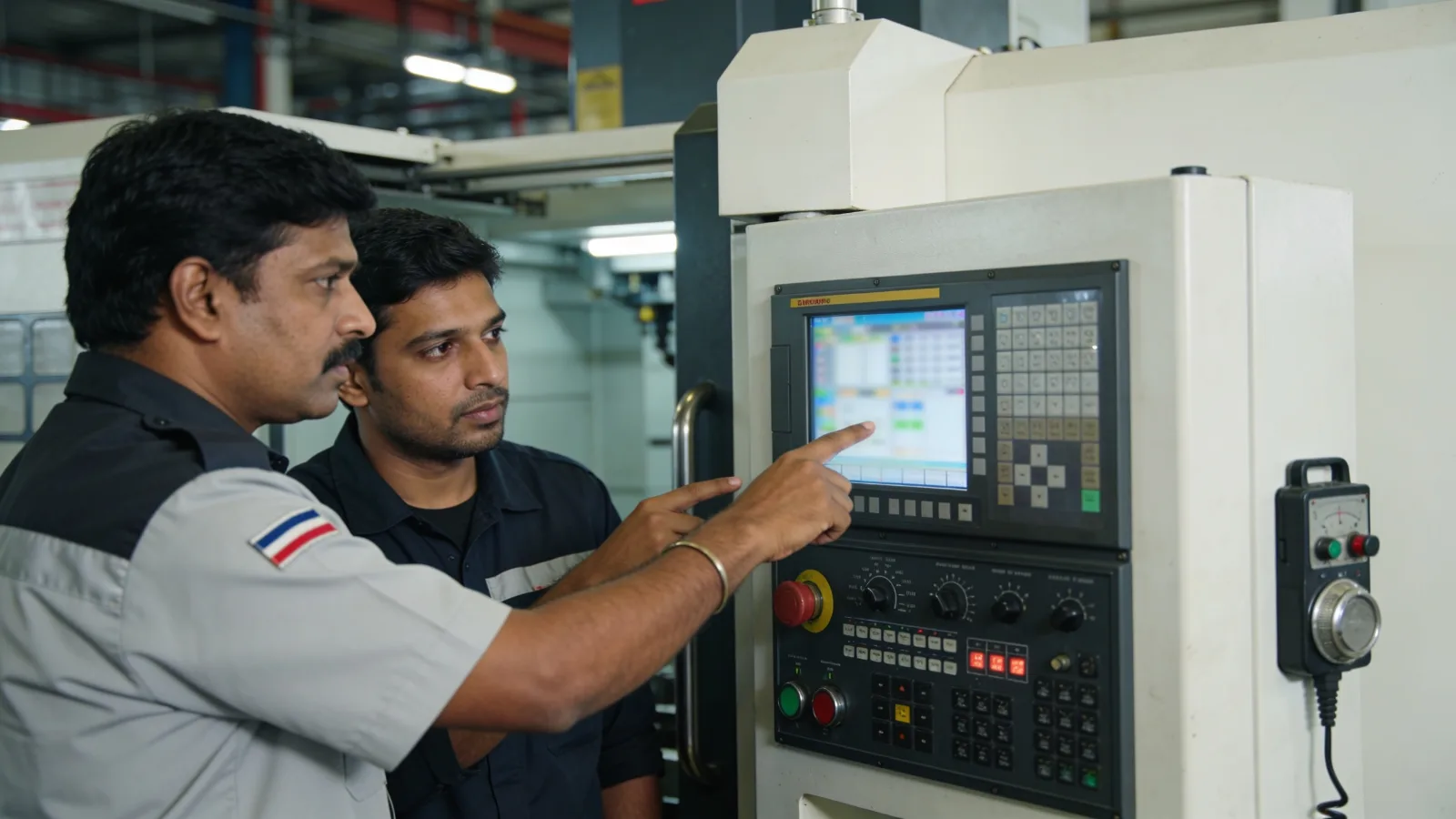
The situations that trigger reskilling
Reskilling is bought for a reason, not as general development. Each of these has a different programme shape.
- ✓New machine or automation: operators moved from manual to controlled process
- ✓Multi-skilling: one worker competent across three stations, for absorption of absence
- ✓Supervisor development: floor promotion into people, output and safety accountability
- ✓Quality behaviour: corrective training after a customer audit or rejection spike
- ✓Skill matrix and competence mapping per line, station by station
- ✓On-shift delivery so production is not stopped for training
- ✓Assessment, re-grading and the wage conversation that follows
Automation does not remove workers. It strands them.
A new line arrives, the manual operators cannot run it, and the plant hires externally while paying the existing workers to do less valuable work.
When the one person who can run the machine is absent, the station stops. There is no matrix, so nobody knows who could cover with two weeks of training.
While experienced workers who know your product and your quality standards stay stuck on a single station.
Station-by-station competence mapping, targeted multi-skilling, machine transition training delivered on shift, and a re-grading path so the worker has a reason to acquire the skill.
Plan a batch →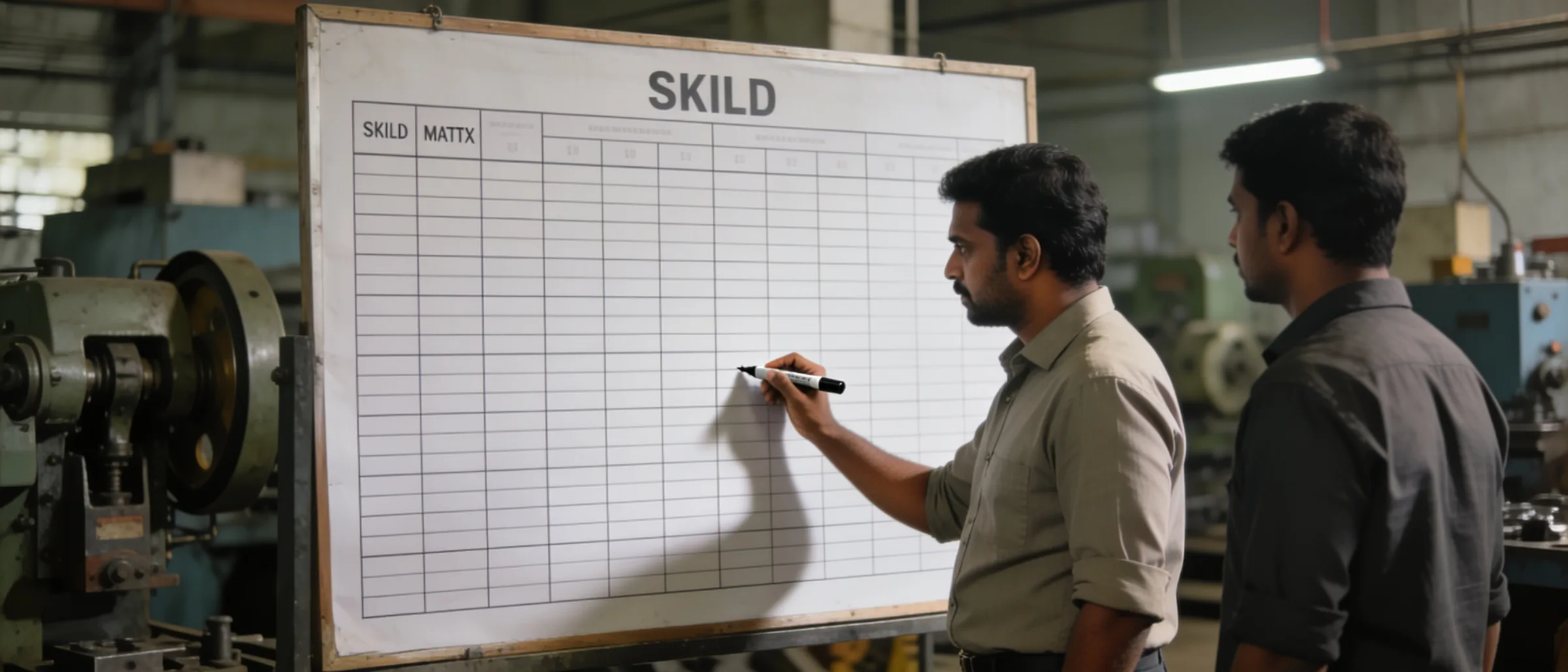
Assess, train, re-grade
Priced per worker per programme, or as a fixed plant-level engagement covering the matrix and a defined number of batches; the actual rates are set out in the rate card. The slider below uses an illustrative per-worker assumption, not our rate.
You cannot plan training without knowing who can do what today.
What a line skill matrix looks like
A skill matrix shows who can run which station, at what level. It is the first thing we build, because it turns 'we need training' into a list of named gaps. Levels: 0 not trained · 1 in training · 2 runs under supervision · 3 runs independently · 4 can train others.
| Worker | Station 1 — Loading | Station 2 — Press | Station 3 — Welding | Station 4 — Inspection | Stations at level 3+ |
|---|---|---|---|---|---|
| Operator A | 4 | 3 | 1 | 2 | 2 |
| Operator B | 3 | 3 | 0 | 0 | 2 |
| Operator C | 3 | 0 | 4 | 2 | 2 |
| Operator D | 2 | 2 | 0 | 3 | 1 |
| Operator E | 3 | 0 | 0 | 0 | 1 |
| People at level 3+ per station | 4 | 2 | 1 | 1 |
Illustration. A common rule is at least three people at level 3 or above for every station, so absence and leave never stop the line. In this example Welding and Inspection are single points of failure and Press is one person short — the programme starts there, not with whoever volunteers first.
Five reasons to reskill, five different programmes
Each trigger needs a different length, format and measure of success. Typical shapes:
| Trigger | Typical length | Format | Success measure |
|---|---|---|---|
| New machine or automation | 2–6 weeks per cohort | Vendor-led controls training plus supervised running on the new line | Output and rejection rate at target, unsupervised |
| Multi-skilling for absence cover | 2–3 weeks per additional station | On-shift pairing with a level-4 trainer, then assessment | Three people at level 3+ per station |
| Supervisor development | 6–12 weeks, modular | Short sessions on people handling, output planning, escalation and safety, plus on-floor coaching | Attrition and absenteeism in the supervisor's team |
| Quality behaviour after an audit | 1–2 weeks | Defect-specific training at the station that produced the finding | Repeat finding closed; rejection trend |
| Certification of experienced workers | Days, assessment-led | Recognition of Prior Learning (RPL) against an NSQF qualification, with gap training where needed | Certified workers for customer audits |
Training, working hours and wages under the Labour Codes
Upskilling existing workers raises questions that a new-intake programme does not. The points to settle before the first batch:
Training time is working time
Training your workers attend at your direction counts as work. Sessions outside the normal shift can take a worker over the daily limit, and overtime is payable at twice the ordinary rate under the Code on Wages.
New skill, new wage category
Minimum wages are notified by skill category — unskilled, semi-skilled, skilled, highly skilled. A worker re-graded after multi-skilling may move into a higher statutory minimum, which should be budgeted.
Free safety training
Instruction and training needed for safe operation of a new machine must be provided free of charge under the OSH Code, and before the worker runs it unsupervised.
Contract workers stay the contractor's employees
You can train a contractor's workers on your process, but assessment, re-grading and pay remain the contractor's decisions, to avoid blurring who the employer is.
No cost recovery from wages
Training cost cannot be deducted from wages. If you use a training agreement for expensive external certification, keep any recovery to a reasonable, documented cost and take advice first.
Retrenchment is not reskilling
The Worker Re-skilling Fund under the Industrial Relations Code applies to workers who are retrenched. Retraining the workers you keep is your own programme — and usually cheaper than retrenchment plus external hiring.
Why multi-skilling programmes stall — and what keeps them going
Most programmes do not fail in the classroom; they fade three months later. The patterns behind both outcomes:
Why they stall
- ✕No re-grading or allowance for the new skill, so volunteers dry up
- ✕Trained workers never rotated, so the skill decays within weeks
- ✕Supervisors not involved, so they keep using the same two people
- ✕Matrix built once and never updated
What keeps them going
- ✓A published re-grading policy linked to matrix levels
- ✓Planned rotation so each skill is used at least monthly
- ✓Supervisors scored on matrix coverage, not only output
- ✓Matrix reviewed monthly and after every joining or exit
Short on skilled people altogether? Build new supply with skill development programmes or apprenticeships, or bring in experienced operators through machine operator staffing.
Questions employers ask before starting a batch
Answers we give in the first call, written down so you can compare providers on the same terms.
Plan a batch →How is reskilling priced?+
Per worker per programme, or as a fixed plant engagement that includes the skill matrix and an agreed number of batches, with the rates set out in the rate card. Machine transition programmes cost more than behaviour or quality modules because of machine time.
Can training run without stopping production?+
Yes — that is the normal constraint. Batches are built around the roster, using shift overlaps, low-load periods and dedicated training bays, so the line keeps running while cohorts rotate through.
Do you train supervisors as well as operators?+
Yes, and it is often the higher-return programme. Supervisors promoted off the floor usually have no training in people handling, output planning, escalation or safety accountability, and the cost of that shows up as attrition beneath them.
What happens after a worker is multi-skilled?+
The skill matrix is updated and we recommend a re-grading or wage position. If competence brings no consequence, workers stop volunteering for the next batch and the programme dies quietly.
Can you train contract workers as well as permanent staff?+
Yes. For workers on our payroll it folds naturally into the deployment; for your own contractors' workers it runs as a separate programme, with the compliance boundaries kept clean.
Is training time counted as working hours?+
Yes, when workers attend at the employer's direction. If training takes a worker beyond the daily or weekly limit, the extra time is overtime, payable at twice the ordinary rate of wages under the Code on Wages.
Does multi-skilling change a worker's minimum wage?+
It can. Minimum wages are notified by skill category, so a worker re-graded from semi-skilled to skilled after training becomes entitled to the higher minimum for that category in your State. Check the rates in our minimum wage calculator.
Can experienced workers be certified without a full course?+
Yes, through Recognition of Prior Learning (RPL), where workers are assessed against an NSQF qualification and certified if they meet it, with short gap training where they do not. RPL is also offered under the government's skilling schemes.
Start with the skill matrix
Two weeks of mapping tells you which stations are single-point risks. The training plan follows from that, not from a catalogue.