
Rigger manpower supply — the half of a lift that gets forgotten.
Cranes get the attention and the audits, while the person choosing the sling and giving the signals is often the least screened member of the crew. Rigger manpower supply is what separates a planned lift from a lucky one. Godstone Consultech screens for sling selection, load estimation, hand signals and permit discipline, employs every worker on our own payroll, and keeps the PF, ESI, wage and contract-labour records — so the person on your floor is documented, replaceable and accountable from day one.
Lift profile, load range and crane types are enough to price.
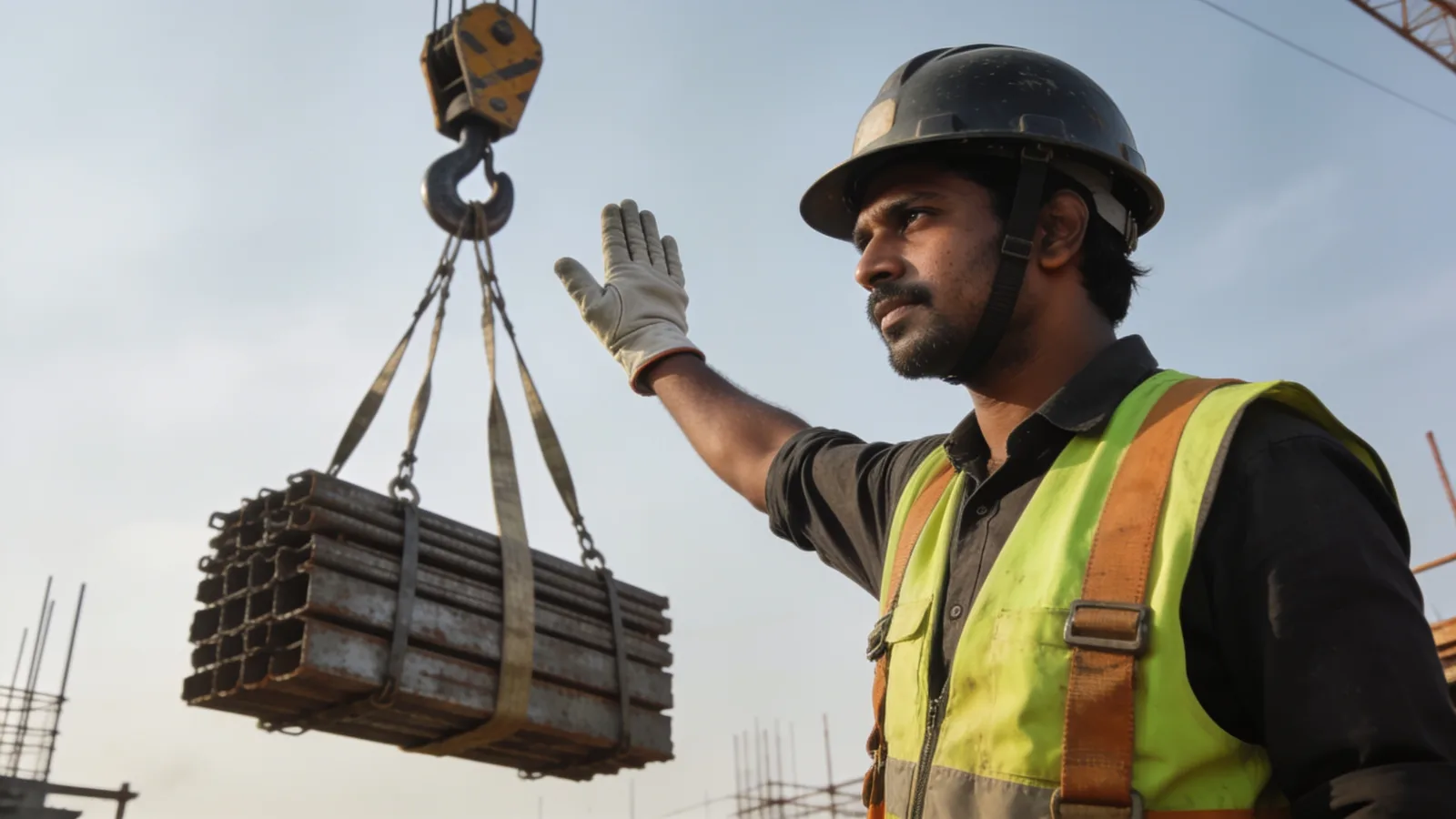
Slinging, signalling and lift execution.
Rigging is judgement work: sling angle, centre of gravity, tag lines, exclusion zones. We test that judgement before deployment and pair riggers with operators as a crew.
- ✓Sling, shackle and chain selection for the load
- ✓Load estimation and centre-of-gravity assessment
- ✓Standard hand signals and crane communication
- ✓Tag line handling and exclusion-zone control
- ✓Pre-lift inspection of tackle and lifting gear
Many lifting incidents start below the hook
Wrong sling, wrong angle, wrong signal: the failures that happen below the hook.
A helper is used as a rigger to save a wage band, selects a sling by eye and signals from a blind spot.
A dropped or swinging load damages equipment, injures people and stops a plant. The investigation asks for the rigger's competence record and the lift plan.
Sling selection and load estimation tested before deployment, signal competence verified, tackle inspected pre-lift and every lift run against a plan and a permit.
Get a rate card →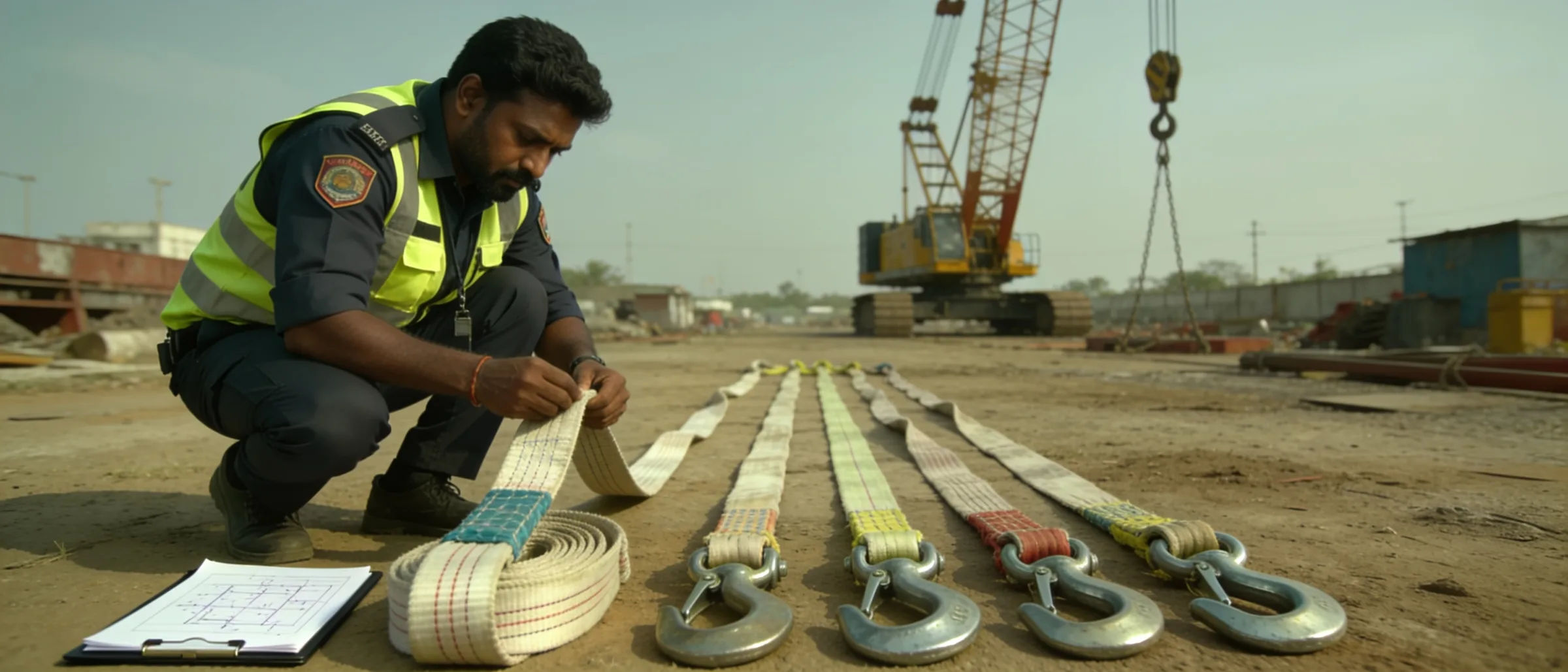
Screening, deployment and compliance
Move the slider for an indicative monthly bill for riggers at a ₹22,000 gross wage, statutory costs and an illustrative 12% service fee (an assumption for the estimate, not our rate; your fee is agreed in your contract). Firm rates follow your State's minimum wage for the skill category, the site and the shift pattern.
What clears before the worker reaches your gate.
What a rigger decides before every lift
The crane operator controls the crane; the rigger decides what is hung from it. For every lift the rigger estimates the load's weight and centre of gravity, chooses slings, shackles and spreaders with enough working load limit at the sling angle used, inspects the tackle, rigs the load to lift level, sets tag lines and the exclusion zone, and — as the one designated signaller — directs the operator. On heavy or critical lifts, a senior rigger works to a written lift plan.
IS 13367 (Part 1), the Indian code of practice for the safe use of cranes, treats the selection of slingers and signallers as seriously as the selection of drivers. Riggers are often confused with fitters and welders, who work alongside them:
Crane operators
Operators tested on the crane type and load charts, crewed with our riggers.
Crane operator staffing →Welders
Code-qualified welders for structures and piping on the same project.
Welder manpower supply →Rigging bands we supply
There is no single statutory rigger licence in India. Competence is proven by test, by experience and, where your site or client requires it, by a third-party rigger competency card.
| Band | Typical background | Works independently on | Usual minimum-wage category |
|---|---|---|---|
| Rigging helper (khalasi) | Trained on site | Carrying tackle, tag lines and packing under a rigger; no signalling | Semi-skilled |
| Rigger | 2+ years on plant or project lifts | Slinging routine lifts, tackle inspection, tag lines, standard hand signals | Skilled |
| Signalman / banksman | Rigger with signalling experience | Sole designated signaller for the crane, radio and hand signals, blind lifts | Skilled |
| Senior rigger / rigging foreman | 5+ years including heavy and tandem lifts | Lift plans, load-chart checks, tandem lifts, jacking, skidding and heavy equipment moves | Highly skilled |
Skill categories come from each State's minimum-wage notification under the Code on Wages, 2019; the mapping is typical, not universal.
The rigger test, station by station
Run with real tackle and, for signalling, a crane and operator. A failed tackle-inspection or signalling station means no offer.
Tackle inspection
Reject damaged gear from a mixed set: broken wires, kinks and bird-caging in wire rope, cut webbing, stretched chain links, deformed hooks, missing latches, unreadable tags.
Weight and centre of gravity
Estimate a steel item's weight from its dimensions (steel is about 7,850 kg per cubic metre), locate its centre of gravity and rig it to lift level.
Sling angles
Work out leg loads: on a two-leg sling each leg carries about 58% of the load at 60° to the horizontal, 71% at 45° and 100% at 30°. Pick slings and shackles with enough WLL.
Load chart
Read the crane's chart for a given radius and boom length, deduct hook block and rigging weight, and say whether the lift is inside capacity.
Signals
Give standard hand signals and radio commands to a live operator; set up tag lines and the exclusion zone.
Height and fitness
Harness use and anchor points for work at height, plus medical fitness where the work needs height clearance.
Senior riggers also prepare a lift plan for a critical lift — for example a tandem lift, a lift over live plant, or one close to chart capacity.
Lifting rules, PPE and the compliance behind each rigger
Lifting rules we brief and enforce
- ✓One designated signaller per lift; nobody else signals except an emergency stop
- ✓No one under a suspended load; exclusion zones barricaded
- ✓Lifting gear only if marked with its safe working load and within its periodic thorough examination by a competent person under State rules
- ✓Stop the lift on high wind, poor visibility or ground doubts under outriggers
PPE issued and checked
- ✓Helmet with chin strap, safety shoes and rigger gloves
- ✓High-visibility vest for the signaller
- ✓Full-body harness with double lanyard for work at height
- ✓Radio sets for blind lifts
Compliance we carry as employer
- ✓EPF and ESI enrolment before day one; ESI covers gross wages up to ₹21,000 a month, and employees' compensation cover applies above that
- ✓Wages at or above the State minimum for the category, paid by the 7th of the following month
- ✓Overtime at twice the ordinary wage rate on extended project days (OSH Code, section 27)
- ✓Journey allowance for inter-State migrant workers under OSH Code section 61, as the appropriate Government prescribes
Crew patterns and the wage basis
Plants usually need riggers on the day shift with call-out cover, since most planned lifts happen in daylight. Shutdowns and erection projects run longer days and sometimes nights, which means overtime at twice the ordinary rate beyond eight hours — budget it with the crew size. Rig crews work best as a fixed team with the same crane operator.
| Basis | Figure | Source and notes |
|---|---|---|
| Legal floor (example) | Haryana: skilled ₹18,501 a month, highly skilled ₹19,426 a month | Haryana notification effective 1 April 2026. Your State, zone and scheduled employment decide the real floor. |
| Karnataka | Skill-and-zone structure with steep increases, notified 22 May 2026 | Its legal validity is being contested; check before budgeting a site in Karnataka. |
| Market reference | Rigger average about ₹22,600 a month | Indeed India, only 12 reports (February 2026) — too small to be more than a rough guide. Kochi and Korba list as higher-paying locations. |
| Our estimator | ₹22,000 gross a month for a rigger | Planning figure. Signalmen and rigging foremen are quoted separately; project site allowances are extra. |
Indicative only, not an offer or a legal rate. State minimum wages apply and may not be set below the national floor wage the Central Government fixes under the Code on Wages. Check your State's rate with the minimum wage calculator.
What to hold riggers, and us, to
Lifts with a plan and permit
Share of lifts done with the required permit, and every critical lift with a signed lift plan. The target is all of them.
Dropped objects
Loads, tackle or tools dropped. The target is zero; every one is investigated.
Tackle inspection
Pre-use inspections logged and damaged gear quarantined the same day.
Crane waiting time
Crane time lost waiting on rigging — a measure of planning, not just speed.
Our service targets
We aim to deploy tested riggers in 7–12 working days, crew them with tested crane operators on request, and replace an exit within 15 days. Targets are written into the SLA schedule.
Rigger staffing FAQs
Testing, crane crews, tackle inspection, certification and cost basis.
Get a rate card →What is tested for a rigger before deployment?+
Tackle inspection, weight and centre-of-gravity estimation, sling-angle calculations, load-chart reading, hand signals with a live operator, and height and medical fitness where the work needs it.
Is there a licence for riggers in India?+
There is no single statutory rigger licence. Competence is shown by testing, experience and, where a site or client requires it, a third-party rigger competency card. IS 13367 (Part 1) sets out how slingers and signallers should be selected.
Do you supply riggers with crane operators?+
Yes, as a crew. A tested operator working with an untested rigger is a common weak point in lifting operations, so both are screened. See crane operator staffing.
Is lifting gear inspection part of the scope?+
Yes. Pre-use inspection of slings, shackles and chains against your register is part of the rigger's job, with defects taken out of service immediately. Periodic thorough examinations remain with the competent person your site appoints.
Can riggers work at height or in confined spaces?+
Where cleared. Height and confined-space work requires medical clearance and specific induction, both recorded per worker before deployment.
What is a critical lift?+
Sites define it, but it usually includes tandem lifts, lifts over live plant or people, lifts near the crane's chart capacity, and unusual loads. Critical lifts need a written lift plan prepared and supervised by a senior rigger.
Do you supply rigging crews for shutdowns?+
Yes, for fixed windows with a rigging foreman, alongside fitters and welders where the scope needs them. See project manpower supply.
How is rigger staffing priced?+
The gross wage for the band (at or above the State minimum), plus employer PF, EDLI and admin charges, ESI where gross is up to ₹21,000, bonus and gratuity provisions, overtime and site allowances, and the service fee. Project crews are often priced per crew for the window. See how staffing fees are calculated.
Planning a lift or a shutdown?
Send the role, headcount and site city. We aim to send an itemised rate card and deployment date within one working day.