
Retail and mall staffing for footfall that peaks on weekends and festivals
Retail staffing has two clocks: the weekday-to-weekend swing inside every store, and the festival and sale seasons that lift footfall for weeks at a stretch. We staff sales floors, cash counters and stock rooms alongside mall-side housekeeping, security and guest services — on rosters that follow footfall instead of fighting it.
Roles, headcount and site city. We aim to send a costed proposal within one working day.
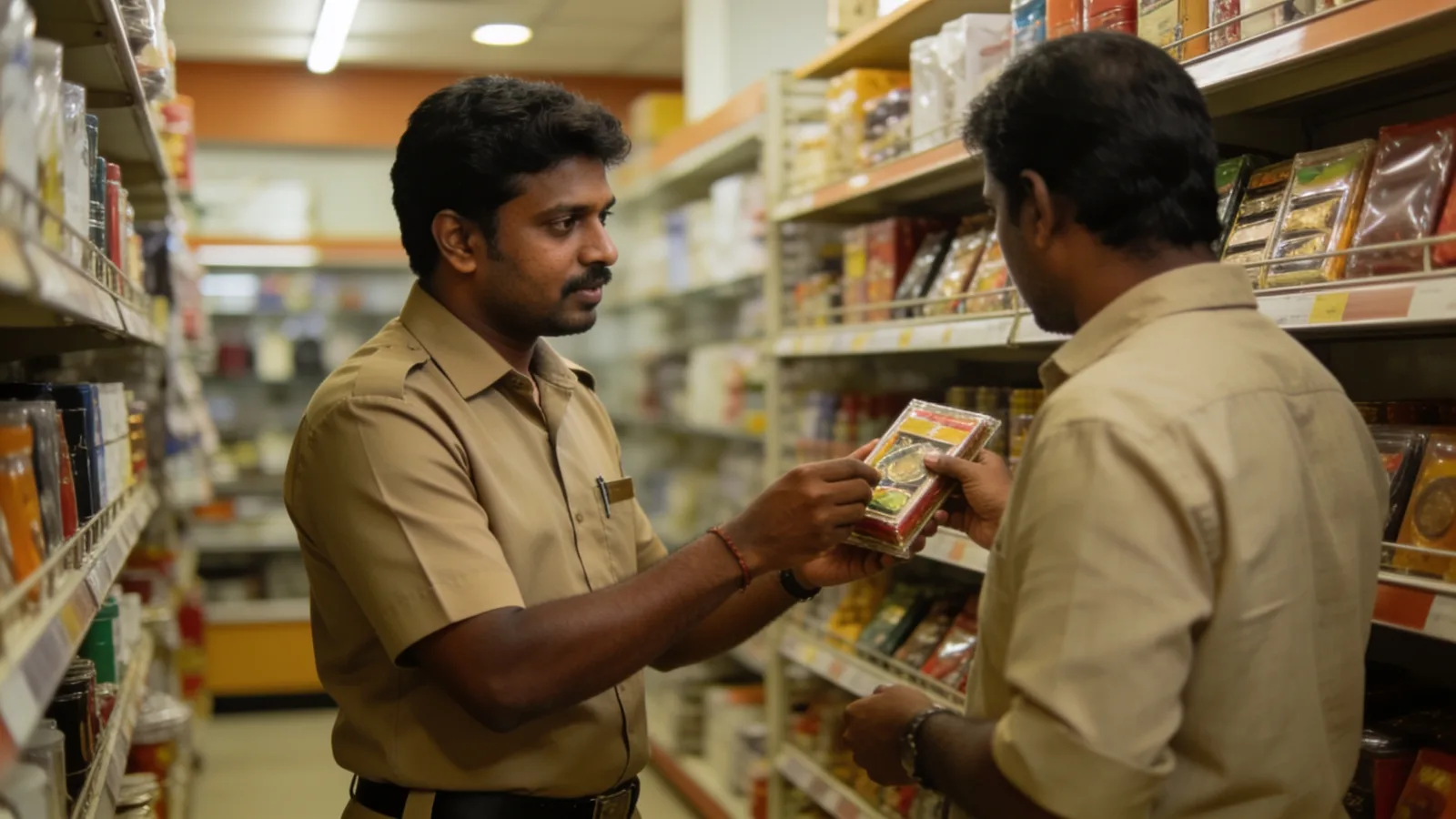
Store side and mall side
Brands buy store staff; mall operators buy the building's workforce. We supply both, and in mall locations that means one vendor coordinating with itself rather than two arguing.
- ✓Store: sales associates, cashiers, customer service desk, trial-room attendants
- ✓Stock: back-store handling, replenishment, inventory counts, shrinkage control
- ✓Visual merchandising: VM assistants, window and display changeover teams
- ✓Promotions: brand promoters, activation staff, sampling and demo teams
- ✓Mall operations: housekeeping, washroom attendants, waste management crews
- ✓Security: manned guarding, CCTV monitoring and fire response, supplied through a PSARA-licensed agency
- ✓Guest services: helpdesk, valet, parking management, concierge, pram and locker desks
Weekend footfall arrives whether the roster planned for it or not
Retail concentrates its revenue into weekends and festival weeks. A store staffed evenly across seven days is overstaffed on Tuesday and losing sales on Saturday.
Queues at the till, no one on the floor to convert a browser, and trial rooms unattended during exactly the hours the store makes its money.
Plus grooming and service standards that slip when untrained temporary staff are dropped in during the busiest week of the year.
Weekend and daypart uplift staffing, a festival ramp trained before the season starts, and a backfill we aim to complete within 48 hours so a store is never left short.
Get a quote →Retail roles, what we screen for and how pay is set
A cashier and a brand promoter need different people. We screen each role for the one thing that goes wrong most often in it, before a store manager ever meets the candidate.
| Role | What they do | Screening before deployment | Pay basis (indicative) |
|---|---|---|---|
| Sales associate | Greets, assists and converts on the floor; fitting-room and size support | Walk-in interview in the store's language(s), role-play on a customer approach, grooming check | State minimum wage for shops and commercial establishments plus sales incentive; job-portal averages about ₹15,800 a month nationally, higher in metros |
| Cashier / billing executive | POS billing, returns and exchanges, card and UPI reconciliation, till handover | Numeracy test, POS trial, background check, cash-handling SOP signed | State minimum wage (semi-skilled or clerical grade); job-portal averages about ₹15,400 a month |
| In-store promoter (brand) | Represents one brand inside a multi-brand store; demos, sell-out reporting | Product-knowledge test after training, sell-out app trial | Fixed wage plus sell-out incentive set by the brand |
| Visual merchandising assistant | Window and floor changeovers to planograms, signage, launches | Portfolio or practical set-up task, night-shift availability for changeovers | Market-linked; above store-floor rates for experienced VM |
| Stock / back-store associate | Receiving, tagging, replenishment, cycle counts | Scanner and count accuracy trial, background check | State minimum wage (unskilled / semi-skilled) |
| Mall housekeeping and washroom attendants | Common-area cleaning, washroom upkeep, waste segregation | Practical cleaning test, chemical-safety briefing | State minimum wage (unskilled); see housekeeping staffing |
| Valet, parking and helpdesk | Car handling, parking flow, directions and complaints | Driving licence and road test for valets, language and grooming for helpdesk | State minimum wage for drivers (skilled) or clerical grades |
Indicative only; job-portal averages from Indeed India salary pages (2026). Minimum wages are notified by each State and revised periodically — check the current rate in our minimum wage calculator. Mall security must be supplied by an agency licensed under the Private Security Agencies (Regulation) Act, 2005 in that State — see security staffing.
What State law allows for late closing, weekly offs and women on night shifts
Store hours, weekly holidays and night work in retail are governed by each State's Shops and Establishments law, alongside the OSH Code, which since 21 November 2025 lets women work before 6 am and after 7 pm with their consent and the safeguards the State prescribes. Mall stores that close at 10 or 11 pm cross those lines every night, so the roster has to be built for it.
| State | Late-hours position for women (summary) | What the roster must provide |
|---|---|---|
| Tamil Nadu | Notification of 8 May 2025 allows establishments with 10 or more persons to stay open 24×7 for three years from 5 June 2025; women between 8 pm and 6 am only with written consent | Written consent, transport for women on late shifts, protection of dignity and safety, rest rooms |
| Maharashtra | Shops and Establishments (Regulation of Employment and Conditions of Service) Act, 2017: women between 9.30 pm and 7 am only with written consent | Consent, safe transport, adequate protection, grievance and POSH arrangements |
| Karnataka | A 2026 amendment to the Shops and Commercial Establishments Act dropped several detailed night-transport and security safeguards; the remaining statutory conditions continue | Written consent and the remaining conditions; transport remains good practice |
| Kerala | Women between 9 pm and 6 am with written consent, in groups of at least five that include at least two women | Consent, group rostering and transport to the doorstep |
Summary for planning, not legal advice. State notifications change and some are time-bound — we check the current notification for each store's State before the roster goes live. Overtime beyond the daily or weekly limit is paid at twice the ordinary rate of wages, and every worker gets the weekly holiday the State law requires, even when weekly offs are staggered across weekdays.
Worked example: staffing the weekend without paying for it on Tuesday
Take a mall store open 10 am to 10 pm, seven days a week, that needs four people rostered each weekday and seven on Saturday and Sunday. Staggering weekly offs across Monday to Thursday and adding a weekend block covers the peak with fewer people than a flat roster.
Flat roster at weekend strength
7 people a day × 7 days = 49 person-days a week. At six working days per person, 49 ÷ 6 = 8.2; with a 10% absence allowance, 9 people on payroll.
Footfall roster
(5 weekdays × 4) + (2 weekend days × 7) = 34 person-days. 34 ÷ 6 = 5.7; with the same 10% allowance, 7 people, with weekly offs taken Monday to Thursday.
What changes
Two fewer people on payroll for the same weekend coverage, and weekday staff stop standing idle. Part-time weekend blocks can close the gap further where the State allows, paid at no less than the minimum hourly or daily rate.
Illustrative arithmetic. We build the real roster from your hourly billing or footfall data, including the lunch-break and spread-over rules of the State.
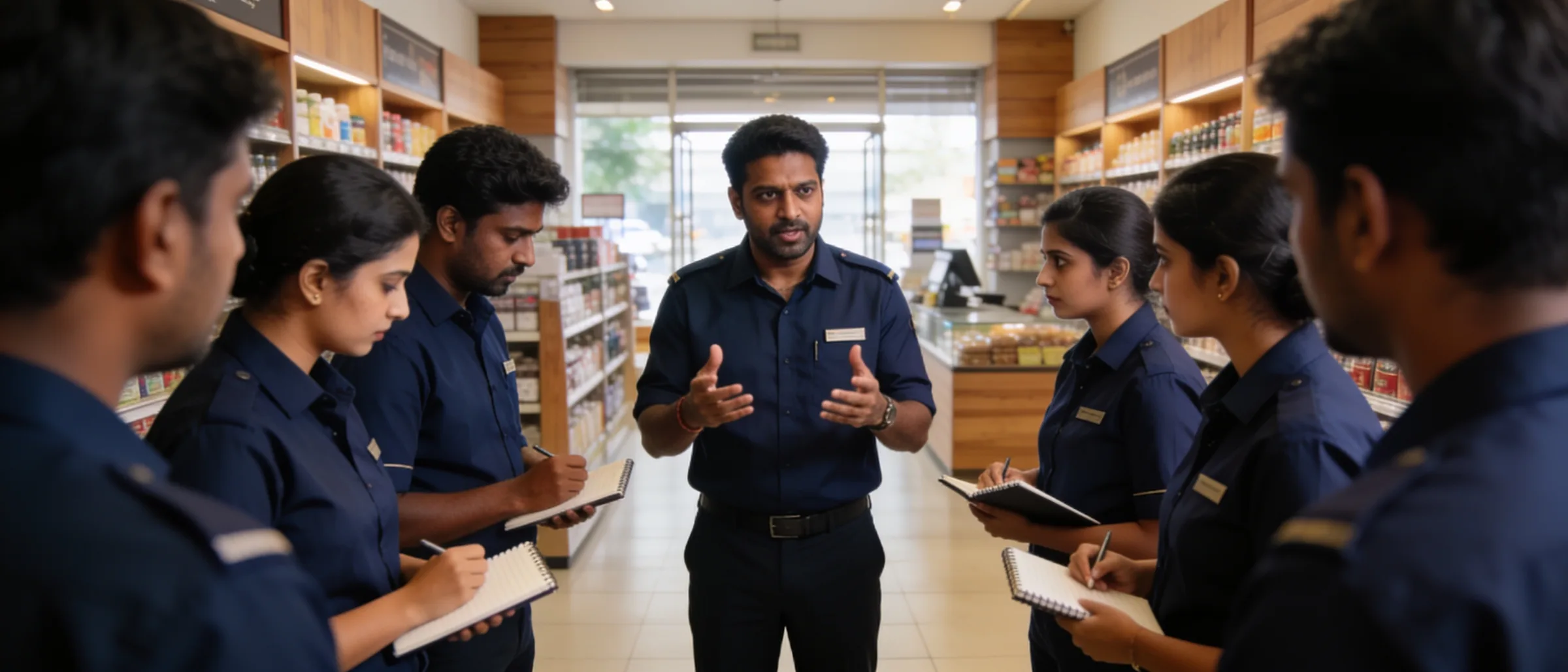
Store rosters, seasons, mall scope
Billed on the loaded wage (wage plus employer PF, ESI and other statutory costs) plus a service fee. Festival and weekend uplift is priced on the same terms as base deployment when it is planned in advance.
Assumes an average monthly gross of ₹17,000 across store and mall-side roles. Promoter incentives and uniforms are billed at actuals.
Store-level rosters built from your own footfall and billing data.
The retail calendar is known a year ahead — staff it that way
Diwali falls on Sunday, 8 November 2026. Regional peaks — Onam in Kerala, Durga Puja in the East, Pongal in Tamil Nadu in mid-January — move footfall State by State, and the end-of-season sales in summer and at year-end create their own rush for billing and stock teams. The ramp works back from each date:
Store-wise demand from your sales calendar: extra heads per store, per week, per role.
Returning seasonal staff called first; walk-in drives near each cluster of stores.
Grooming, greeting, product and POS training; background checks closed for cash roles.
Shadow shifts with your store teams so day one of the sale is not anyone's first day.
Daily attendance by store, a floating pool for no-shows, overtime paid at twice the rate.
Planned release at the end of each fixed term, or conversion of the best performers through temp-to-hire.
Where retail staffing contracts usually go wrong
Deductions have legal limits
Under the Code on Wages, a deduction for lost cash is allowed only where the loss is directly attributable to the worker's neglect or default, after the worker has had a chance to explain, and total deductions in a wage period cannot exceed 50% of wages. We run a till SOP — opening float, handover counts, variance log — so shortages are traced, not guessed.
Separate the counters from the sellers
Cycle counts done by stock staff, not the associates whose floor is being counted; background checks closed for every cash and stock role before day one; bag-check rules agreed with mall security and applied to everyone, including our staff.
Three parties, one person
A brand promoter is paid by the brand, deployed by us and works under the store's rules. Agree in writing who approves attendance, which store rules apply, how incentives are computed from sell-out data, and how a harassment complaint reaches an Internal Committee under the POSH Act.
Need the compliance side checked? See statutory compliance and background verification.
KPIs you can hold us to
Targets are agreed store by store in the SLA schedule. What we report on from the first week:
- ✓Staff present at store opening and at the weekend peak, by store
- ✓Time to backfill an absence or exit (we aim for 48 hours)
- ✓Training and background checks complete before the first shift
- ✓30-day and 90-day retention of new joiners
- ✓Grooming and service audit scores, where you run mystery shopping
- ✓Till variance incidents and how each was closed
- ✓Salary on the agreed date; PF and ESI challans shared each month
When contract retail staff is the wrong answer
- —Store and cluster managers. They carry your P&L and your brand; hire them through permanent recruitment.
- —A single store with steady footfall. Two or three permanent associates on your own rolls will usually cost less than a managed service.
- —Specialist selling — fine jewellery, high-end electronics, luxury — where months of product training walk out with the person. Use contract staff for the peak, not the core team.
Questions operations and HR heads ask us
Answers we give in the first call, written down so you can compare vendors on the same terms.
Get a quote →Do you staff brand stores, mall operations, or both?+
Both. Store-side sales, cash, stock and visual merchandising teams for brands and retailers; mall-side housekeeping, valet, parking and guest services for mall operators and facility managers. In a mall, one vendor across both sides means one roster and one escalation point.
How do you handle festival season staffing?+
As a planned ramp worked back from your sales calendar: returning seasonal staff called first, grooming, greeting and POS training done before the season, and shadow shifts in the last week so nobody's first day is the first day of the sale.
Can women staff work until the store closes at 10 or 11 pm?+
Yes, with their written consent and the conditions the State prescribes — typically safe transport home, security and rest facilities. Time windows differ: in Tamil Nadu the line is 8 pm, in Maharashtra 9.30 pm. We check the current State notification and build transport into the roster before offering late shifts.
Can a cashier's salary be cut for till shortages?+
Only within the Code on Wages: the loss must be directly attributable to the cashier's neglect or default, the cashier must get a chance to explain, and total deductions in a wage period cannot exceed 50% of wages. A proper till SOP with handover counts prevents most disputes.
Is grooming and customer service training included?+
Yes, before deployment — grooming standards, greeting and service protocol, queue and fitting-room handling, and POS familiarisation where the role involves billing. Brand-specific product training is run with your trainers or material.
Can staff work part shifts around peak hours?+
Yes. Weekend and evening peak blocks are common in retail. Pay is at least the State minimum for the hours or days worked, weekly-holiday rules still apply, and PF and ESI are applied as the law requires for each person.
Do you supply in-store promoters for brands?+
Yes — brand promoters, sampling and demo teams and activation staff, on our payroll, with attendance and sell-out reporting per store. We agree attendance approval, store rules and incentive calculation in writing with the brand before deployment.
Who supplies mall security guards?+
Private security must come from an agency licensed under the Private Security Agencies (Regulation) Act, 2005 in the State where the mall is, with guards who have completed the prescribed training. Ask any vendor for the licence for that State before signing.
How quickly can you replace a store absence?+
We aim to backfill within 48 hours, using a floating pool planned for the weekend peak. Every backfill is reported by store, so you can see where absences cluster and fix the cause rather than the symptom.
Related roles and services
Staff the weekend, not the average
Send store list and footfall pattern. We will propose rosters that follow the curve and a festival ramp plan.