
Power press operator staffing where safety discipline is the first test.
Press shops lose fingers, not just parts, and incident reports keep tracing back to the same two causes: a bypassed guard or an untrained hand on the feed. That makes press operators the riskiest role to staff carelessly. Godstone Consultech screens for guarding and interlock discipline, two-hand control use and feed accuracy, employs every worker on our own payroll, and keeps the PF, ESI, wage and contract-labour records — so the person on your floor is documented, replaceable and accountable from day one.
Press tonnage, feed type and shift pattern are enough to price.
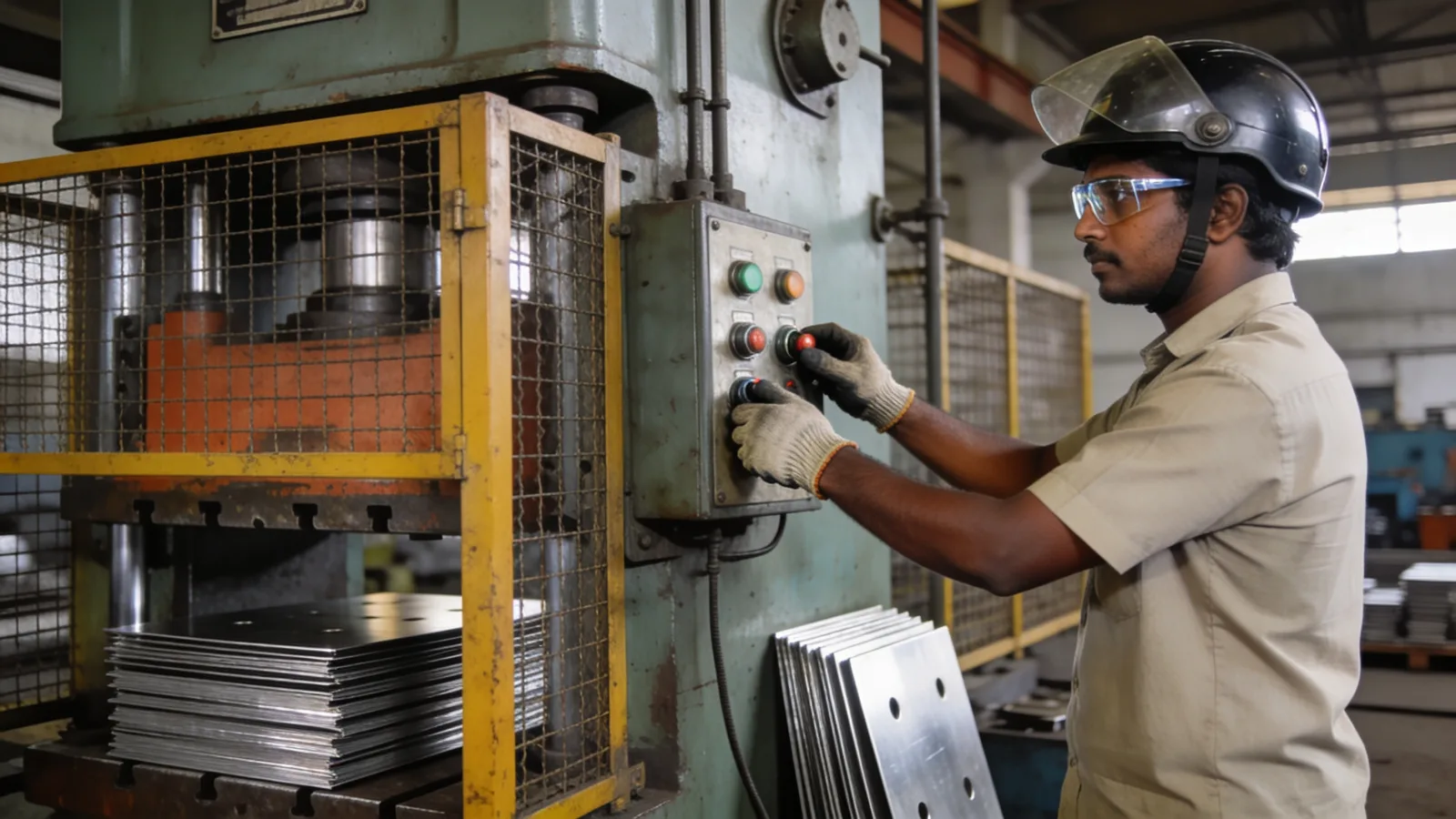
Blanking, forming, feed accuracy and die changes.
Press work is guarded work. We screen for operators who will not bypass a control to make rate, then induct on your specific guarding, light curtains and die-change protocol.
- ✓Blanking, piercing and forming operations
- ✓Coil and strip feeding with accuracy checks
- ✓Two-hand control and light-curtain compliance
- ✓Die-change support and first-part approval
- ✓Scrap segregation and bin discipline
Press shop incidents follow a familiar script
Production pressure, a bypassed guard, an operator who was never trained on why it exists.
A new operator is put on a press with a jammed light curtain because the shift target was behind, and no one had inducted them on the interlock at all.
An injury stops the line, triggers a factory inspection and a claim, and permanently changes the cost of that press. Add scrap and die damage from inaccurate feeding.
Guarding and interlock discipline screened before deployment, site-specific safety induction recorded per operator, and a supervisor who stops the press rather than the paperwork.
Get a rate card →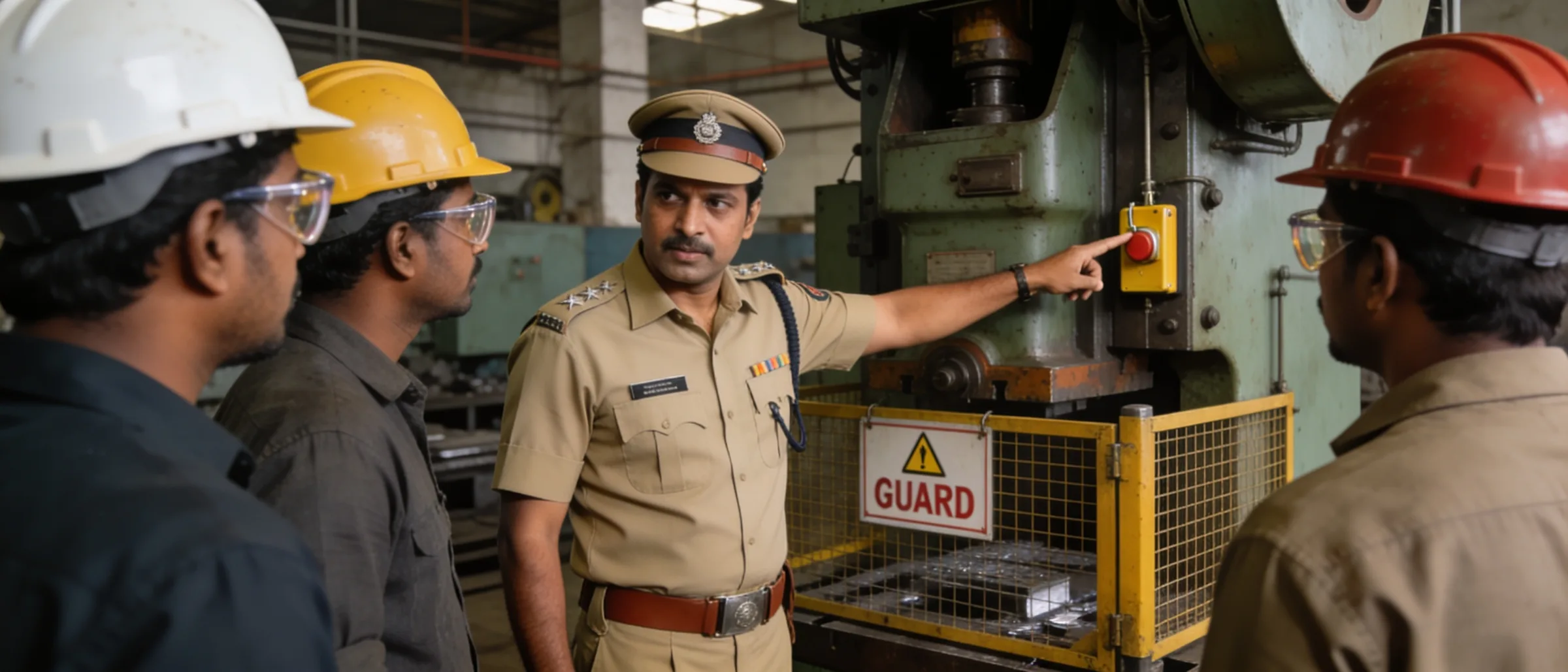
Screening, deployment and compliance
Move the slider for an indicative monthly bill for press operators at a ₹19,500 gross wage, statutory costs and an illustrative 12% service fee (an assumption for the estimate, not our rate; your fee is agreed in your contract). Firm rates follow your State's minimum wage for the skill category, the grade and the shift pattern.
What clears before the worker reaches your gate.
What a power press operator does, and where the risk sits
A power press operator feeds blanks or strip into mechanical, hydraulic or pneumatic presses for blanking, piercing, bending, forming, drawing and coining, then removes the part, checks it and clears scrap. On coil lines the operator watches the feeder, straightener and misfeed sensors instead of hand-feeding. The danger zone is the point of operation between punch and die, and almost every serious press injury happens when a hand is inside it while the ram can still move.
The die setter installs and proves the tools, and in some States (Maharashtra, for example) must be trained and entered in a register before doing so. We staff operators, press brake operators and die setters as separate grades. Related roles:
Injection moulding operators
Plastic moulding, where the hazards are heat, hydraulics and the mould area.
Moulding operator staffing →Machine operators
Lathes, drilling, grinding and special-purpose machines in general machine shops.
Machine operator staffing →Press shop grades we staff
Tell us the press types and tonnage range. Manual-feed presses, coil lines and CNC press brakes need different people.
| Grade | Typical background | Works independently on | Usual minimum-wage category |
|---|---|---|---|
| Press operator (manual feed) | 10th pass or ITI, trained on site; must be 18 or older | Feeding with hand tools, two-hand control operation, part check, scrap clearing | Semi-skilled |
| Coil-line operator | ITI or 1–3 years on progressive dies | Coil loading, feeder and straightener settings, misfeed recovery with the press isolated | Semi-skilled or skilled |
| Press brake operator | ITI Fitter or Sheet Metal Worker, 2+ years | Back-gauge setting, bend sequence, angle check, CNC press brake programmes | Skilled |
| Die setter | ITI Fitter or tool and die background, 4+ years | Die setting with safety blocks, shut height and stroke, clamping, trial and first-off approval | Skilled or highly skilled |
Skill categories come from each State's minimum-wage notification under the Code on Wages, 2019; the mapping is typical, not universal.
The press operator test, station by station
A single bypass behaviour at any station — reaching past a guard, tying down a button — ends the test. It is not a coaching point.
Guard recognition
Identify fixed barrier guards, interlocked guards, light curtains and two-hand controls, and explain what each prevents.
Two-hand control and single stroke
Operate the press correctly, spot a tied-down button or an unguarded foot pedal, and explain why continuous mode is never used for hand feeding.
Feeding with hand tools
Feed and remove parts using pushers, pickers, tongs or magnets, with hands kept out of the die space.
Part check
Check burr height, cracks, missing holes and key dimensions with vernier or gauge; segregate and tag rejects.
Stop, isolate, report
State what to do on a double stroke, misfeed, unusual noise or damaged guard: stop, isolate, report, and never attempt the fix alone.
Fitness and age
Vision and reaction screening, and age proof checked from ID. Nobody under 18 is deployed on a press.
Die setters also demonstrate safety-block insertion, power isolation, inching, shut-height setting and a guarded trial run.
Power press rules, PPE and who is responsible for what
Safe plant and machinery, including guarding, is part of the employer's general duty under section 6 of the OSH Code, 2020. Until each State notifies its own OSH rules, earlier State factory rules continue where they are not inconsistent — and several contain a dedicated power-press schedule. Maharashtra's Schedule VIII-A under Rule 57 of the Maharashtra Factories Rules, 1963 (added in 2017) is a clear example.
What a power-press schedule requires (Maharashtra example)
- ✓Fixed barrier guard, interlocked guard or presence-sensing device at the point of operation
- ✓Two-hand controls placed at a safety distance D = 1.6 m/s × the press's hazard time T (in seconds)
- ✓Operators aged 18 or above; die setters trained and entered in a register
- ✓Thorough examination by a competent person: the press every 12 months, safety devices every 6 months
- ✓Safety block between punch and die, and power isolated, while setting dies
PPE issued and checked
- ✓Cut-resistant gloves and arm sleeves for sheet handling
- ✓Safety shoes with toe protection for blanks and dies
- ✓Safety glasses
- ✓Hearing protection — press shops are often above safe noise levels; follow your noise survey
Who owns what
- ✓You, as occupier: guards, safety devices, examinations and safe systems of work
- ✓Us, as employer: age and fitness checks, training records, PPE issue, wages, ESI or employees' compensation cover
- ✓Both: accident reporting and joint investigation, written into the scope document
- ✓Contract-labour registers under the OSH Code (which replaced the CLRA Act, 1970), shared monthly
Other States have their own schedules and forms; we check the rules for your site's State before deployment.
Shift patterns and the wage basis
Hand-fed press work is repetitive, and attention fades late in a long shift. We recommend 8-hour shifts with rotation between presses rather than 12-hour shifts on one machine. The OSH Code caps ordinary hours at eight a day in any case, and hours beyond that are overtime at twice the ordinary rate.
| Basis | Figure | Source and notes |
|---|---|---|
| Legal floor (example) | Haryana: semi-skilled ₹16,781 a month, skilled ₹18,501 a month | Haryana notification effective 1 April 2026. Your State, zone and scheduled employment decide the real floor. |
| Karnataka | Skill-and-zone structure with steep increases, notified 22 May 2026 | Its legal validity is being contested; check before budgeting a site in Karnataka. |
| Market reference | Machine operator average ₹18,113 a month; typical range ₹9,417–₹34,839 | Indeed India, 383 reports, updated May 2026. There is no separate press-operator series; die setters sit toward the top of the range. |
| Our estimator | ₹19,500 gross a month for a press operator | Planning figure. Press brake operators and die setters are quoted separately. |
Indicative only, not an offer or a legal rate. State minimum wages apply and may not be set below the national floor wage the Central Government fixes under the Code on Wages. Check your State's rate with the minimum wage calculator.
What to measure a press operator, and us, against
Guard checks completed
Pre-shift guard and safety-device checks signed off for every press, every shift. The leading indicator that matters most.
Near-miss reports
Near misses reported and closed. A shop reporting none is usually not looking.
Strokes and rejection
Strokes per hour against standard, and rejection ppm for burr, cracks and dimensions.
Die change time
Minutes from last good part to first approved part, measured per die setter.
Our service targets
We aim to send a test plan and rate card within one working day, deploy inducted operators in 7–10 working days, and replace an exit within 15 days. Targets are written into the SLA schedule.
Three press shop staffing mistakes to avoid
Paying for strokes without guard checks
Output incentives without a guard-check gate reward bypassing. Tie any incentive to zero bypass findings.
Letting operators set dies
Die setting needs trained setters, safety blocks and isolation — and in some States a register entry.
Skipping the examination records
Check that presses and safety devices are within their examination dates before contract operators start.
Power press operator staffing FAQs
Safety screening, legal checks, die setting, incidents and cost basis.
Get a rate card →What safety screening do press operators go through?+
Guard recognition, two-hand control and light-curtain use, safe feeding with hand tools, stop-isolate-report drills, fitness and age checks, then a site-specific induction recorded per operator before the first shift. Bypass behaviour is a disqualifier, not a coaching point.
Can a contract worker operate a power press?+
Yes, if the worker is 18 or older, trained on that press and its safety devices, and the press is guarded and within its examination dates under your State's rules. Those conditions apply to contract and direct workers alike.
Do operators support die changes?+
Only at support level — handling with the setter, first-part checks and clean-up. Die setting is done by trained die setters, who are screened and priced separately.
How often must power presses be examined?+
It depends on the State. Under Maharashtra's power-press schedule, a competent person must examine each press every 12 months and its safety devices every 6 months. We check your State's requirement before deployment.
Who is responsible if there is an incident?+
We are the employer and carry employment obligations such as ESI or employees' compensation cover, training records and reporting. Machine guarding and plant safety systems remain the occupier's responsibility. The scope document draws the line explicitly.
Do you supply press brake operators?+
Yes, as a separate grade. Press brake operators are tested on back-gauge setting, bend sequence and angle checks, including CNC press brake programmes where you run them.
How fast can a press shop be staffed?+
We aim for 7–10 working days, in waves for larger requirements, with safety induction completed before any operator reaches a machine.
How is press operator staffing priced?+
The gross wage for the grade (at or above the State minimum), plus employer PF, EDLI and admin charges, ESI where gross is up to ₹21,000, bonus and gratuity provisions, agreed night-shift or heavy-tonnage allowances, and the service fee. See how staffing fees are calculated.
Press shop running short?
Send the role, headcount and site city. We aim to send an itemised rate card and deployment date within one working day.