
BPO and ITES staffing measured on the seats filled, not the CVs sent
Contact centre hiring is a throughput problem. To hold a hundred seats live you have to hire against attrition, shrinkage and training drop-out every single month — which means a pipeline that runs continuously, communication assessment matched to the process the agent will actually handle, and batches that show up on the training start date. We recruit for domestic and international voice, chat, email and back-office processes, and for the team leaders, QA, trainers and WFM analysts who keep a floor stable.
Roles, headcount and site city. We aim to send a costed proposal within one working day.
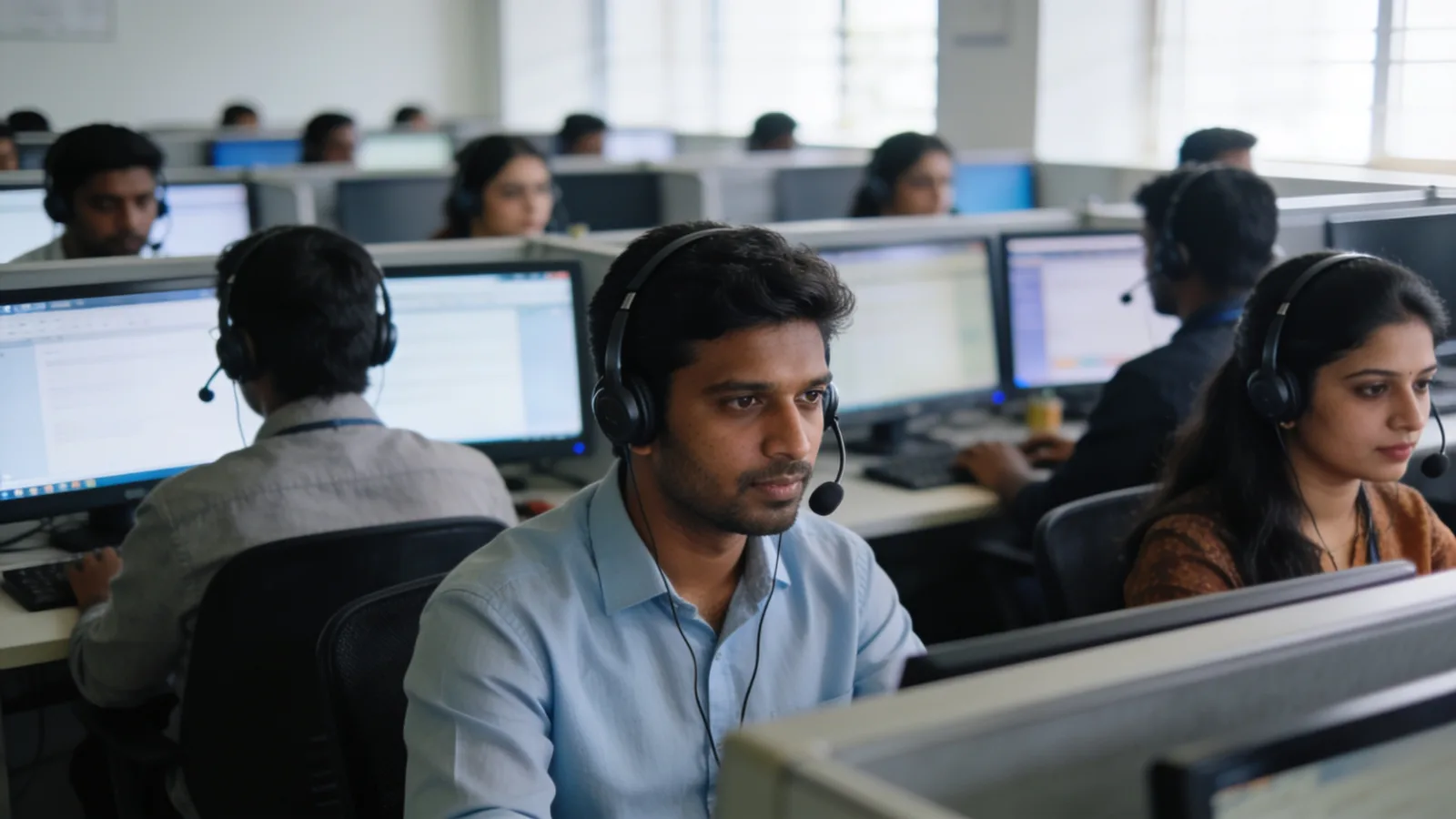
BPO and ITES roles we recruit for
Volume sits in agents; stability comes from the support layer. Hiring only agents and starving team leads and QA is why floors churn.
- ✓Voice: inbound customer service, outbound sales, collections, retention
- ✓Non-voice: chat, email, social media support, moderation
- ✓Back office: data entry, claims and document processing, KYC verification
- ✓Domain: healthcare RCM, insurance claims, finance and accounting support
- ✓Support layer: team leaders, quality analysts, trainers, workforce management
- ✓Multilingual: Hindi, Tamil, Telugu, Kannada, Malayalam, Bengali, Marathi
- ✓Facility side: housekeeping, security, front desk, transport coordination
What each contact-centre role is screened for, and what it typically pays
Pay bands below are indicative monthly gross figures for metro contact centres in 2026, drawn from published salary surveys and job-portal data. Actual offers move with city, language, shift allowance, incentive design and the State minimum wage, which is always the floor. We benchmark every mandate against live offers in your city before the first drive.
| Role | What we screen for | Usual shift pattern | Indicative gross / month |
|---|---|---|---|
| Domestic voice agent | Regional language plus Hindi or English fluency, listening, basic CRM navigation | Day or rotational, 6 days | ₹14,000–₹22,000 |
| International voice agent | Graded spoken English, accent neutrality, US/UK/AU process knowledge, empathy on a mock call | Night or late-evening, 5 days, cab provided | ₹25,000–₹45,000 |
| Chat / email agent | Written English, grammar, typing speed with accuracy, handling two or three concurrent chats | Rotational, often 24×7 | ₹16,000–₹28,000 |
| Back-office / transaction processing | Accuracy on a sample file, Excel basics, attention to detail, domain basics for claims, KYC or RCM | Day shift or client time zone | ₹14,000–₹24,000 |
| Quality analyst | Call audit on recorded samples, calibration, feedback writing, COPC-style parameters | Aligned to the process shift | ₹24,000–₹38,000 |
| Team leader | Floor handling of 12–20 agents, AHT and CSAT coaching, roster discipline, escalation handling | Aligned to the process shift | ₹30,000–₹48,000 |
| Process trainer | Teach-back on a real module, TNI, certification design, nesting support | Day, plus nesting overlap | ₹30,000–₹55,000 |
| WFM / MIS analyst | Erlang-based forecasting, scheduling, real-time adherence, advanced Excel or a WFM tool | Day, with real-time desk rotation | ₹30,000–₹60,000 |
Indicative only, not an offer benchmark. Night-shift and language allowances, incentives and cab cost sit on top. For an employer-cost view including PF, ESI and bonus, see the CTC breakup calculator.
Every empty seat is billed revenue you cannot invoice
A seat sold to a client and unmanned for three weeks is margin gone, and a service level missed is a contractual conversation you should not be having in month two.
A drive fills the floor in January, and by March attrition and training drop-out have taken a fifth of it back. The next drive starts only when the shortfall becomes visible in service levels.
Plus training batches that start at 60% strength because nobody engaged the joiners between offer and day one.
Rolling drives, assessment that predicts on-floor performance, engagement between offer and training start, and a batch-strength target set for the date your trainer actually needs them.
Get a quote →A 100-seat ramp, counted back from go-live
New processes miss go-live because hiring starts when the contract is signed instead of when the training calendar is fixed. This is how we plan a typical 100-seat voice ramp with a three-week classroom phase and a one-to-two-week nesting phase. The funnel sizes are planning assumptions; we replace them with your process's real conversion and drop-out ratios after the first batch.
Calibrate the profile
Listen to live calls with your operations head, fix the pass mark for the language test, agree shift, cab zones, salary band and the documents needed for background checks.
Run the funnel
Walk-in and virtual drives, referral campaigns and job-portal sourcing sized so that roughly 600–800 screened applicants yield 130–140 offers for 100 seats. Assessment results are shared daily.
Hold the joiners
Offer letters, document collection, background verification started, cab routing, and weekly contact with every joiner so that counter-offers surface before day one, not on it.
Backfill and certify
Drop-outs in week one are backfilled from the buffer list while the batch can still absorb them. Certification results feed the next drive's pass mark, and the 30/60/90-day survival of each batch is reported to you.
Running continuous hiring for several processes at once? A dedicated RPO team or a bulk hiring programme is usually cheaper per joiner than one-off drives.
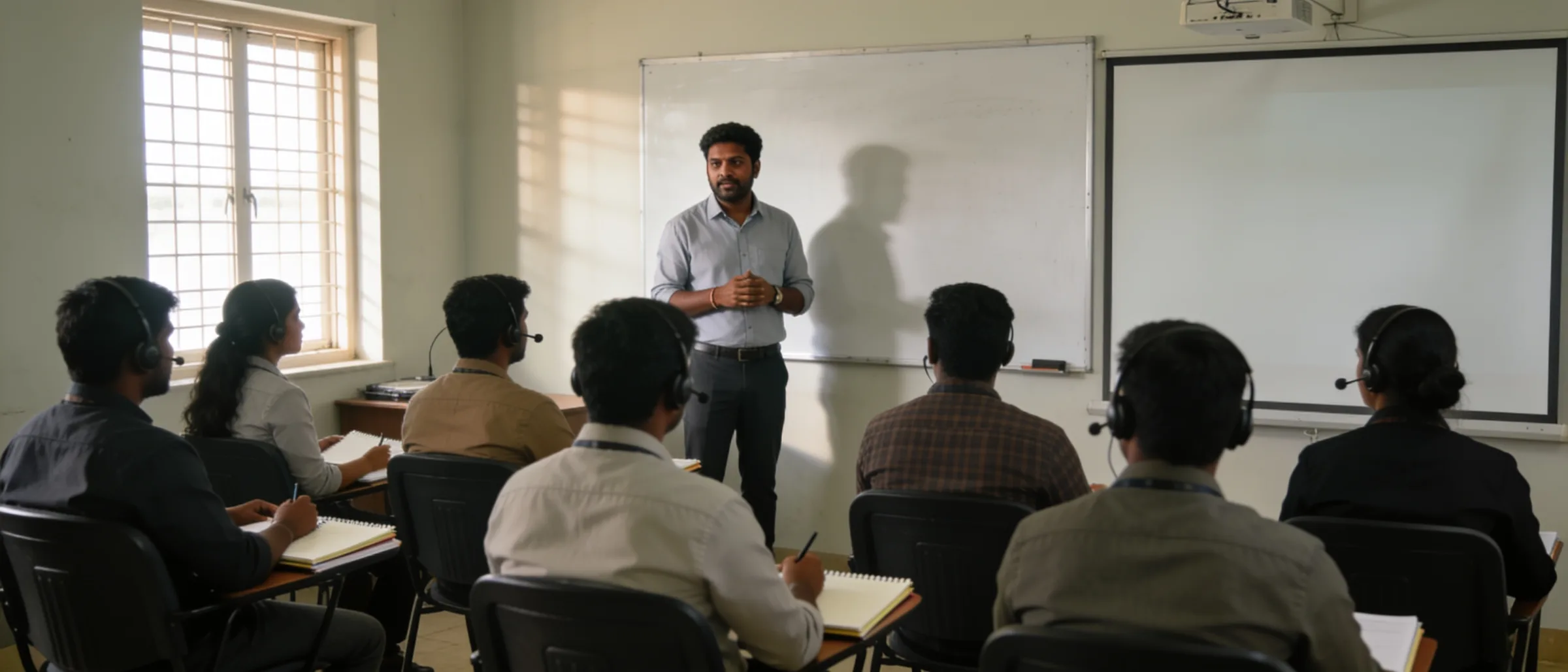
How agents are assessed, batched and retained
Priced per joined candidate for direct hiring, or per agent per month where the agents sit on our payroll. The slider gives an indicative monthly bill for agents on our payroll at an average gross of about ₹23,000 a month (a blended domestic and non-voice mix), plus statutory costs and an illustrative service fee. International voice, team leader and WFM roles price higher; night-shift cabs are billed separately.
Every candidate is assessed against the process they will handle, and the pass marks are calibrated with your operations head before the first drive.
What an international or 24×7 process has to get right
The four Labour Codes have applied since 21 November 2025, and most contact-centre working-hour rules now come from the OSH Code read with your State's Shops and Establishments law and its IT/ITES or 24×7 exemption conditions. State rules are still being notified, so the exact conditions depend on where the floor sits. This is the checklist we work through with you before the first night batch.
Women on night shifts
Section 43 of the OSH Code allows women to work before 6 am and after 7 pm with their consent, subject to the safety, holiday and working-hour conditions the State sets. Tamil Nadu's 24×7 permission for establishments with 10 or more employees (extended on 8 May 2025 for three years from 5 June 2025), for example, requires written consent for work between 8 pm and 6 am, transport, rest rooms and a functioning Internal Committee.
Transport and safety
Home pick-up and drop for night shifts, verified drivers, route plans that avoid a woman employee being the first picked up or last dropped alone, a security escort where required, GPS tracking and a transport notice at the entrance. We map cab zones before the drive so offers go to people who can actually be routed.
Hours, overtime and weekly offs
Rosters are built to the 48-hour weekly limit with a weekly rest day; work beyond the daily or weekly limit is overtime paid at twice the ordinary wage rate. Rotational rosters, shift allowances and comp-offs are written into the appointment letter, which the OSH Code now requires for every employee.
POSH, data and telecom
An Internal Committee under the POSH Act is mandatory once you have 10 or more employees. Agents handle personal data, so NDAs, clean-desk rules and access controls should match your DPDP Act obligations as data fiduciary. On the telecom side, DoT's June 2021 OSP guidelines removed OSP registration and the domestic/international distinction, and non-voice processes fall outside them.
General information, not legal advice. For a review of your own site conditions, see our labour law advisory and statutory compliance services.
Which model fits which seat
Contract staffing is not always the right answer for a contact centre. If agents run your core, permanent process, the OSH Code's rule on contract labour in core activities (section 57) needs a considered answer, and many operators keep those agents on their own rolls and use us to hire them. Contract deployment fits best for pilots, seasonal peaks, client-funded ramps and support functions.
| Model | Who employs the agent | Best for | Watch-outs |
|---|---|---|---|
| Permanent hiring | You, from day one | Core processes, team leaders, QA, trainers, WFM | Attrition and backfill stay with you; agree a replacement window |
| Contract staffing | Godstone, deployed to your floor | Pilots, peaks, client-funded ramps, facility and support roles | Core-activity rule; contractor licence once 50 or more contract workers; you stay principal employer |
| Fixed-term on your rolls | You, for a defined term | Contracts with a known end date | Same wages and benefits as permanent staff; gratuity after one year |
| Temp-to-hire | Godstone first, then you | New processes where on-floor performance should decide who is converted | Fix the conversion window and fee in the contract up front |
KPIs to write into any BPO staffing contract
Ours included. We aim to report these weekly, per batch, so you can compare vendors on the same numbers.
- ✓Offer-to-join and training show-up ratio against the batch plan
- ✓Certification pass rate at the end of classroom training
- ✓30, 60 and 90-day survival for each batch
- ✓Backfill turnaround for exits in the first 90 days
- ✓Wage and statutory payments made on time, with challans shared monthly
Red flags when choosing a BPO hiring partner
Most of the cost of a bad vendor shows up in month two, as early attrition and complaints.
- ✕Candidates charged a "registration" or "training" fee
- ✕Profiles sent without assessment scores or voice samples
- ✕Offers that hide shift timings, targets or cab zones
- ✕A per-agent rate that cannot cover the State minimum wage plus PF, ESI and bonus
- ✕No written replacement terms and no per-batch retention reporting
BPO staffing questions operations and HR heads ask
Answers to the questions we hear most in first calls, written down so you can compare vendors on the same terms.
Get a quote →How is BPO staffing priced?+
Two ways. For direct hiring onto your rolls, a fee per joined candidate with an agreed replacement window. For agents employed by us and deployed to your floor, a monthly per-agent bill made up of gross wages, statutory costs (PF, ESI, bonus and gratuity provision), our service fee and night-shift cabs where applicable, with GST charged on the whole invoice. The second model also moves attrition backfill and payroll administration to us.
How many candidates do we need to screen to fill 100 seats?+
It depends mostly on the language bar. International voice processes reject far more applicants at the spoken-English stage than domestic or back-office processes do. For a first ramp we plan on roughly 600 to 800 screened applicants and 130 to 140 offers for 100 seats, then replace those assumptions with your process's real ratios after the first batch.
Can you hire multilingual agents?+
Yes. We hire for Hindi, Tamil, Telugu, Kannada, Malayalam, Bengali and Marathi processes, with proficiency graded on a spoken test by a native speaker, and we grade English separately for international processes.
How do you improve training show-up rates?+
By treating the weeks between offer and day one as part of the job: regular contact with every joiner, documents and background checks started early, cab routing confirmed before joining, and a buffer list sized from your own offer-to-join ratio. Drop-outs in the first week of training are backfilled while the batch can still absorb them.
Do you hire team leaders, quality analysts, trainers and WFM analysts?+
Yes, and floors that skip this layer tend to churn faster. These roles are usually hired onto your rolls as permanent placements, with a call-audit exercise for QA, a floor-scenario interview for team leaders, a teach-back for trainers and a forecasting task for WFM analysts.
Does a BPO still need OSP registration from DoT?+
No. The Department of Telecommunications' revised Other Service Provider guidelines of 23 June 2021 removed the registration requirement for OSP centres and the distinction between domestic and international OSPs. Entities not running voice-based processes are outside those guidelines altogether. Your telecom and network set-up still has to meet the remaining conditions in the guidelines.
Can women work night shifts in an international voice process?+
Yes, with their consent and subject to the conditions your State sets. The OSH Code (section 43) permits it, and State Shops and Establishments exemptions add conditions such as written consent, transport, security and a functioning Internal Committee. We plan cab routing and consent records before the first night batch.
Can you handle a 300-seat new-site ramp?+
We would run it as a dated mobilisation plan tied to your training calendar: rolling drives, batch-wise assessment, buffer offers and backfill, with facility-side staffing for housekeeping, security and front desk arranged alongside. Tell us the seat plan and training dates and we will send the batch schedule.
What is the difference between BPO and ITES staffing?+
BPO staffing covers customer-facing and transaction-processing roles such as voice, chat, email and back office. ITES is the wider term and also includes IT helpdesk, application support and data operations. For those technical roles on contract, see our IT and back-office contract staffing page.
Tell us the seat count and the training calendar
We will size the pipeline against your real attrition and set a batch-strength target for each training start date.