
Renewable energy staffing for sites two hours from the nearest town
Solar and wind projects are staffed where nobody lives. Construction needs hundreds of hands for a few months in a remote district; O&M then needs a small, skilled crew to stay there for twenty years. Both are logistics and retention problems as much as hiring problems.
Roles, headcount and site location. We aim to send a costed proposal within one working day.
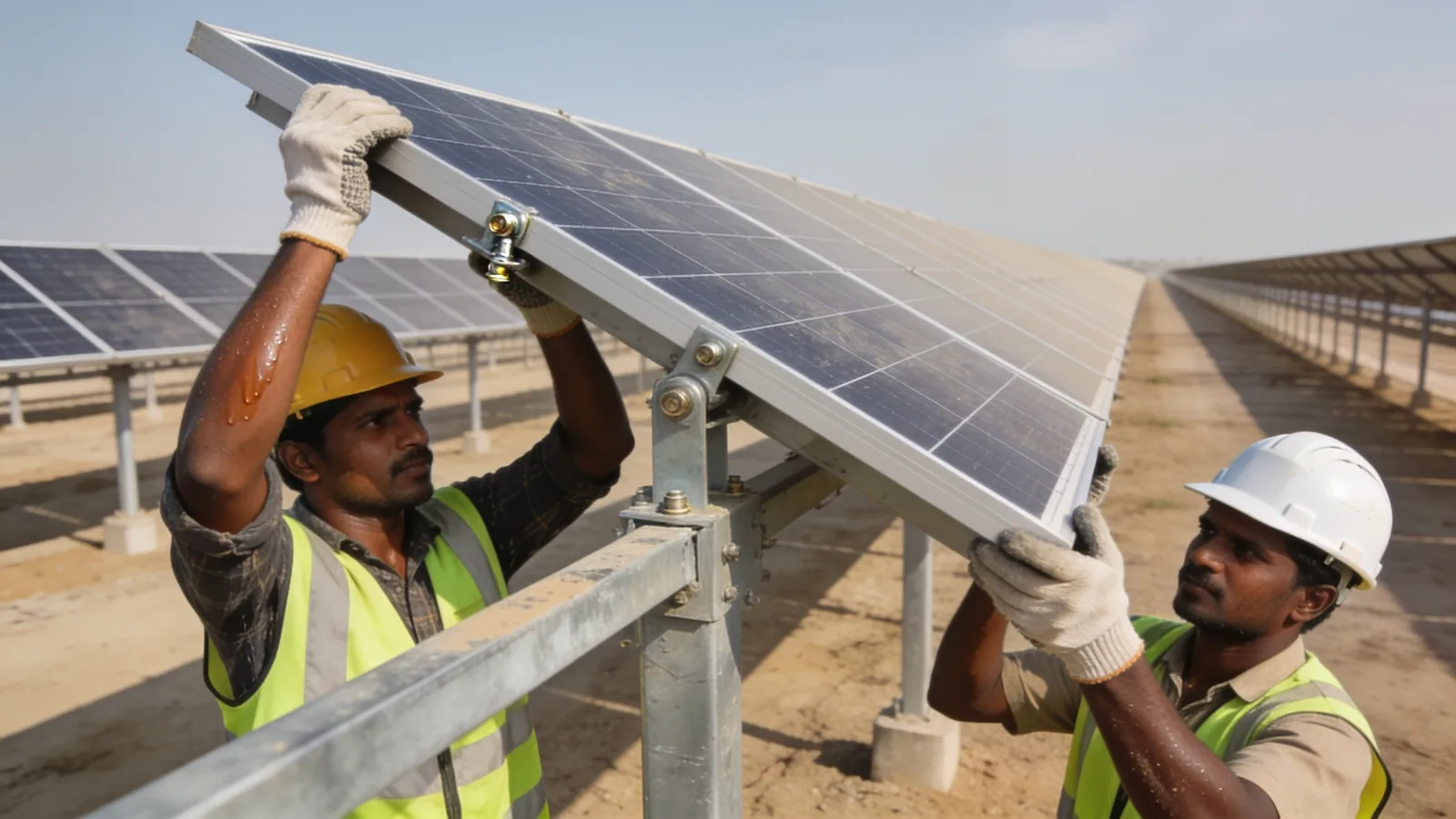
Construction crews and operating crews
EPC and O&M are different businesses with different labour models, and vendors that treat them the same fail at one of them.
- ✓EPC civil: piling, structure erection, tracker assembly, module mounting crews
- ✓Electrical: DC string wiring, inverter and transformer installation, AC cabling
- ✓Substation: switchyard erection, testing and commissioning support, HV work
- ✓Commissioning: string testing, IV curve and thermography support, punch closure
- ✓O&M solar: site technicians, module cleaning teams, inverter and SCADA monitoring
- ✓O&M wind: turbine technicians, blade inspection support, gearbox and yaw maintenance
- ✓Site support: store keepers, security, camp management, safety officers, HSE stewards
The site is remote, so the labour problem is a logistics problem
Skilled workers do not live near a solar park. Getting them there, housing them, keeping them safe and keeping them for the full contract is the actual scope.
Either way the ramp fails: local labour cannot do string wiring or HV work, and imported crews leave within weeks if the camp, food and pay discipline are poor.
Plus penalty exposure under the EPC contract and PPA timeline, and O&M crews who resign because nobody planned for living conditions.
Crews built to the task list with certification verified, camp and transport arranged, heat-stress and electrical safety protocols enforced, and O&M crews recruited from the region so they actually stay.
Get a quote →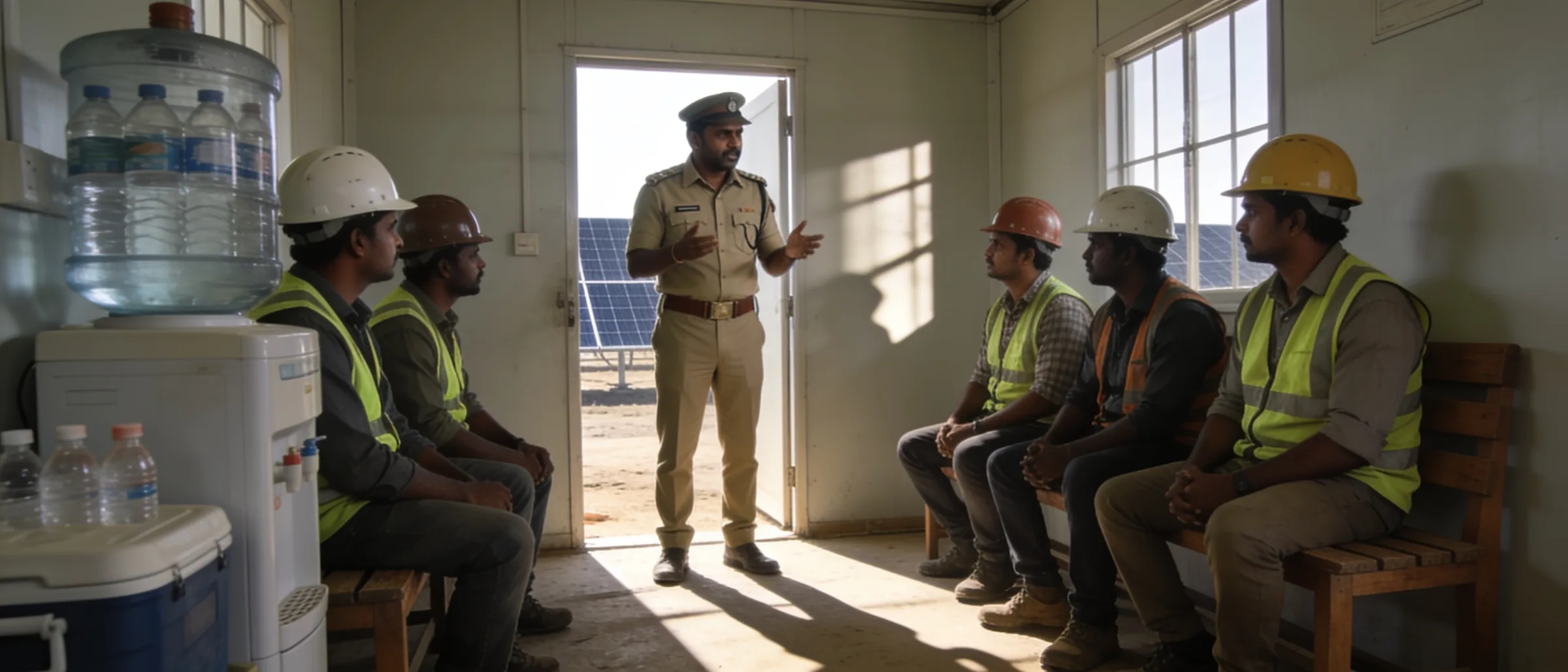
EPC mobilisation, safety, O&M
EPC crews are billed per crew per day or per MW of scope; O&M teams are billed on loaded wage plus service fee on long-term deployment.
Construction manpower is a project, dated to your MW milestones.
Where renewable capacity is being built
India's target of 500 GW of non-fossil capacity by 2030 is being built mostly in a few high-resource districts, far from the cities where skilled electricians live.
Western Rajasthan
Utility solar around Bhadla, Jodhpur, Bikaner and Jaisalmer, plus wind; extreme summer heat and long travel from towns.
Kutch and north Gujarat
Very large solar and hybrid parks around Khavda, wind in Kutch, and module and cell factories around Mundra and Ahmedabad.
Pavagada and Tumakuru
Large solar park capacity in Karnataka's dry interior, with local farmer-landowner communities often wanting site jobs.
Southern Tamil Nadu
Wind belts around Kanyakumari, Tirunelveli and Theni, and utility solar in Ramanathapuram and Thoothukudi.
Rayalaseema and Telangana
Solar parks around Kurnool and Anantapur, and module manufacturing around Hyderabad.
Madhya Pradesh and Maharashtra
Utility solar at Rewa and Neemuch, floating solar at Omkareshwar, and wind in western Maharashtra.
EPC crews and O&M crews need different staffing models
Construction is a short, intense ramp; operations is a small crew for decades. Treating them the same is how most renewable staffing goes wrong.
| EPC construction | O&M operations | |
|---|---|---|
| Duration | A few months per site, ramping to peak and back | The life of the asset, often 25 years |
| Crew logic | Gangs sized to the MW schedule: piling, structures, modules, DC and AC cabling | Small fixed crew per site with roster cover for leave and rotation |
| Sourcing | Skilled trades brought in, unskilled work offered locally first | Recruited from the surrounding region so people stay |
| Billing | Per crew per day or per MW of measurable scope | Loaded wage plus service fee, monthly |
| Key credentials | Electrical licence for HV work, work-at-height training, crane and rigging competence | Electrical licence, inverter and SCADA training, GWO training for wind |
| What breaks it | Camp, food, water and late wages | Isolation, no career path, no leave cover |
The credentials we check before a worker reaches site
On a renewable site the serious hazards are high voltage, height, heat and heavy lifts. These are the credentials we verify for each.
| Role | Credential we look for | Why it matters |
|---|---|---|
| HV and substation electricians | State-issued electrical licence, certificate of competency or wireman permit | The CEA (Measures relating to Safety and Electric Supply) Regulations 2023 restrict electrical work to authorised, competent persons |
| Solar PV installers and technicians | Suryamitra or Skill Council for Green Jobs PV installer certification, preferred rather than mandatory | Correct string wiring and connector crimping prevent DC arcs and rework |
| Wind technicians | GWO Basic Safety Training, plus turbine-maker courses | Tower climbing and nacelle work are the highest-risk tasks on a wind farm |
| Crane operators and riggers | Operator licence or certificate for the crane class, rigging training | Module, inverter and transformer lifts; wind component lifts |
| All site workers | Medical fitness, heat-stress induction, PPE issue | Summer temperatures in solar districts regularly cross 40°C |
Distributed rooftop programmes need a different crew
The PM Surya Ghar: Muft Bijli Yojana aims to put rooftop solar on one crore homes, alongside a growing commercial and industrial rooftop market. That work is many small jobs across a district, not one large site.
Small, mobile crews
Two- to four-person installation teams with a vehicle, kit and a supervisor covering several jobs a week.
Local electricians first
Licensed local electricians trained on PV installation, earthing and net-metering paperwork, so crews do not need camps.
Rooftop safety
Working at height on residential roofs without scaffolding is the main risk; anchor points, harnesses and ladder discipline are part of induction.
Service after install
Crews retained for inspection, cleaning and inverter fault calls after the installation wave passes.
Questions project and HR heads ask us
Answers we give in the first call, written down so you can compare vendors on the same terms.
Get a quote →Can you mobilise crews to a remote solar site?+
Yes, and mobilisation includes the logistics: travel, camp identification, food and water arrangements and transport. Remote-site failures are almost always logistics failures, not sourcing failures.
How is EPC construction manpower billed?+
Per crew per day, or against MW of installed scope where the work packages are measurable. Overtime, night work and travel are agreed before mobilisation.
Do you staff long-term O&M at operating plants?+
Yes — site technicians, inverter and SCADA monitoring staff, module cleaning teams and security, recruited from the surrounding region because retention over a twenty-year asset life depends on it.
Do you supply wind turbine technicians?+
Yes, including technicians holding Global Wind Organisation (GWO) Basic Safety Training — first aid, manual handling, fire awareness and working at heights — for nacelle and tower work, blade inspection support and mechanical maintenance crews. OEM-specific training is added as your turbine maker requires.
How do you handle safety in extreme heat?+
Shift timing adjusted to avoid peak heat, mandatory hydration and rest protocols, shaded rest points and heat-stress awareness training, with incident and near-miss reporting maintained for your HSE file.
Do solar electricians need a licence in India?+
Anyone doing electrical installation work must be authorised and competent under the Central Electricity Authority (Measures relating to Safety and Electric Supply) Regulations 2023, which in practice means a State-issued electrical licence, certificate of competency or wireman permit, depending on the State and voltage. We verify these before HV and substation work.
Can you staff rooftop solar installation under PM Surya Ghar?+
Yes, with small mobile crews built around licensed local electricians, trained on PV installation, earthing, working at height on roofs and net-metering documentation. Crew size is planned against your monthly installation target per district.
Do you staff solar module and cell factories as well as sites?+
Yes. Module lines need operators for stringing, lay-up, lamination, framing and testing, and they run like electronics plants rather than construction sites. See our electronics and manufacturing staffing pages for how factory deployment works.
Send the MW schedule and the site location
We come back with a crew plan, camp and transport logistics, the safety protocol and a dated mobilisation sequence.