
Oil and gas staffing where the permit system is the job
In a refinery or terminal, nothing happens outside a permit. Hot work, confined space, height, isolation — the crew that cannot work inside that system is not a resource, it is a hazard. We supply trades and operations manpower with certification, medicals and HSE training verified before anyone reaches the gate.
Roles, headcount and site location. We aim to send a costed proposal within one working day.
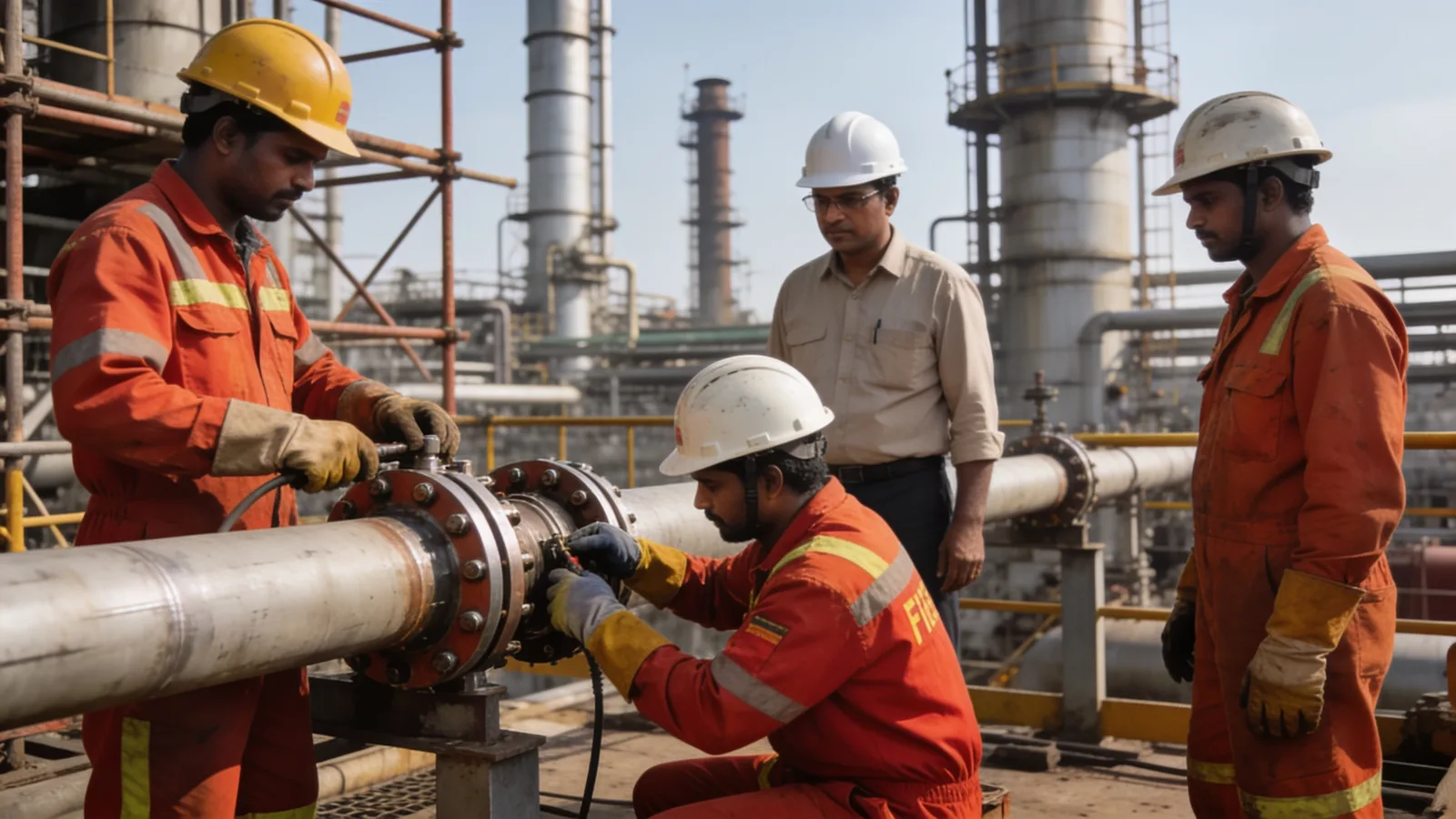
Roles across refinery, pipeline and terminal
Turnaround work is project manpower; terminal and pipeline operations are long-term deployment. Both are HSE-gated and document-heavy.
- ✓Turnaround trades: 6G welders, fitters, riggers, scaffolders, insulators, painters
- ✓Mechanical: static and rotating equipment maintenance, heat exchanger crews
- ✓Electrical and instrumentation: field technicians, calibration, cable and tray work
- ✓Confined space: vessel entry crews, hole watch, gas testing support
- ✓Terminal operations: tank farm operators, loading and unloading gantry crews, TLF
- ✓Pipeline: right-of-way crews, welding fronts, cathodic protection support, patrolling
- ✓HSE support: safety stewards, fire watch, first aid, permit coordination assistance
In hydrocarbons, a shortcut is not a delay risk, it is a fatality risk
Every serious refinery incident report contains a line about a worker who was not trained for the task, or a permit condition that was treated as paperwork.
Hot work started without fire watch, vessel entries with no gas testing discipline, and workers who have never been inside a permit system before.
Plus contractor blacklisting from a site you need continuing access to, which ends the commercial relationship entirely.
Trade certification and medicals verified before travel, HSE and permit-system training before deployment, insurance active, and named supervisors accountable inside your permit process.
Get a quote →
Mobilisation, HSE, operations
Turnaround work is billed per trade per day or lump sum against scope; terminal and pipeline operations are billed on loaded wage plus service fee.
Turnaround windows are fixed months in advance and the crew plan is built backwards from them.
Refinery, terminal and pipeline locations we source for
Hydrocarbon work clusters around refineries, ports and producing basins. Turnaround gangs travel; operations crews are best sourced locally.
Jamnagar, Vadinar, Vadodara, Hazira, Dahej
Refineries, petrochemical complexes, crude terminals and chemical ports along the Gujarat coast.
Mumbai, Uran, Thane
City refineries, the offshore supply base serving the western offshore fields, and terminals around the harbour.
Chennai, Kochi, Mangaluru, Visakhapatnam
Coastal refineries and marketing terminals, plus the Krishna–Godavari basin operations around Kakinada.
Paradip, Haldia, Barauni
Eastern refineries, port terminals and petrochemicals.
Panipat, Mathura, Bathinda, Bina
Inland refineries and the pipeline and depot network that feeds north and central India.
Assam and Rajasthan
Producing oilfields and refineries in upper Assam, and onshore fields around Barmer.
The regulators and standards your contract crews work under
Oil and gas sites answer to several regulators at once. Most set site-level duties for the operator, but each has consequences for how contract crews are trained and documented.
| Regime | What it covers | What it means for our workers |
|---|---|---|
| OISD standards (Oil Industry Safety Directorate) | Safety standards for refineries, terminals, pipelines and offshore; OISD-STD-105 sets the work permit system | Crews are briefed on permit types, isolation, gas testing and their own role in the permit before deployment |
| PESO (Petroleum and Explosives Safety Organisation) | Licensing of petroleum storage, LPG and compressed-gas installations under the Petroleum Rules, SMPV(U) Rules and Gas Cylinder Rules | Terminal and filling-plant staff follow the licensed site's safe-operating rules; no unlicensed storage work |
| PNGRB technical and safety standards | City gas distribution and pipeline networks | CGD technicians trained on the network operator's safety procedures for PE and steel lines |
| OSH Code 2020 and the Central Rules | Hours, overtime, welfare, accident reporting and contractor licensing; for many oil PSUs and oilfields the Central Government is the appropriate government | Contractor licence (where 50 or more contract workers) and registers confirmed before quoting; fatal accidents reported immediately and serious injuries within the rule timelines |
| Offshore safety rules | Petroleum and Natural Gas (Safety in Offshore Operations) Rules 2008 | Offshore survival training and offshore medicals are required before anyone travels offshore |
| Motor vehicle rules for hazardous goods | Drivers of tankers carrying petroleum products | Tanker drivers carry the hazardous-goods training endorsement on their licence |
Summary only; the site operator's permit system and safety management system always take precedence.
A turnaround manpower plan, working back from shutdown day
Shutdown dates are set months ahead and rarely move. The manpower plan should be just as fixed.
-
1T − 90 days
Job list to gang plan
Your job list and critical path become a trade-wise gang plan: welders, fitters, riggers, scaffolders, insulators, fire watch and hole watch, per shift.
-
2T − 60 days
Sourcing and welder testing
Workers identified and booked; welders tested against your welding procedure with test coupons sent for inspection.
-
3T − 30 days
Papers and medicals
Medical fitness, police verification, training certificates and insurance collected; gate-pass applications filed with your security.
-
4T − 7 days
Travel and induction
Travel and accommodation confirmed, site induction and permit-system briefing scheduled for arrival day.
-
5Shutdown
Shift supervision
Named supervisors per gang inside your permit process; daily attendance and manhour reports to your shutdown planner.
-
6Start-up
Demobilisation
Demobilisation sequenced to the start-up plan, final settlements paid, and certificates and incident records handed over.
What every worker carries to your gate
Gate-pass delays cost turnaround days. This is the document pack we assemble per worker before travel.
- ✓Photo ID, address proof and police verification
- ✓Medical fitness certificate, including fitness for working at height and confined-space entry where the role needs it
- ✓Training certificates: hot work, confined space, working at height, H2S awareness and breathing apparatus where required
- ✓Trade test or welder qualification record against your procedure
- ✓ESIC registration or employee-compensation insurance, plus group accident cover
- ✓PF (UAN) and bank details for wage transfer
- ✓PPE issue record and site induction acknowledgement
- ✓Appointment letter with wage, shift and project end date
Questions project and HR heads ask us
Answers we give in the first call, written down so you can compare vendors on the same terms.
Get a quote →Do your workers have hot work and confined space certification?+
Yes — training certificates from recognised providers for hot work, confined-space entry and working at height, verified before travel rather than at the gate, along with medical fitness and insurance. Your site induction and permit-system briefing still apply on arrival. Certification that expires mid-project is tracked and renewed before it lapses.
How quickly can you mobilise a turnaround gang?+
We aim for around seven days from a confirmed work order for a certified gang, assuming trades, headcount and shift pattern are frozen and gate-pass processing can run in parallel.
How is oil and gas manpower billed?+
Per trade per day for turnaround and project work, lump sum where scope is measurable, and loaded wage plus service fee for continuous terminal, pipeline and operations deployment.
Do you supply 6G welders with test coupons?+
Yes, tested and documented, which matters because refinery and pipeline welding is subject to procedure qualification and radiographic acceptance rather than a general skill claim.
Who carries safety accountability on site?+
You own the permit system and the site's safety authority; we are accountable for supplying trained, certified, insured workers and named supervisors who work inside that system, with training and incident records maintained.
Do State or Central labour rules apply on an oil and gas site?+
It depends on who the appropriate government is. For many oil and gas PSUs and for oilfields, the Central Government is the appropriate government under the OSH Code, so the OSH (Central) Rules notified on 8 May 2026 and central licensing apply; for private refineries and terminals it is usually the State. We confirm this before quoting, because it decides which contractor licence and registers apply.
Do you staff city gas distribution (CGD) networks?+
Yes — PE pipeline welders for electrofusion and butt-fusion joints, steel-line welders, meter and connection technicians, and patrolling and emergency-response support, all trained on the network operator's safety procedures before deployment.
What insurance cover do contract workers on an oil and gas site need?+
Workers within the ESI wage ceiling are covered for employment injury through ESIC. Workers above it, which includes many skilled trades, need employee-compensation insurance because the employer's liability for work injuries continues under the Code on Social Security. We arrange both, plus group accident cover, and share the policy details with your contractor file.
Send the turnaround dates and the job list
We come back with a trade-wise gang plan, the certification each worker will carry and a dated mobilisation sequence.