
Injection moulding operator staffing built around cycle discipline.
A moulding shop loses money in short bursts — a run of short shots, a flash-heavy batch, a mould left running past its window. Injection moulding operator staffing is judged by rejection percentage, not attendance. Godstone Consultech screens for cycle-time discipline, defect identification and mould-safety awareness, employs every worker on our own payroll, and keeps the PF, ESI, wage and contract-labour records — so the person on your floor is documented, replaceable and accountable from day one.
Tonnage range, shift pattern and component mix are enough to price.
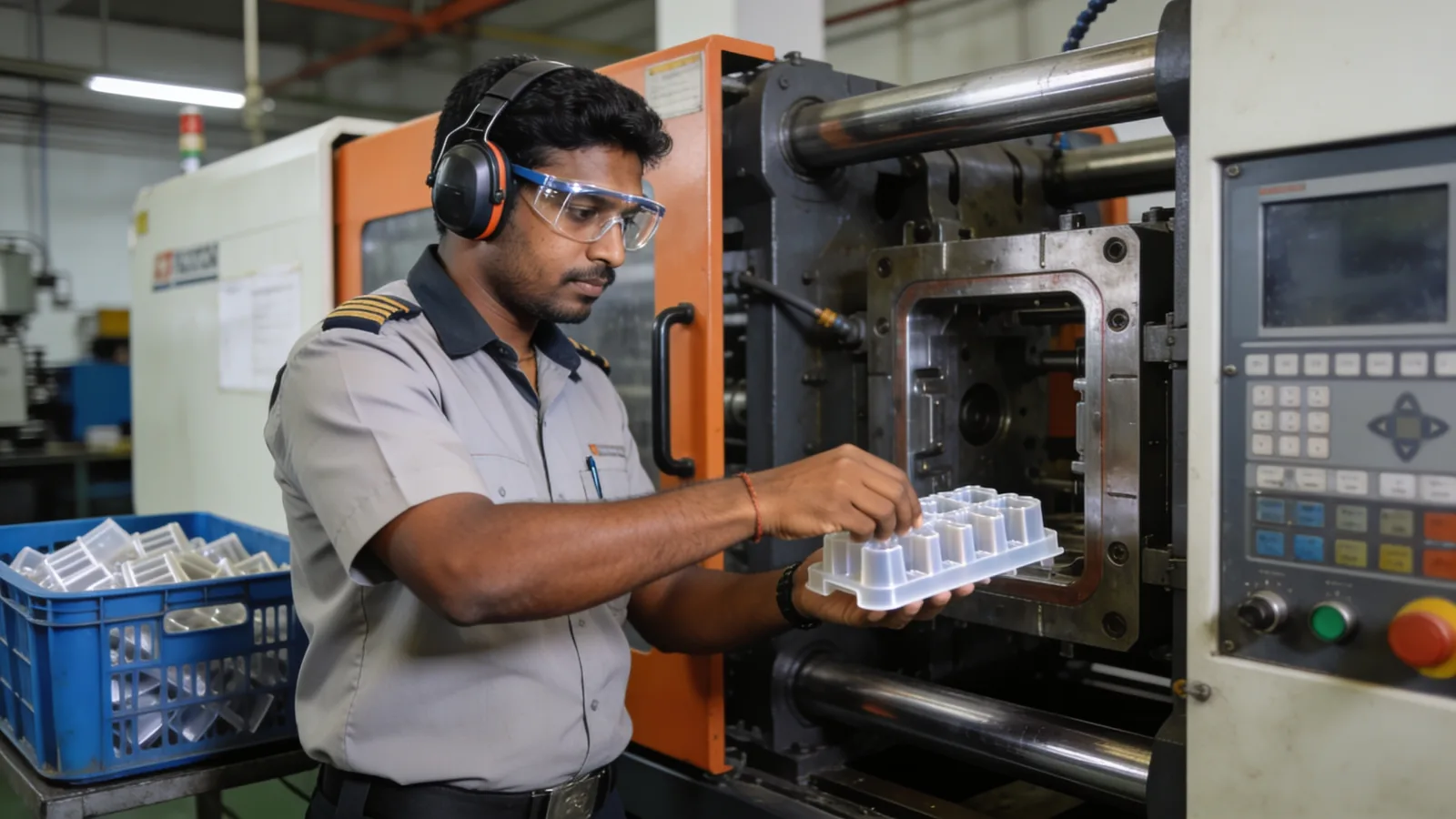
Machine tending, defect control and mould changes.
Moulding needs operators who notice a drift before it becomes a batch. We screen on defect recognition — short shot, flash, sink, weld line — and on the discipline that keeps a cycle stable through a shift.
- ✓Machine tending across tonnage ranges
- ✓Shot-weight, cycle and parameter monitoring
- ✓Defect identification and segregation
- ✓Insert loading, de-gating and trimming
- ✓Mould-change support with the setter
Rejections are a staffing outcome
The machine is capable; the shift decides whether it stays capable.
An operator who cannot tell a sink mark from a weld line packs three hours of defective parts because nobody trained them on what to look for.
Rejected batches, reworked material, a customer complaint on cosmetic defects, and mould damage from an insert loaded wrong.
Defect-recognition screening before deployment, mould-safety induction, parameter-monitoring discipline and a supervisor who reviews rejection data daily.
Get a rate card →
Screening, deployment and compliance
Move the slider for an indicative monthly bill for moulding operators at a ₹21,000 gross wage, statutory costs and an illustrative 12% service fee (your actual fee is set out in the rate card). Firm rates follow your State's minimum wage for the skill category, the grade and the shift pattern.
What clears before the worker reaches your gate.
What an injection moulding operator does on the shop floor
In most Indian moulding shops the operator tends a running machine rather than setting it: removing parts where there is no robot, degating and trimming, loading metal inserts, checking every shot or sample against limit samples, and packing to the standard. A good operator also watches the controller — cycle time, cushion, injection pressure, barrel temperatures — and calls the setter the moment a value drifts out of its window, instead of adjusting it.
The mould setter changes moulds, connects water and hot-runner circuits, sets process parameters and approves the start-up. The process technician owns the parameter window and troubleshooting. We staff each grade separately, because the test, the wage and the safety exposure differ. Neighbouring roles:
Power press operators
Sheet-metal stamping and forming, where the main hazard is the point of operation.
Power press operator staffing →Production operators
Line work across packing, filling and general manufacturing, without process-specific machines.
Production operator staffing →QC inspectors
Incoming, in-process and final inspection with limit samples, gauges and inspection reports.
QC inspector staffing →Moulding grades we staff
Most shops need a pyramid: many tenders, fewer operators who can read the process, and one setter per shift for a group of machines.
| Grade | Typical background | Works independently on | Usual minimum-wage category |
|---|---|---|---|
| Machine tender | 10th or 12th pass, trained on site; ITI helpful | Part removal, degating, trimming, visual check against limit samples, packing | Semi-skilled (unskilled in some State schedules) |
| Moulding operator | ITI Plastic Processing Operator or 1–3 years in moulding | Monitoring controller values, material top-up and labelling, insert loading, first-level defect calls | Semi-skilled or skilled |
| Mould setter | ITI or CIPET diploma plus 3+ years | Mould change, clamping, water and hot-runner hook-up, parameter setting, start-up approval | Skilled or highly skilled |
| Process technician | CIPET diploma (plastics technology or mould technology) or engineering diploma | Parameter windows, defect root cause, new-mould trials, material changeovers | Highly skilled; usually paid above the floor |
Skill categories come from each State's minimum-wage notification under the Code on Wages, 2019; the mapping is typical, not universal. CIPET is the Central Institute of Petrochemicals Engineering & Technology.
The moulding trade test, station by station
Operators clear stations 1–5. Setters also clear station 6 on a machine and mould you nominate.
Defect recognition
Sort a tray of sample parts into good, short shot, flash, sink, weld line, silver streaks, burn marks and warpage, and name the likely cause of each.
Reading the controller
Find cycle time, cushion, injection and holding pressure and barrel zone temperatures on the screen, and say which values an operator must never change.
Material handling
Explain why nylon, PC and ABS need drying before moulding while PP usually does not, and follow the regrind ratio, masterbatch dosing and bag labelling rules.
Insert loading and finishing
Load metal inserts the right way round, degate and trim without marking the part, and count and pack to the packing standard.
Safety
Front gate and interlocks respected, no reaching into the mould area, purge only behind the purge guard, heat and hydraulic-oil hazards, robot zones.
Setter station
Change a mould with the hoist, check slings and eyebolts, connect water and hot-runner circuits, set parameters from the process sheet and get a first-off approved.
PPE, mould-area rules and the compliance behind each operator
PPE issued and checked
- ✓Heat-resistant gloves and face shield for purging and hot parts
- ✓Safety glasses and safety shoes
- ✓Cut-resistant gloves and guarded knives for trimming
- ✓Hearing protection where your noise survey requires it
Mould-area rules we brief
- ✓Front gate, interlock and mechanical safety bar never bypassed
- ✓Motor off and locked before anyone enters the mould area
- ✓Mould lifting only by trained setters with examined lifting tackle
- ✓Machine guarding is a duty under the OSH Code, 2020 and State factory rules
Compliance we carry as employer
- ✓EPF and ESI enrolment before day one; ESI covers gross wages up to ₹21,000 a month
- ✓Wages at or above the State minimum for the skill category, paid by the 7th of the following month
- ✓Overtime at twice the ordinary wage rate (OSH Code, section 27)
- ✓Contract-labour registers under the OSH Code (which replaced the CLRA Act, 1970), shared monthly
24x7 rosters, night shifts and the wage basis
Moulding shops rarely stop: heating barrels and moulds back up is slow and wasteful, so most run three 8-hour shifts, seven days a week. A post manned round the clock needs about 3.5 people at six 8-hour shifts a week each (168 ÷ 48), before leave and absence — budget for relievers and staggered weekly offs, or the roster runs on overtime.
Women can work night shifts under section 43 of the OSH Code, 2020 with their consent and the safety, transport and other conditions the State prescribes. We plan those conditions into the roster rather than leaving them to the site.
| Basis | Figure | Source and notes |
|---|---|---|
| Legal floor (example) | Haryana: semi-skilled ₹16,781 a month, skilled ₹18,501 a month | Haryana notification effective 1 April 2026. Your State, zone and scheduled employment decide the real floor. |
| Karnataka | Skill-and-zone structure with steep increases, notified 22 May 2026 | Reported to be under challenge in the Karnataka High Court; check the current position before budgeting a site in Karnataka. |
| Market reference | Operator average ₹18,876 a month; typical range ₹11,524–₹30,919 | Indeed India generic operator series, 467 reports, updated August 2026. Indeed publishes no separate moulding series; Hosur is among the higher-paying locations. |
| Our estimator | ₹21,000 gross a month for a moulding operator | Planning figure. Tenders price lower; setters and process technicians are quoted separately. |
Indicative only, not an offer or a legal rate. A national floor wage under the Code on Wages is still being fixed; until then State rates apply. Check your State's rate with the minimum wage calculator.
What to measure a moulding operator, and us, against
Rejection by defect
Rejection percentage or ppm split by defect type, so short shots and flash are traced to process, mould or handling.
Cycle-time adherence
Actual against standard cycle time per shift. Slow part removal on manual machines shows up here first.
Material loss
Purge, runner and start-up scrap against the norm, and regrind used within the permitted ratio.
Mould change time
Minutes from last good part to first approved part, measured per setter.
Our service targets
We aim to send a test plan and rate card within one working day, deploy tested operators in 7–10 working days, and replace an exit within 15 days. Targets are written into the SLA schedule.
Three moulding staffing mistakes to avoid
Letting operators touch parameters
Lock the parameter window and route changes through the setter. Unrecorded tweaks are a common source of drifting rejection.
No drying discipline
Hygroscopic materials moulded wet give silver streaks and brittle parts. Make dryer checks part of the operator's shift log.
A 24x7 shop staffed on day-shift maths
Without relievers, weekly offs turn into double shifts and fatigue. Plan the roster before the headcount.
Injection moulding operator staffing FAQs
Screening, grades, night shifts, 24x7 rosters and cost basis.
Get a rate card →What is screened for a moulding operator?+
Defect recognition (short shot, flash, sink, weld line, silver streaks), controller reading, material handling and drying rules, insert loading and finishing, and mould-area safety. Setters also clear a mould change and start-up on your machine.
What is the difference between a moulding operator and a mould setter?+
The operator tends the running machine, checks parts and reports drift. The setter changes moulds, connects services, sets parameters and approves the start-up. They are tested and priced separately.
What qualification should a moulding operator have?+
Tenders are usually 10th or 12th pass and trained on site. Operators often hold an ITI Plastic Processing Operator certificate; setters and process technicians commonly hold a CIPET or engineering diploma. The trade test decides the grade.
How do you help control rejection percentage?+
Defect-recognition screening before deployment, a locked parameter window, shift-wise output and rejection reporting, and a supervisor who reviews the data daily rather than at month end.
Can women work night shifts in a moulding shop?+
Yes. Section 43 of the OSH Code, 2020 allows it with the worker's consent and the conditions the State prescribes on safety, transport and working hours. We check those conditions for your State before rostering.
How many people does a 24x7 moulding post need?+
About 3.5 people per post at six 8-hour shifts a week each, plus cover for leave and absence. We build the reliever count into the rate card.
How quickly can moulding operators be deployed?+
We aim for 7–10 working days, in waves for larger requirements so induction and buddy pairing keep pace.
What does a contract moulding operator cost?+
The gross wage for the grade (at or above the State minimum), plus employer PF, EDLI and admin charges, ESI where gross is up to ₹21,000, bonus and gratuity provisions, shift or night allowances you agree, and the service fee. See how staffing fees are calculated.
Moulding shop short of operators?
Send the role, headcount and site city. We aim to send an itemised rate card and deployment date within one working day.