
Production operator staffing that holds through the ramp.
Getting a few hundred operators through the gate is the easy part; keeping nearly all of them there in month three is the real job. Production operator staffing is a retention problem disguised as a recruitment problem. Godstone Consultech screens for SOP adherence, shift-work fitness and local commutability, employs every worker on our own payroll, and keeps the PF, ESI, wage and contract-labour records — so the person on your floor is documented, replaceable and accountable from day one.
Headcount, shift pattern and SOP date are enough to plan waves.
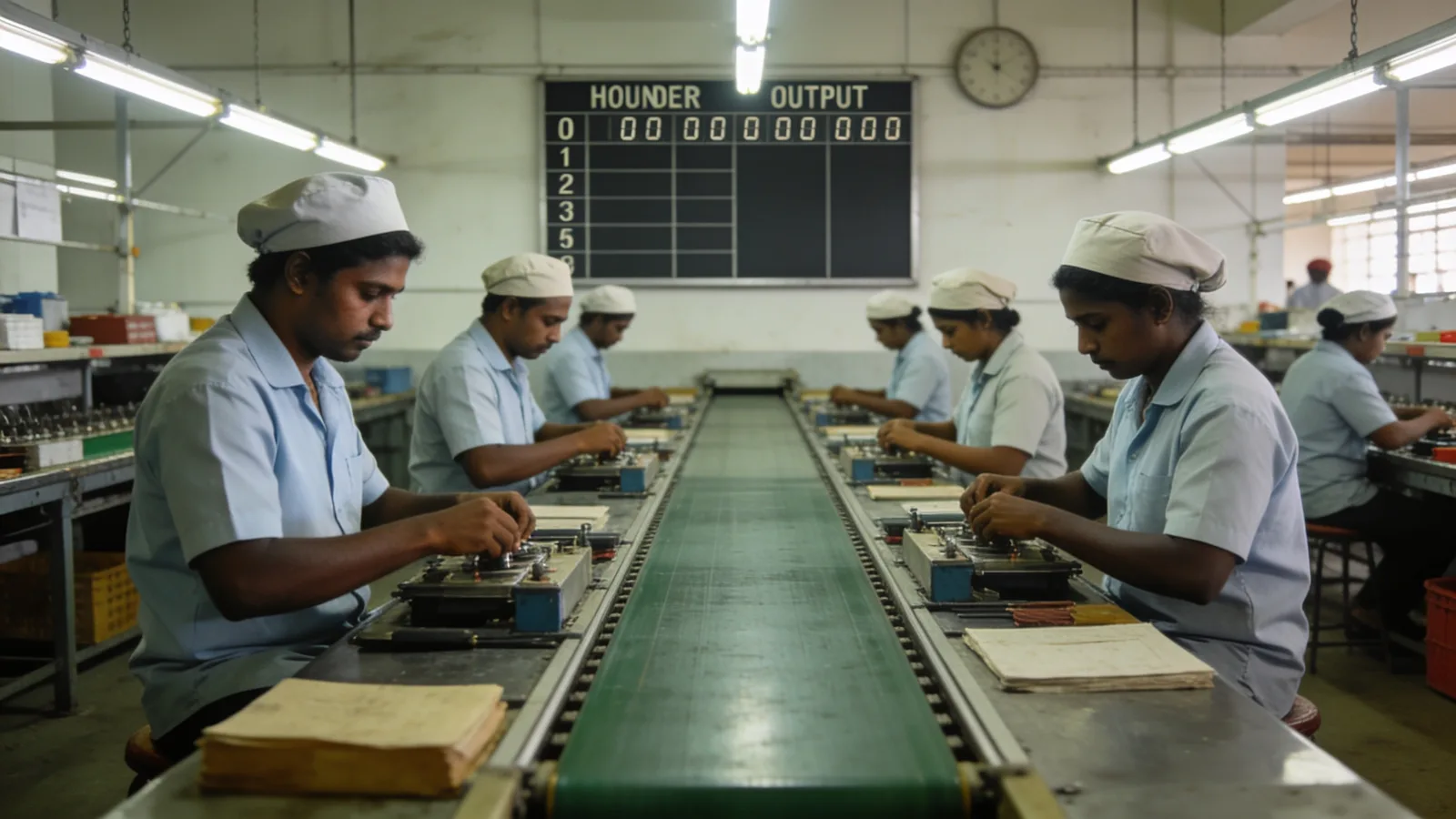
Line operation, quality checks and shift discipline.
Volume lines need operators who follow an SOP the same way on the third shift as on the first. We source locally so attendance holds, induct on your SOP and safety, and report attrition with coded reasons every month.
- ✓Line and station operation to SOP
- ✓In-process quality checks and rejection segregation
- ✓Material feeding, kitting and line replenishment
- ✓Changeover support and 5S discipline
- ✓Shift handover and output logging
Ramps fail in month three, not week one
The gap between headcount hired and headcount productive is where plans break.
Forty operators join from a district four hours away with no hostel plan. Attendance is fine for a fortnight and broken by week six.
Every exit is a fresh induction, a fresh safety briefing and a productivity dip. Overtime covers the gap until quality slips and a customer audit notices.
Wave plans tied to your SOP date, sourcing inside commuting distance, transport or accommodation planned with you where the commute needs it, wages by the 7th, and attrition reported per site.
Get a rate card →
Screening, deployment and compliance
Move the slider for an indicative monthly bill for production operators at a ₹20,000 gross wage, statutory costs and an illustrative 12% service fee (an assumption for the estimate, not our rate; your fee is agreed in your contract). Firm rates follow your State's minimum wage for the skill category, the city and the shift pattern.
What clears before the worker reaches your gate.
What a production operator does, and how it differs from assembly
A production operator runs or tends a process line: feeding and watching filling, mixing, moulding-support, cutting or packing machines, moving material between stations, checking output against the SOP, recording counts and batch details, and raising the alarm when something drifts. In food and pharma plants the job also carries hygiene and documentation rules — gowning, batch records, line clearance. The skill is consistency across a long shift, not a single trade.
It is a different hire from an assembly line operator, who builds a product station by station against takt time, and from a machine operator, who runs one machine to a drawing. Because production lines need volume, our focus is ramp speed and keeping people in month three:
Assembly line operators
Station-based assembly with torque tools, poka-yoke and traceability on a paced line.
Assembly line operator staffing →Machine operators
Lathes, drills, grinders and special-purpose machines run to a drawing.
Machine operator staffing →Apprentices under NAPS
Trainees on stipend under the Apprentices Act, 1961, where the role is a genuine training post.
NAPS apprenticeship services →Production grades, and why the category matters
Minimum wage depends on the skill category, and calling skilled work unskilled is a wage-law breach, not a saving. Agree the category per role before the rate card.
| Grade | Typical background | Works independently on | Usual minimum-wage category |
|---|---|---|---|
| Helper / loader | 8th–10th pass, no trade needed | Material movement, loading and unloading, carton handling, housekeeping | Unskilled |
| Production operator | 10th–12th pass or ITI; trained on site | Machine tending, SOP-based checks, counts and records, line clearance support | Semi-skilled |
| Senior operator / line lead | ITI or diploma with 2+ years on similar lines | Changeovers, first-level troubleshooting, shift handover and output records | Skilled |
Skill categories and their definitions come from each State's minimum-wage notification under the Code on Wages, 2019; the mapping is typical, not universal.
How production operators are screened
A production line doesn't need a trade test; it needs people who follow instructions every time and turn up on day 30. The screen checks for exactly that.
SOP comprehension
Read a one-page SOP in the local language, explain it back, and follow it on a mock task without prompts.
Counting and records
Basic numeracy: count, tally and fill a shift record or batch log without errors.
Visual checks
Spot label, seal, fill-level and packing defects on a sample tray; colour-vision check where the line needs it.
Fitness for the shift
Standing, lifting and night-shift fitness as your line requires, with the pre-employment medical you specify.
Hygiene habits
For food and pharma lines: gowning, hand-washing and jewellery rules, and why line clearance exists.
Identity and commute
Age, identity, address and bank checks, plus a realistic commute to your gate — one of the best early signs of who stays.
How a production ramp is staffed, and held
Big ramps fail in month two, not week one. The plan below is built backwards from your line-live date.
4 weeks before line-live
Headcount by shift and skill category agreed, sourcing radius mapped around the plant, transport or hostel needs identified.
2–3 weeks before
Screening drives and document checks; offers issued in waves sized to what your induction team can absorb.
Week of line-live
Day-zero safety, quality and hygiene induction; buddy pairing with experienced operators for the first week.
Weeks 2–6
Further waves plus an agreed buffer for early exits, so sanctioned strength does not dip as people drop out.
Every month
Attendance, early attrition and coded exit reasons reported, so causes such as commute, shift timing or supervisor behaviour get fixed.
PPE, welfare thresholds and the compliance we carry
PPE by line type
- ✓General manufacturing: safety shoes, gloves suited to the task, ear protection where required
- ✓Food lines: hairnets, beard covers, food-grade gloves, no jewellery
- ✓Pharma lines: gowning to the room classification, as your SOP specifies
- ✓Moving machinery: close-fitting uniform and guard awareness
Welfare thresholds that count contract workers
- ✓Canteen where 100 or more workers, including contract labour, are ordinarily employed (OSH Code, section 24)
- ✓Rest rooms and lunch room above 50 workers, and crèche facilities above 50 workers, as the rules prescribe
- ✓Women on night shifts only with consent and the State's prescribed safeguards (section 43)
- ✓A large contract ramp can push your plant over a threshold — plan for it
Compliance we carry as employer
- ✓EPF and ESI enrolment before day one; ESI covers gross wages up to ₹21,000 a month
- ✓Wages at or above the State minimum for the category, paid by the 7th of the following month
- ✓Overtime at twice the ordinary wage rate (OSH Code, section 27)
- ✓Contract-labour registers under the OSH Code (which replaced the CLRA Act, 1970), shared monthly
Shift patterns and the wage basis
Most production lines run three 8-hour shifts, or two shifts with a general shift for support staff. The OSH Code caps ordinary hours at eight a day; hours beyond that are overtime at twice the ordinary rate. Fixed shift timings with a published roster tend to hold people better than rotating them at short notice.
| Basis | Figure | Source and notes |
|---|---|---|
| Legal floor (example) | Haryana: unskilled ₹15,221 a month, semi-skilled ₹16,781 a month | Haryana notification effective 1 April 2026. Your State, zone and scheduled employment decide the real floor. |
| Karnataka | Skill-and-zone structure with steep increases, notified 22 May 2026 | Its legal validity is being contested; check before budgeting a site in Karnataka. |
| Market reference | Production operator average ₹20,638 a month; typical range ₹13,262–₹32,116 | Indeed India, 57 reports, updated May 2026 — a small sample. Hosur and the Ankleshwar–Bharuch belt list among higher-paying locations. |
| Our estimator | ₹20,000 gross a month for a production operator | Planning figure. Helpers price lower and line leads higher. |
Indicative only, not an offer or a legal rate. State minimum wages apply and may not be set below the national floor wage the Central Government fixes under the Code on Wages. Check your State's rate with the minimum wage calculator.
What to hold production staffing to
Fill rate by shift
Operators present against sanctioned strength, per shift, not as a monthly average.
Early attrition
Exits in the first 30 and 90 days, with coded reasons. This is where ramps are won or lost.
Line output and quality
Output against plan and quality escapes per shift, tracked with your supervisor.
Induction completion
Every operator inducted and signed off before reaching the line, with records ready for audits.
Our service targets
We aim to have wave one reporting within 7 working days of a signed requisition and to replace exits within 15 days, with an agreed buffer in each wave. Targets are written into the SLA schedule.
Production operator staffing FAQs
Ramp speed, retention, training, replacement and cost basis.
Get a rate card →How quickly can production operators be deployed?+
We aim to have wave one reporting within 7 working days of a signed requisition, with further waves weekly until the line reaches strength. The pace depends on your induction capacity as much as on sourcing.
What is the difference between a production operator and an assembly line operator?+
A production operator tends a process line — filling, packing, mixing, cutting — and follows SOPs and records. An assembly line operator builds a product station by station against takt time, often with torque tools and traceability. They are screened differently.
What qualification does a production operator need?+
Usually 10th or 12th pass; an ITI certificate helps for senior operators. For most lines, SOP comprehension, reliability and commute matter more than a certificate, and that is what we screen.
How do you keep attrition under control?+
Local sourcing within commuting distance, transport or accommodation planned with you where the commute needs it, wages paid by the 7th every month, fixed rosters, and monthly attrition reporting with coded exit reasons so the causes get fixed.
Are operators trained before joining the line?+
Day-zero safety, quality and hygiene induction is standard, followed by buddy pairing for the first week. Station-specific training runs with your trainers to your SOP, with records kept per operator.
What happens when an operator leaves?+
We aim to replace exits within 15 days, and each wave carries an agreed buffer so early exits do not open a hole in your sanctioned strength.
Can we use apprentices instead of contract operators?+
Only where the role is a genuine training post under the Apprentices Act, 1961. Apprentices learn on a structured curriculum and receive a stipend; they are not a substitute for regular production headcount. See NAPS apprenticeship services.
How is production operator staffing priced?+
The gross wage for the category and city (at or above the State minimum), plus employer PF, EDLI and admin charges, ESI where gross is up to ₹21,000, bonus and gratuity provisions, overtime and night-shift payments as actuals, and the service fee. See how staffing fees are calculated.
Line going live soon?
Send the role, headcount and site city. We aim to send an itemised rate card and deployment date within one working day.