
Diagnostics staffing across the lab, the collection centre and the doorstep
A diagnostics network fails at its edges. The central lab is professionally run; the shortfall is at the collection centre with no phlebotomist at 7 a.m., the home-collection slot nobody could service, and the sample that sat outside its temperature range for two hours. We staff pathology labs, collection centres, home-collection teams and imaging units, including the parts that are hardest to supervise.
Roles, headcount and cities. We aim to send a costed proposal within one working day.
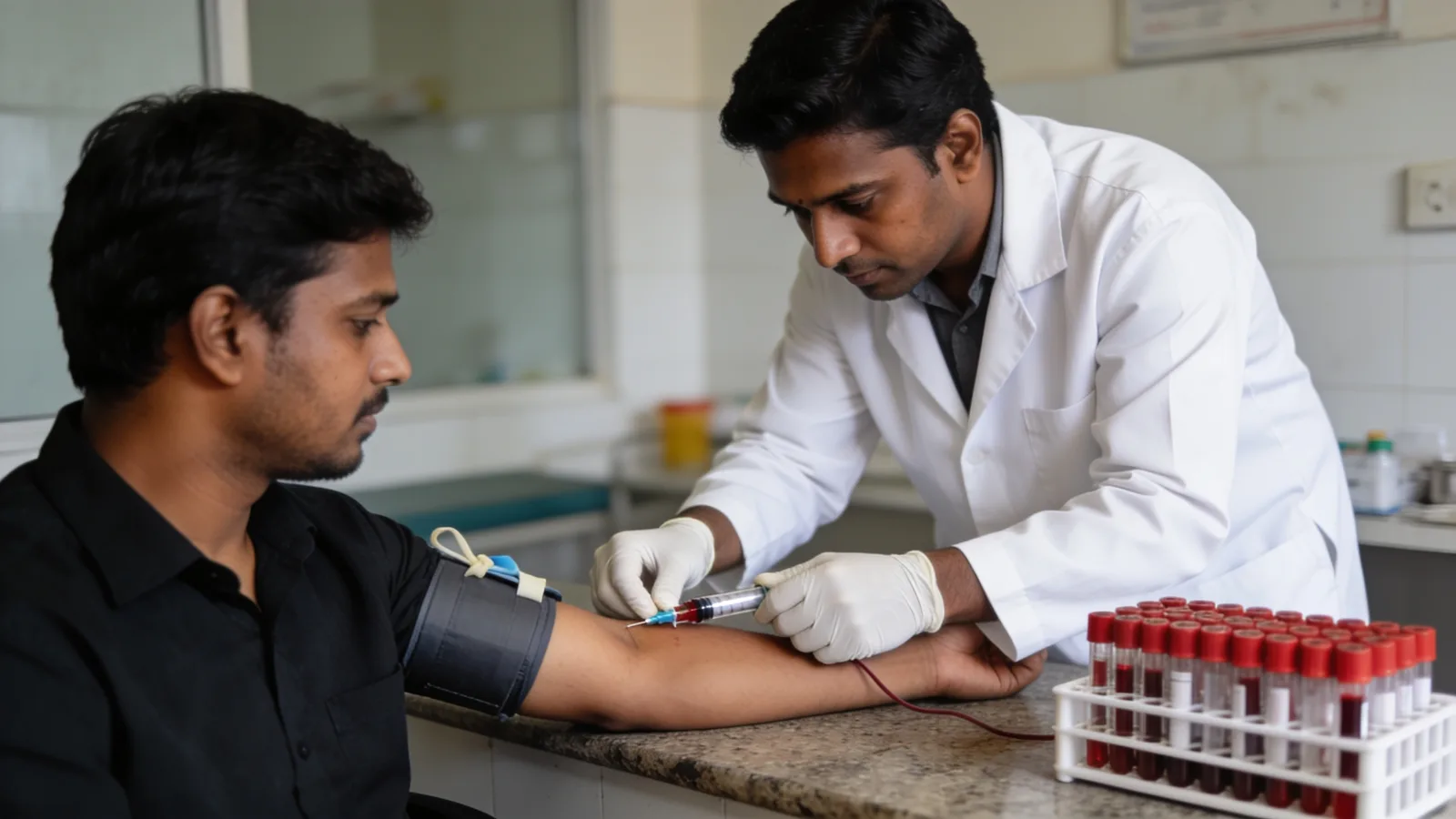
Roles across a diagnostics network
Sample integrity depends on the least supervised person in the chain, which is why selection and training matter more here than headcount speed.
- ✓Phlebotomists for collection centres, hospitals and home collection
- ✓DMLT, BMLT and B.Sc MLT technicians: biochemistry, haematology, microbiology, histopathology
- ✓Molecular and PCR lab technicians, cytology and specialised assay support
- ✓Imaging: X-ray and CT technologists, MRI technologists, ultrasound front desk and patient preparation
- ✓Sample logistics: collection riders, cold-box handling, chain-of-custody discipline
- ✓Front office: centre executives, registration, billing, report dispatch, tele-support
- ✓Quality: NABL documentation support, internal quality control record keeping
Diagnostics roles: qualification, regulation and checks
Who may do the work differs sharply across the network. A phlebotomist, a CT technologist and the person at the ultrasound front desk sit under different rules. We screen against this matrix before deployment.
| Role | Typical qualification | Registration or regulation | Checked before deployment | Pay benchmark (indicative) |
|---|---|---|---|---|
| Phlebotomist (centre or hospital) | DMLT, a phlebotomy certificate from the Healthcare Sector Skill Council, or documented experience | NCAHP registration where the State register is open; otherwise qualification verified | Practical draw test, order of draw, labelling, hepatitis B status | Job-portal average about ₹16,400/month; salary-survey average about ₹2.4 lakh a year |
| Home-collection phlebotomist | As above, plus field experience | As above | Driving licence and vehicle papers, route test, cold-box handling | Base pay plus a per-visit incentive, set by city |
| Lab technician | DMLT, BMLT or B.Sc MLT | NCAHP (medical laboratory science) registration where open; otherwise verified with the board or university | Bench test in the discipline, internal quality control habits, LIS use | Job-portal average about ₹16,900/month; typical range ₹10,000–28,000 |
| Radiographer, CT or MRI technologist | Diploma or B.Sc in radiology and imaging technology from an AERB-recognised course | Your facility needs an AERB licence and an approved RSO; the technologist is a monitored radiation worker | Course recognition, modality experience, TLD badge issued before first shift | Large-hospital offers on job portals about ₹2.6–3.6 lakh a year; quoted by modality |
| Ultrasound front desk and patient preparation | Graduate or diploma; local languages | PC&PNDT Act: centre registered, scans by qualified doctors only, Form F for every pregnant patient | Written briefing that sex of the foetus is never disclosed; records discipline | Benchmarked to local front-office wages |
| Sample runner or logistics rider | Driving licence | None beyond road rules; the lab owns sample-transport procedures | Licence, vehicle papers, cold-box and hand-off training | See rider staffing for field-role pay |
Pay figures are indicative, not a quote: national averages from job portals and salary surveys, with the State minimum wage as the legal floor. Reporting pathologists, radiologists and sonologists are doctors and are outside this staffing model.
What NABL, AERB, PC&PNDT and the BMW Rules ask of your staff
Each modality brings its own regulator. These are the staff-facing requirements a vendor must support, summarised from the source documents.
NABL (ISO 15189:2022)
NABL accredits medical labs to ISO 15189, now the 2022 edition. Its guidance for collection centres (NABL 112B) requires trained staff, covering collection method, packaging, transport, hygiene, first aid, safety and waste. Needle-stick injuries must be recorded, each collection centre audited internally at least once a year, and assessors assess phlebotomist competence.
AERB for X-ray and CT
No diagnostic X-ray equipment may be used on patients without an AERB licence for operation, applied for through the eLORA portal. The installation needs a radiologist or X-ray technologist to operate the equipment, a Radiological Safety Officer approved by AERB, and personnel monitoring (TLD badges) for every radiation worker.
PC&PNDT Act for ultrasound
Every centre with an ultrasound machine must be registered, and scans must be done by persons with the prescribed qualifications, meaning doctors, not technicians. Form F is completed for every pregnant patient and records are kept. Front-desk and support staff must never communicate the sex of a foetus.
BMW Rules 2016
Everyone handling biomedical waste needs induction training, a refresher at least once a year, and immunisation against hepatitis B and tetanus. NABL also expects collection centres to dispose of waste under the BMW Rules and State Pollution Control Board conditions.
Cold chain in transit
NABL 112B notes that most analytes are stable at ambient temperature for about 2–4 hours from collection. Beyond that, samples travel with coolants at 4–8 °C, ideally with a data logger, and samples that left their range should be rejected. See cold-chain staffing.
Allied health registration
The NCAHP Act 2021 makes registration mandatory for allied professions, including medical laboratory and imaging technology. As of September 2026 the Commission is issuing curricula, but State councils and registers are still being set up in many States, so we verify qualifications at source and add council registration where it is open.
A bad sample is a wrong report
Diagnostics is the one healthcare business where an untrained hand at the periphery produces a clinically wrong answer that a doctor then acts on.
Phlebotomists hired without a skill test, home-collection agents with no temperature discipline, and chain-of-custody treated as a form rather than a process.
Plus the clinical risk of a report issued on a haemolysed or mis-timed sample, which is the failure mode nobody wants to explain.
Phlebotomy tested before deployment, temperature and chain-of-custody training for collection and logistics staff, and documentation habits that hold up in a NABL assessment.
Get a quote →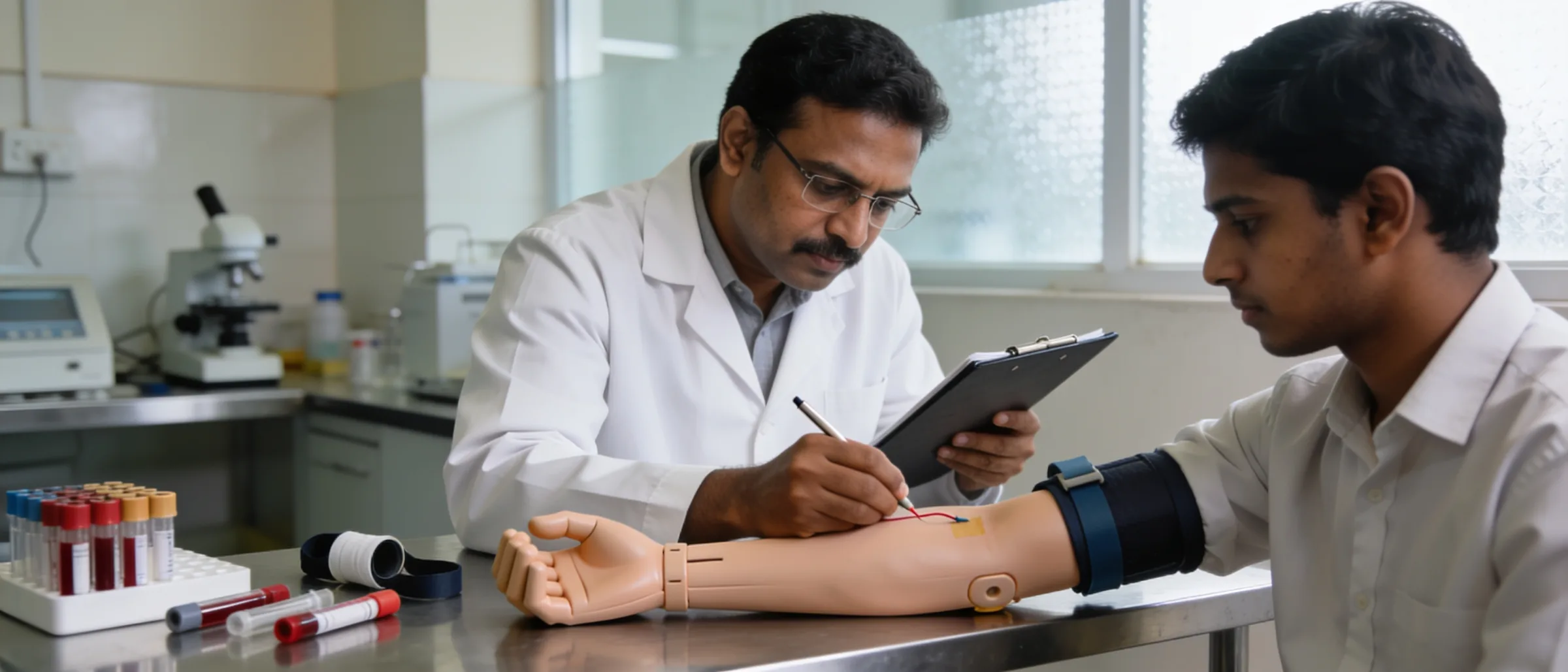
Selection, sample integrity, coverage
Move the slider for an indicative monthly bill: about ₹19,000 gross per head (a mixed phlebotomy, lab and front-desk band), statutory costs and an illustrative 12% service fee (your actual fee is set out in the rate card). Radiology technologists price higher. Home-collection roles are often billed per head with a per-visit incentive.
Phlebotomy is a manual skill and it is assessed as one.
Sizing collection teams for the fasting-sample peak
Fasting tests such as lipid profile and fasting glucose push most collections into the first hours of the morning. A team sized on daily volume will be short at 7 a.m. and idle at 3 p.m. Size it on the peak window instead.
| Step | Planning rule | Example |
|---|---|---|
| 1. Peak demand | Home visits booked in the morning fasting window | 120 visits between 6:30 and 10:30 a.m. |
| 2. Visits per phlebotomist | Window length ÷ (time per visit + travel between visits) | 4 hours ÷ (20 + 20 minutes) = 6 visits |
| 3. Heads for the peak | Peak visits ÷ visits per phlebotomist | 120 ÷ 6 = 20 |
| 4. Reserve | Add 10–15% for absence and late cancellations | 20 + 2 or 3 = 22 or 23 |
| 5. Afternoon plan | Move field staff to centres, hospital rounds, corporate camps or report and sample runs | Keeps the monthly cost per visit down |
The visit and travel times above are planning assumptions; replace them with your own data by pincode cluster. Split shifts must still fit your State's spread-over limits, and women rostered before 6 a.m. may work only with their consent and under the safety and transport conditions set under section 43 of the OSH Code. Collection centres need the same logic: two phlebotomists through the morning rush, one in the afternoon, and Sunday cover planned into the weekly-off rotation.
What to measure in a diagnostics staffing contract
Targets are agreed per site in the SLA. These pre-analytical measures show whether collection staff are working to standard.
| KPI | How it is measured |
|---|---|
| Sample rejection rate | Rejected samples ÷ samples collected, by collector and reason (haemolysed, clotted, wrong tube, mislabelled) |
| Re-draw rate | Patients called back for a repeat collection |
| Collection-to-accession time | Minutes from draw to receipt at the lab, against the time limit for each test |
| Temperature excursions | Transport boxes outside range on data-logger checks |
| Home-slot adherence | Visits started inside the booked slot |
| Needle-stick and safety incidents | Incidents per month and time to close |
Common mistakes in diagnostics staffing
- Hiring phlebotomists on interview alone. A short practical draw shows technique, order of draw and labelling habits that an interview cannot.
- Sizing home collection on daily volume. The fasting peak decides headcount.
- Letting technicians or front-desk staff operate an ultrasound machine. Under the PC&PNDT Act, scans are for qualified doctors only.
- Starting a new radiographer before the TLD badge is issued. Every radiation worker needs personnel monitoring from the first shift.
- Treating riders as couriers. Sample runners handle clinical material and need cold-box, spill and hand-off training.
- Keeping training records at the vendor only. NABL assesses collection centres on site, so records must be available there.
Questions operations and HR heads ask us
Answers we give in the first call, written down so you can compare vendors on the same terms.
Get a quote →Do you skill-test phlebotomists before deployment?+
Yes. A practical assessment covers order of draw, tube choice, technique, labelling and requisition matching, alongside qualification verification. Many sample rejections trace back to collection (haemolysis, clotting, wrong tube, mislabelling), and these are testable before anyone meets a patient.
Do phlebotomists and lab technicians need registration in India?+
The NCAHP Act 2021 makes registration mandatory for allied health professionals, including medical laboratory science. As of September 2026 State councils and registers are still being set up in many States, so qualifications are verified with the issuing board or university and council registration is added wherever the State register is open.
Can you staff home-collection teams?+
Yes, with cold-box and temperature training, chain-of-custody hand-offs, slot planning by pincode cluster, and licence and vehicle verification for anyone who rides.
Which lab and imaging roles do you supply?+
Phlebotomists; DMLT, BMLT and B.Sc MLT technicians for biochemistry, haematology, microbiology, histopathology and cytology; molecular and PCR technicians; X-ray, CT and MRI technologists; sample runners; and front-desk, billing and report-dispatch staff. Reporting doctors are outside this model.
Can a technician perform ultrasound scans in India?+
No. Under the PC&PNDT Act, ultrasonography may be done only at a registered centre by persons with the prescribed qualifications, which in practice means qualified doctors. Technicians and front-desk staff can prepare patients and keep records in order, but Form F is signed by the doctor who performs the scan, and support staff must never scan or disclose the sex of a foetus.
Does a diagnostic centre need a Radiological Safety Officer?+
Yes. AERB's safety code for diagnostic X-ray requires every X-ray installation to have an AERB-approved RSO, who can be the employer or a designated employee, plus a licence for operation and personnel monitoring for radiation workers.
What does NABL require of collection-centre staff?+
NABL 112B requires trained staff covering collection method, processing, packaging, transport, hygiene, first aid, safety and waste disposal, with training evaluated and recorded. Each collection centre is internally audited at least once a year, and NABL assessors assess phlebotomist competence.
Are your staff ready for a NABL assessment?+
Each deployed worker carries qualification, training and competence records, and staff are trained in quality-control documentation habits. Responsibility for the assessment stays with your quality manager.
How quickly can a new collection centre be staffed?+
We aim for about seven days for a phlebotomist and front-office executive, including skill testing and verification. Allow longer for imaging roles, where course recognition and TLD badges must be in place first.
Related roles and services
Staff the periphery as carefully as the lab
Send the centre and route list. We will propose the skill-test standard, the roster and the sample-integrity training.