
Cold chain staffing for work nobody can do for eight hours straight
A minus-twenty chamber is not a warehouse with a lower thermostat. Productivity falls, error rates rise and health risk is real, so staffing it means shorter rotations, correct PPE and medical screening — plus workers who understand that a temperature excursion is a product loss, not a paperwork issue.
Roles, headcount and site location. We aim to send a costed proposal within one working day.

Roles across the cold chain
Cold chain staffing spans food, pharma and quick-commerce fresh operations, with pharma imposing the strictest documentation discipline of the three.
- ✓Cold store: chilled and frozen chamber handlers, pallet movers, order pickers
- ✓MHE: reach truck and forklift operators rated for cold environments
- ✓Dispatch: reefer loading and unloading crews, dock and door discipline
- ✓Pharma cold chain: vaccine and biologic handling, temperature logging, excursion reporting
- ✓Fresh and dairy: grading, sorting, packing, wastage control, chill-room hygiene
- ✓Reefer transport support: pre-cooling checks, temperature monitoring, data logger handling
- ✓Supervision: shift in-charge, temperature compliance monitoring, WMS coordination
A temperature excursion writes off the load, not the shift
Cold chain failure is binary. Product either stayed inside its range or it did not, and the loss is the full value of the consignment plus, in pharma, a regulatory report.
Full-length shifts inside the chamber, missing or shared cold PPE, no medical screening, and dock doors left open during loading because nobody was trained on why it matters.
Plus productivity well below plan, because human output inside a freezer without rotation falls away fast.
Rotation cycles with warm-up breaks, individually issued cold PPE, cold-exposure medical screening, and dock, door and temperature discipline trained and logged.
Get a quote →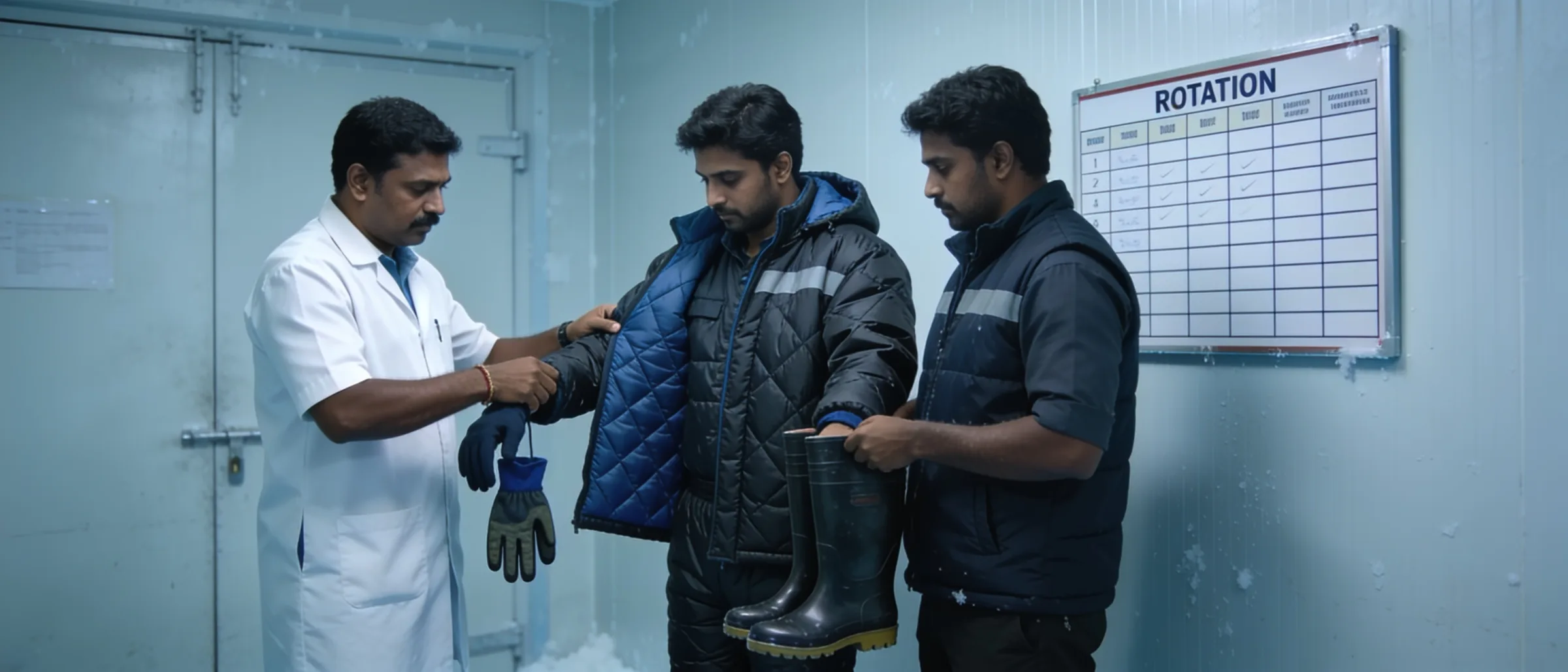
Rotation, PPE, temperature discipline
Billed on loaded wage plus service fee, with cold-work allowance shown as a separate line item rather than absorbed into the markup.
Nobody works a full shift inside a freezer, and pretending otherwise costs output.
Each temperature zone needs a different staffing plan
A multi-temperature warehouse is really three or four workplaces under one roof. Rotation, PPE and screening change with the zone.
| Zone | Typical range | Typical products | What changes for staffing |
|---|---|---|---|
| Deep frozen / frozen | −18°C or colder | Ice cream, frozen foods, seafood, some biologics | Shortest work blocks with warm-up breaks, full freezer suits, cold-exposure medical screening |
| Chilled | about 0°C to +4°C | Dairy, meat, fresh produce, ready-to-eat | Longer blocks, insulated jackets and gloves, hygiene rules for open food |
| Pharma refrigerated | +2°C to +8°C | Vaccines, insulin, biologics | Documentation and excursion discipline as strict as the temperature itself |
| Controlled ambient | +15°C to +25°C | Many medicines, chocolates, some FMCG | Ambient work, but temperature logging and door discipline still apply |
Ranges are the common industry bands; your product specifications and customer contracts decide the actual limits.
The safety basics our cold chain crews are inducted on
Freezer work carries risks an ambient warehouse does not. These are covered at induction, re-briefed at shift start, and checked by the shift in-charge.
- ✓Never enter a frozen chamber alone; a name board or tag system at the door shows who is inside
- ✓Know the inside door-release and trapped-person alarm in every chamber before starting work
- ✓Recognise early frostbite and hypothermia signs, and leave the chamber at once if they appear
- ✓Keep individually issued freezer suit, gloves and boots dry; damp PPE loses insulation
- ✓Ammonia refrigeration: recognise a leak, evacuate upwind, and never re-enter until cleared
- ✓Ice on floors and ramps: slow speeds for MHE and walking routes kept clear
- ✓Condensation on goods and trucks when moving between zones: wipe-down and brake checks for reach trucks
- ✓Warm-up breaks taken as rostered, with hot drinks and a heated rest area
Good distribution practice for temperature-sensitive medicines
Pharma customers and regulators treat a cold chain worker's logbook as part of the product record. Our pharma crews are trained against WHO guidance on the storage and transport of time- and temperature-sensitive pharmaceutical products and your own SOPs.
Temperature records
Manual and data-logger readings recorded at the set frequency, signed by the person who took them, never back-filled.
Excursion reporting
Any reading outside range is reported at once, the stock is quarantined, and nothing is shipped until your QA releases it.
Packing and conditioning
Gel packs and phase-change materials conditioned for the time your SOP sets; validated shipper configurations followed exactly.
Chain of custody
Handover documents, logger IDs and seal numbers checked and recorded at every receipt and dispatch.
Cold chain hubs we recruit for
India's cold storage capacity has grown up around farm produce, dairy and pharma, and now around quick-commerce and organised retail in the metros.
Uttar Pradesh and West Bengal
Much of the country's traditional cold storage capacity, built for potatoes and other produce, with sharp seasonal loading peaks.
Bhiwandi, Chakan, Kundli–Sonipat
Modern multi-temperature warehouses serving Mumbai, Pune and Delhi NCR retail and food service.
Hoskote, Red Hills, Shamshabad
Multi-temperature hubs serving Bengaluru, Chennai and Hyderabad.
Hyderabad, Pune, Ahmedabad
Vaccine and biologics makers and their distributors, with the strictest 2–8°C documentation.
Kochi, Visakhapatnam, Veraval
Seafood processing and export cold stores with blast freezing.
Questions project and HR heads ask us
Answers we give in the first call, written down so you can compare vendors on the same terms.
Get a quote →Do you screen workers for cold-environment work?+
Yes — cold-exposure medical screening at selection, because respiratory and circulatory conditions make freezer work genuinely unsafe for some people, and that screening is also your liability protection.
How do you handle productivity in frozen chambers?+
By designing the shift around rotation cycles with warm-up intervals and pairing chamber tasks with ambient tasks. Planned productivity rates are set realistically rather than copied from ambient warehouse benchmarks.
Do you staff pharma cold chain operations?+
Yes, with the stricter discipline that demands: temperature logging, data logger handling, chain-of-custody documentation, excursion reporting and per-worker training records for your quality system.
Is cold PPE included?+
Cold PPE is individually issued, fit-checked and replaced on schedule. It is costed as a line item so you can see it rather than assuming it is inside the markup.
Can you staff reefer loading and unloading crews?+
Yes, including pre-cooling checks, dock door and airlock discipline, temperature monitoring during loading and data logger placement and retrieval.
How long can a worker safely stay inside a frozen chamber?+
It depends on the temperature, air movement, the work rate and the PPE. We agree a work–warm-up schedule with your EHS team, referencing recognised cold-stress guidance, and in frozen chambers that usually means warm-up breaks at least every hour, often more often at lower temperatures.
Do you staff cold rooms in quick-commerce dark stores?+
Yes. Dark-store chillers and freezers are small but busy, and pickers move in and out of them all shift, so PPE, hygiene and door discipline matter as much as in a large cold store. See our e-commerce and quick-commerce staffing page for dark-store crews.
Is a cold-work allowance mandatory?+
There is no national statutory cold-work allowance; wages must meet the State minimum for the skill category. Many operators pay a cold-zone allowance to hold staff, and we show it as a separate line so you can compare vendors fairly.
Can you supply loading crews for the produce cold storage season?+
Yes. Produce cold stores, especially potato stores in Uttar Pradesh and West Bengal, load most of their capacity in a few weeks after the late-winter harvest and unload gradually through the year. We plan loading crews as a short, dated deployment with accommodation where needed, and a smaller crew for the unloading months.
Staff the chamber the way the chamber works
Send the chamber temperatures, volumes and shift pattern. We propose rotation design, PPE and realistic productivity rates.