
Automotive staffing that holds takt time on a two-shift pattern
In automotive, manpower failure is measured in units, not vacancies. A press shop short of two operators pushes the whole downstream sequence, and a customer line-stop notice arrives before HR has finished the requisition. We staff OEM and Tier 1/2 plants with operators, trades and inspectors who understand takt, traceability and IATF discipline.
Roles, headcount and plant city. We aim to send a costed proposal within one working day.
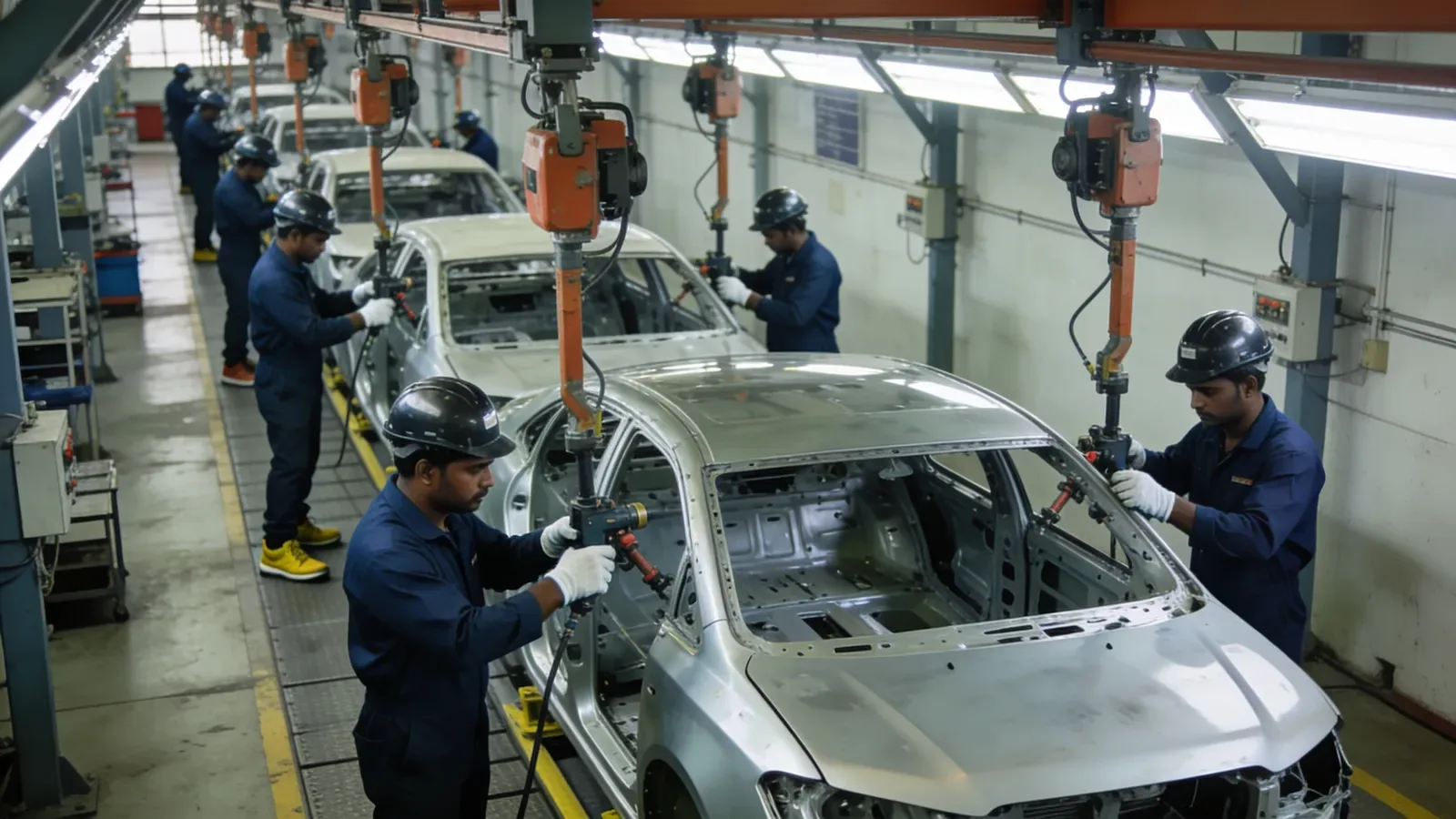
Shop by shop, the roles we deploy
Automotive plants do not need generic labour. Each shop has its own skill, safety and documentation profile, and the deployment is built that way.
- ✓Press shop: power press operators, die setters, material handlers
- ✓Weld shop: spot and MIG welders, fixture loaders, robot tenders
- ✓Paint shop: PT line, masking, booth operators, touch-up and polish
- ✓Assembly: line operators, sub-assembly, torque and leak-test stations
- ✓Quality: incoming, in-process and final inspectors, CMM and gauge handling
- ✓Maintenance: fitters, electricians, hydraulics and tooling technicians
- ✓Logistics: forklift and reach truck operators, stores and kanban handlers
One line-stop notice costs more than a year of staffing fees
Automotive customers do not accept manpower as an excuse. Penalty clauses, premium freight and audit escalations follow a shortfall that lasted one shift.
Nobody knows at 6:30am how many operators reported. By 8am the sequence is broken, and the standby list is a phone number nobody answers.
Plus rejection and rework from untrained standby workers put on unfamiliar stations, which then shows up as a customer complaint two weeks later.
Station-wise skill matrix, a bench trained on your stations, biometric attendance visible to your production planner by 7am, and a 48-hour backfill target written into the contract.
Get a quote →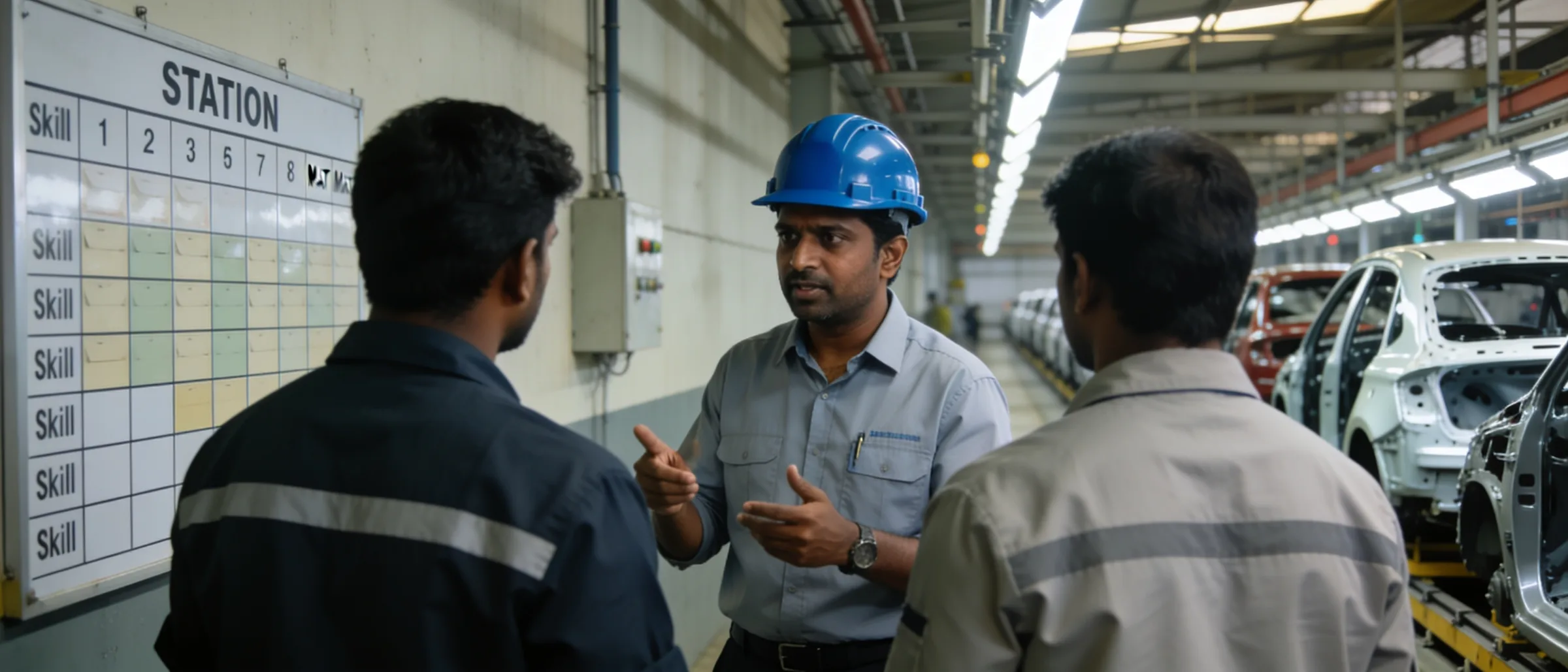
Deployment, quality discipline, compliance
Billed on loaded wage plus service fee. Skill grade and shift pattern determine the wage; volume and city determine the fee.
We map your stations first, then supply against the skill each one needs.
Automotive clusters and what each one builds
Sourcing works best within commuting distance of the gate. These are the belts where OEM and supplier demand concentrates, and where we source locally, within commuting distance of your gate, when a requisition lands.
Chennai, Sriperumbudur, Oragadam
Passenger cars, commercial vehicles, two-wheelers and a dense tier-1 base along the Sriperumbudur–Oragadam corridor, with deep ITI and diploma pools.
Hosur and Krishnagiri
Two-wheelers, commercial vehicles, components and newer EV two-wheeler plants; a large Karnataka–Tamil Nadu cross-border commuter pool.
Pune, Chakan, Talegaon, Ranjangaon
Cars, two- and three-wheelers, commercial vehicles and forging and machining suppliers, with strong competition for trained operators.
Chhatrapati Sambhajinagar
Waluj, Shendra and Bidkin: two- and three-wheelers, cars and component clusters.
Gurugram, Manesar, Bawal
Car and two-wheeler assembly with a deep supplier base; a high share of migrant workers who need hostel or shared-accommodation support.
Sanand, Becharaji, Hansalpur
Car plants and supplier parks in north Gujarat, where ramps often draw on workers from outside the district.
Pithampur
Commercial vehicles, tractors and components near Indore.
Bengaluru, Bidadi, Narasapura
Cars, two-wheelers and components on the city's western and eastern industrial belts.
What an automotive auditor asks about agency workers
IATF 16949 clause 7.2.2 requires on-the-job training for anyone in a newly assigned or modified role affecting quality, and says in terms that this includes contract or agency personnel. So the evidence an auditor wants for your own operators, they want for ours. This is the file we keep per worker, per station.
- ✓Station-wise skill matrix with the level each operator is cleared to (trainee, can work under supervision, independent, can train)
- ✓On-the-job training record per station, signed off by your line trainer, including customer-specific requirements
- ✓Work-instruction and special-characteristic awareness sign-off for safety- and fit-critical stations
- ✓Requalification record when an operator returns from long leave or moves to a new station
- ✓PPE issue, safety induction and lockout–tagout (LOTO) awareness record
- ✓Rejection and rework trend by operator, shared at the monthly review
How we test before anyone reaches your line
Generic "semi-skilled operator" screening is why agency workers fail on automotive stations. Each shop has its own test.
| Shop | What the station needs | How we screen | Induction before day one |
|---|---|---|---|
| Press shop | Safe loading and unloading, die-change support, two-hand and light-curtain discipline | Practical handling test, safety-awareness interview, prior press experience check | Press guarding, LOTO, cut-resistant PPE, pinch-point walk |
| Weld shop | Spot and MIG welding to specification, fixture loading, robot-cell tending | Trial weld on the process in use, visual and destructive check by a qualified assessor | Fume and spatter PPE, cell safety zones, burn first aid |
| Paint shop | Masking, sealing, touch-up and polish without contamination | Colour-vision test for touch-up and inspection roles, steadiness task | Respirator fit, booth discipline, solvent handling |
| Assembly | Sequence, fastening to torque, connector seating, leak test | Dexterity test, torque-tool trial, instruction-reading check | Takt awareness, poka-yoke and andon use, ergonomics |
| Quality | Gauge reading, visual standards, traceability entries | Vernier, micrometer and attribute-gauge test, colour-vision test | Defect catalogue, containment and red-bin rules |
| Maintenance | Electrical, hydraulic and pneumatic fault-finding | Trade test by a technician; licence check for electrical work where the State requires it | Permit-to-work, LOTO, working at height |
Planning a model launch or seasonal build-up backwards from SOP
Automotive volume is lumpy: model launches, platform changeovers and the festive retail season from Navratri to Diwali pull production forward by weeks. We plan the manpower backwards from the date you cannot move.
-
1SOP − 8 to 10 weeks
Volume and station plan
Your planned rate, shift pattern and station list become a wave plan with trainers, team leaders and relievers sized alongside operators.
-
2SOP − 6 weeks
Core and pilot build crew
Team leaders and experienced operators join first for pilot builds, so they can train the waves that follow.
-
3SOP − 4 to 1 weeks
Operator waves
Screened waves report on dates tied to your line trials, each completing induction and station OJT before the next arrives.
-
4SOP to SOP + 6 weeks
Stabilisation
Daily attendance to your planner, weekly skill-matrix update, and backfill from the trained bench rather than fresh hires.
-
5After the peak
Planned ramp-down
Release dates agreed in advance, redeployment to other clients where possible, and full-and-final settlement run on time.
Questions plant and HR heads ask us
Answers we give in the first call, written down so you can compare vendors on the same terms.
Get a quote →Which automotive belts do you cover?+
We recruit for plants in the main clusters, managed from our Chennai office: Chennai and Sriperumbudur, Hosur, Bangalore, Pune and Chakan, Pithampur, Gurgaon and Manesar, Sanand and Ahmedabad, and the emerging belts around Anantapur and Sri City.
Can you staff a three-shift press or weld shop?+
Yes. We roster for three-shift and continuous patterns, including the general shift and rotational cycles that automotive plants run, with attendance and overtime registers kept under the OSH Code, which replaced the Factories Act in November 2025.
Do your workers understand IATF documentation?+
Our supervisors do, and the deployment carries the records automotive audits ask for — competence and training evidence, PPE issue, safety induction and rejection tracking. Process ownership stays with your quality team.
How fast can you ramp for a new model launch?+
We aim for around seven days for fifty semi-skilled heads in an established belt, and two to three weeks for a full-line ramp with trade testing and pre-employment training built in.
What is the cost structure?+
Loaded wage plus a service fee. The loaded wage is basic and DA at or above the State minimum wage for the skill category, employer PF of about 13% on PF wages (12% plus EDLI and admin charges), employer ESI of 3.25% where gross wages are within ₹21,000 a month, statutory bonus and leave provisioning. The service fee depends on headcount, skill mix and city and is set out in the rate card.
Can contract operators work on safety-critical or special-characteristic stations?+
Yes, if they are trained and cleared for that station like any other operator. IATF 16949 treats agency personnel the same as your own for on-the-job training. We only release an operator to such a station once your line trainer has signed off, and we keep the record for your audit.
How do you handle the festive-season production build-up?+
We plan it as a ramp with a fixed end. The wave plan starts eight to ten weeks before the peak, relievers are built in, and release dates are agreed up front so the ramp-down is orderly and settlements are paid on time.
Should we use apprentices instead of contract operators?+
Often both. Establishments with 30 or more workers must engage apprentices within a band of 2.5% to 15% of their workforce under the Apprentices Act 1961, and apprentices are a good pipeline for future operators. They are trainees, though, not a substitute for production headcount. See our NAPS apprenticeship services for how we run both.
What changed for automotive plants under the Labour Codes?+
The Factories Act and the Contract Labour Act were replaced by the OSH Code from 21 November 2025. Contractors with 50 or more contract workers need a single licence, overtime is paid at twice the ordinary rate, women can work night shifts with consent and safeguards, and principal employers remain liable if a contractor fails to pay wages.
Send us your station list and shift pattern
You get a station-wise deployment plan, the loaded cost per worker and the fill-rate and backfill targets before you sign.