
Assembly line operator staffing measured against takt, not headcount.
An assembly line is only as fast as its slowest station, and a station staffed by an untrained hand slows everything behind it. Assembly line operator staffing has to hold takt time on the third shift, or the plan is fiction. Godstone Consultech screens for dexterity, torque and fastening discipline and poka-yoke compliance, employs every worker on our own payroll, and keeps the PF, ESI, wage and contract-labour records — so the person on your floor is documented, replaceable and accountable from day one.
Station count, takt time and shift pattern are enough to plan.
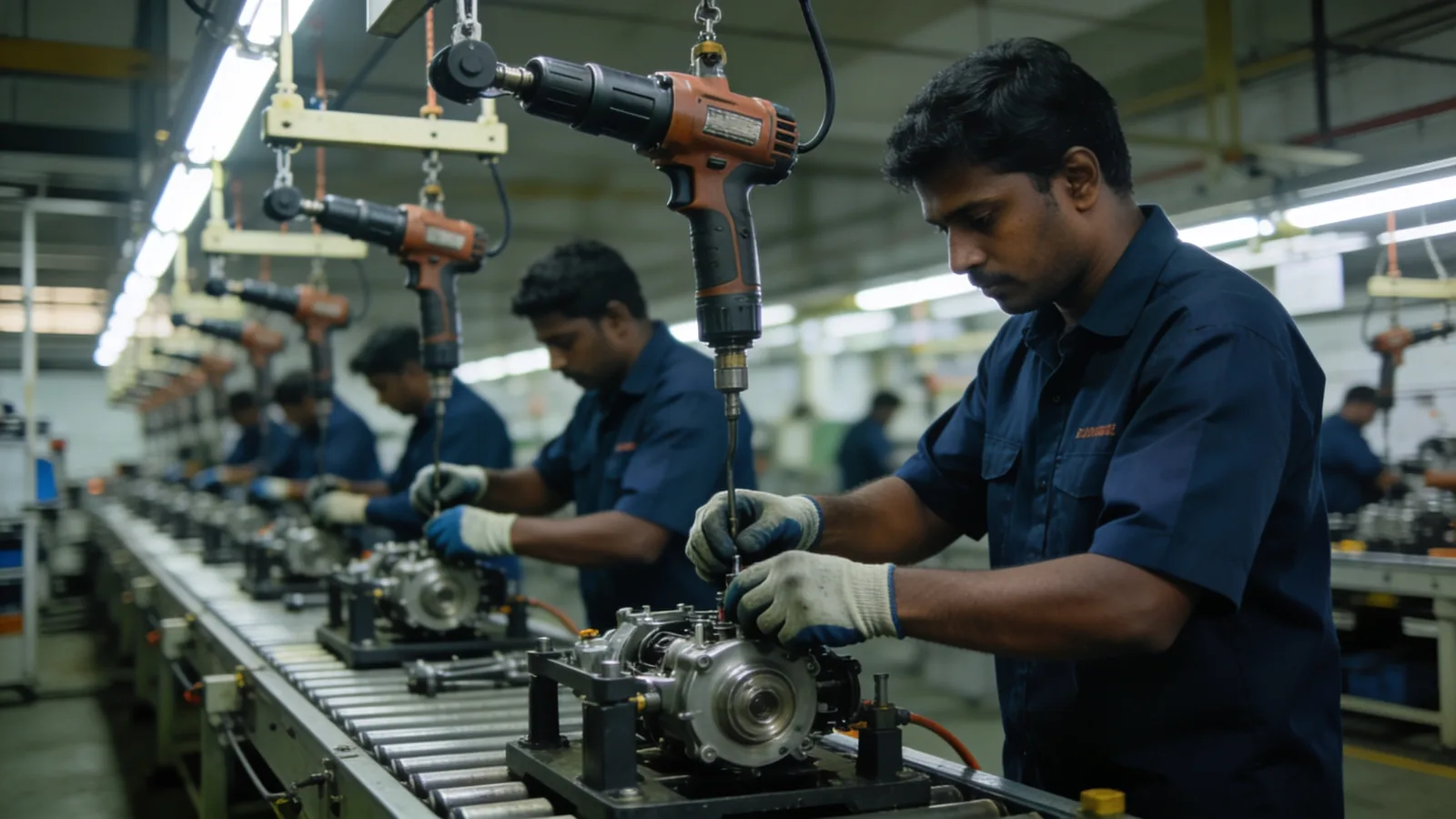
Stations, sub-assembly, torque and traceability.
Assembly work is repetitive precision. We screen dexterity and fastening discipline, induct on traceability and poka-yoke behaviour, then hold consistency with buddy pairing and supervision.
- ✓Station-level assembly and sub-assembly
- ✓Torque tool use with traceability logging
- ✓Poka-yoke and error-proofing compliance
- ✓Visual inspection and rework segregation
- ✓Line replenishment and kitting support
A torque-critical station is not a place to learn
An assembly defect that escapes the line costs far more once a customer finds it.
An untested operator on a torque-critical station under-tightens a joint for half a shift, and the traceability log cannot say which units.
A field failure, a recall conversation, and a customer audit that questions the whole line's manning plan — plus rework hours you cannot bill.
Dexterity and torque screening before deployment, traceability and poka-yoke induction, buddy pairing for the first week and a supervisor watching takt daily.
Get a rate card →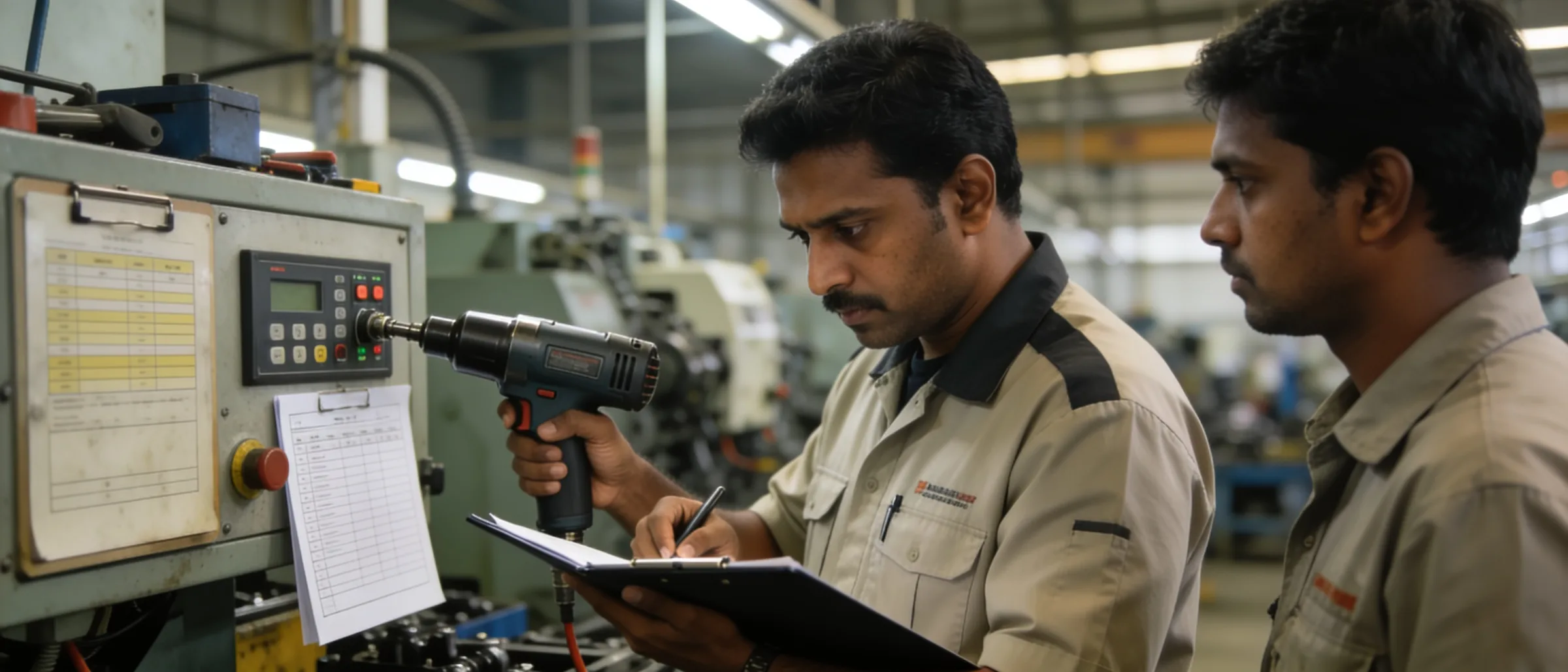
Screening, deployment and compliance
Move the slider for an indicative monthly bill for assembly operators at a ₹20,500 gross wage, statutory costs and an illustrative 12% service fee (your actual fee is set out in the rate card). Firm rates follow your State's minimum wage for the skill category, the city and the shift pattern.
What clears before the worker reaches your gate.
What an assembly line operator does on a paced line
An assembly line operator builds part of a product at one station within the takt time: picking the right variant from the rack, fitting and fastening it in the set sequence with a DC nutrunner or torque wrench, scanning parts for traceability, checking the station's poka-yoke has passed, and pulling the andon when something is wrong. On electronics lines the work is manual insertion, screwing, cable dressing and testing, with ESD precautions throughout.
The skill that matters is doing the same station correctly for eight hours at line speed. That makes it a different hire from a production operator on a process line, and from the inspector who releases the product:
Production operators
Process, filling and packing lines where SOP adherence and volume matter most.
Production operator staffing →Electronics staffing
Operators and technicians for electronics and semiconductor plants.
Electronics and semiconductor staffing →Assembly grades, mapped to the station skill matrix
Many plants run an I-L-U-O matrix per station: I is in training, L works with supervision, U works alone to standard, O can train others. We deploy and report against the same scale, so your line engineers can see coverage at a glance.
| Grade | Typical background | Matrix level on your stations | Usual minimum-wage category |
|---|---|---|---|
| Trainee operator | 10th–12th pass or fresh ITI (Fitter, Electronics Mechanic, Mechanic Motor Vehicle) | I → L during the buddy period | Semi-skilled |
| Assembly operator | ITI or 1–2 years on a paced line | U on one or two stations | Semi-skilled |
| Multi-skilled / relief operator | 2+ years, several stations qualified | U on four or more stations; covers breaks and absence | Semi-skilled or skilled |
| Team leader | ITI or diploma, 4+ years | O: trains, audits stations, first response to andon calls | Skilled |
Skill categories come from each State's minimum-wage notification under the Code on Wages, 2019; the mapping is typical, not universal.
The assembly screening test, station by station
Torque-critical and safety-critical stations are gated on the result; others use it to decide the grade.
Dexterity under time
A timed pick-and-fit exercise with small fasteners and clips, repeated to check the pace holds without errors.
Torque tools
Use a DC nutrunner or click-type torque wrench, follow a cross-pattern tightening sequence, and explain what an NOK signal means.
Work instruction reading
Follow a pictorial work instruction, including variant selection, without verbal prompting.
Visual defect recognition
Spot missing clips, wrong variants, scratches, dents and loose connectors on a sample set.
Traceability and andon
Scan parts in the right order, react to a scan error, and know when to pull the andon rather than fix it alone.
ESD and fitness
For electronics lines: wrist-strap and handling discipline. For all lines: fitness for standing, repetitive work at line speed.
PPE, audit records and the compliance behind each operator
PPE issued and checked
- ✓Safety shoes and gloves suited to the station
- ✓ESD footwear, wrist straps and coats on electronics lines
- ✓Safety glasses at pressing, riveting and clipping stations
- ✓Hearing protection where your noise survey requires it
Records your customer audit will ask for
- ✓Training record per operator, per station, with sign-off dates
- ✓Skill matrix showing coverage for every station and shift
- ✓Work instruction version the operator was trained on
- ✓Customer audits under IATF 16949 and similar systems commonly check these for contract staff too
Compliance we carry as employer
- ✓EPF and ESI enrolment before day one; ESI covers gross wages up to ₹21,000 a month
- ✓Wages at or above the State minimum for the category, paid by the 7th of the following month
- ✓Women on night shifts only with consent and State-prescribed safeguards (OSH Code, section 43)
- ✓Contract-labour registers under the OSH Code (which replaced the CLRA Act, 1970), shared monthly
Shift patterns, relievers and the wage basis
Assembly lines usually run two or three 8-hour shifts at a fixed line speed. Every break, leave day or absence needs a qualified relief operator, or the station stops the line — plan relievers per shift based on your absenteeism, not as an afterthought. The OSH Code caps ordinary hours at eight a day; hours beyond that are overtime at twice the ordinary rate.
| Basis | Figure | Source and notes |
|---|---|---|
| Legal floor (example) | Haryana: semi-skilled ₹16,781 a month, skilled ₹18,501 a month | Haryana notification effective 1 April 2026. Your State, zone and scheduled employment decide the real floor. |
| Karnataka | Skill-and-zone structure with steep increases, notified 22 May 2026 | Its legal validity is being contested; check before budgeting a site in Karnataka. |
| Market reference | Operator average ₹18,876 a month; typical range ₹11,524–₹30,919 | Indeed India generic operator series, 467 reports, updated August 2026. There is no separate assembly-operator series. |
| Our estimator | ₹20,500 gross a month for an assembly operator | Planning figure. Trainees price lower; relief operators and team leaders higher. |
Indicative only, not an offer or a legal rate. A national floor wage under the Code on Wages is still being fixed; until then State rates apply. Check your State's rate with the minimum wage calculator.
What to hold assembly staffing to
Station coverage
At least three people qualified to U level on every station, per shift, so absence never stops the line.
First-pass yield
Units passing end-of-line test first time, with defects traced back to the station and shift.
Torque NOK rate
NOK signals per 1,000 joints at torque-critical stations. A rise usually means tool, sequence or training drift.
Line stops caused at station
Minutes of line stoppage attributable to operator-side causes, reviewed per shift.
Our service targets
We aim to deploy trained operators in 7–12 working days, build launch waves backwards from your SOP date, and replace exits within 15 days. Targets are written into the SLA schedule.
Three assembly staffing mistakes to avoid
Launching without trial-build training
Operators who first see the new model on SOP day learn on your customer's units. Put them on trial builds.
One person per station
A line with no multi-skilled relievers stops whenever someone is absent. Fund the matrix, not just the headcount.
Treating ESD as optional
On electronics lines, one unstrapped operator can damage boards that fail only in the field.
Assembly line operator staffing FAQs
Screening, launches, skill matrices, ESD, replacement and cost basis.
Get a rate card →How are assembly operators screened?+
A timed dexterity exercise, torque tool use and tightening sequence, pictorial work-instruction reading, visual defect recognition, traceability scanning and andon use, plus ESD discipline for electronics lines. Torque-critical stations are gated on the result.
What is the difference between an assembly line operator and a production operator?+
An assembly operator builds a product station by station against takt time, usually with torque tools and traceability. A production operator tends a process line such as filling or packing. The screening and skill matrix differ.
Can you staff a full line for a new model launch?+
Yes. Wave plans are built backwards from the SOP date with a buffer for early exits, operators go through trial builds, and station allocation follows a skill matrix agreed with your line engineers.
How do you maintain quality consistency across shifts?+
A skill matrix per station, buddy pairing in the first week, takt and first-pass yield reviewed per shift, and a supervisor accountable for station-level defects, not only attendance.
Do you supply operators for electronics assembly?+
Yes, screened for ESD discipline, fine-motor dexterity and work-instruction reading. Soldering and rework roles are tested separately against the workmanship standard your line follows.
Is training to our SOP included?+
Induction on safety, quality and traceability is ours. Station-specific training runs with your trainers, with training records kept per operator for customer audits.
What is the replacement commitment?+
We aim to replace exits within 15 days, and each wave carries an agreed buffer so sanctioned strength on the line does not drop.
How is assembly operator staffing priced?+
The gross wage for the category and city (at or above the State minimum), plus employer PF, EDLI and admin charges, ESI where gross is up to ₹21,000, bonus and gratuity provisions, overtime and night-shift payments as actuals, and the service fee. See how staffing fees are calculated.
New model or a second shift?
Send the role, headcount and site city. We aim to send an itemised rate card and deployment date within one working day.