
Ports and shipping staffing where the vessel does not wait
Berth time is the most expensive clock in logistics. A gang short at 2am means a slower discharge rate, a missed sailing window and demurrage that dwarfs any manpower saving. We staff terminals, CFS yards and support operations with authorisation-checked operators and gangs on genuine 24×7 rosters.
Roles, headcount and site city. We aim to send a costed proposal within one working day.
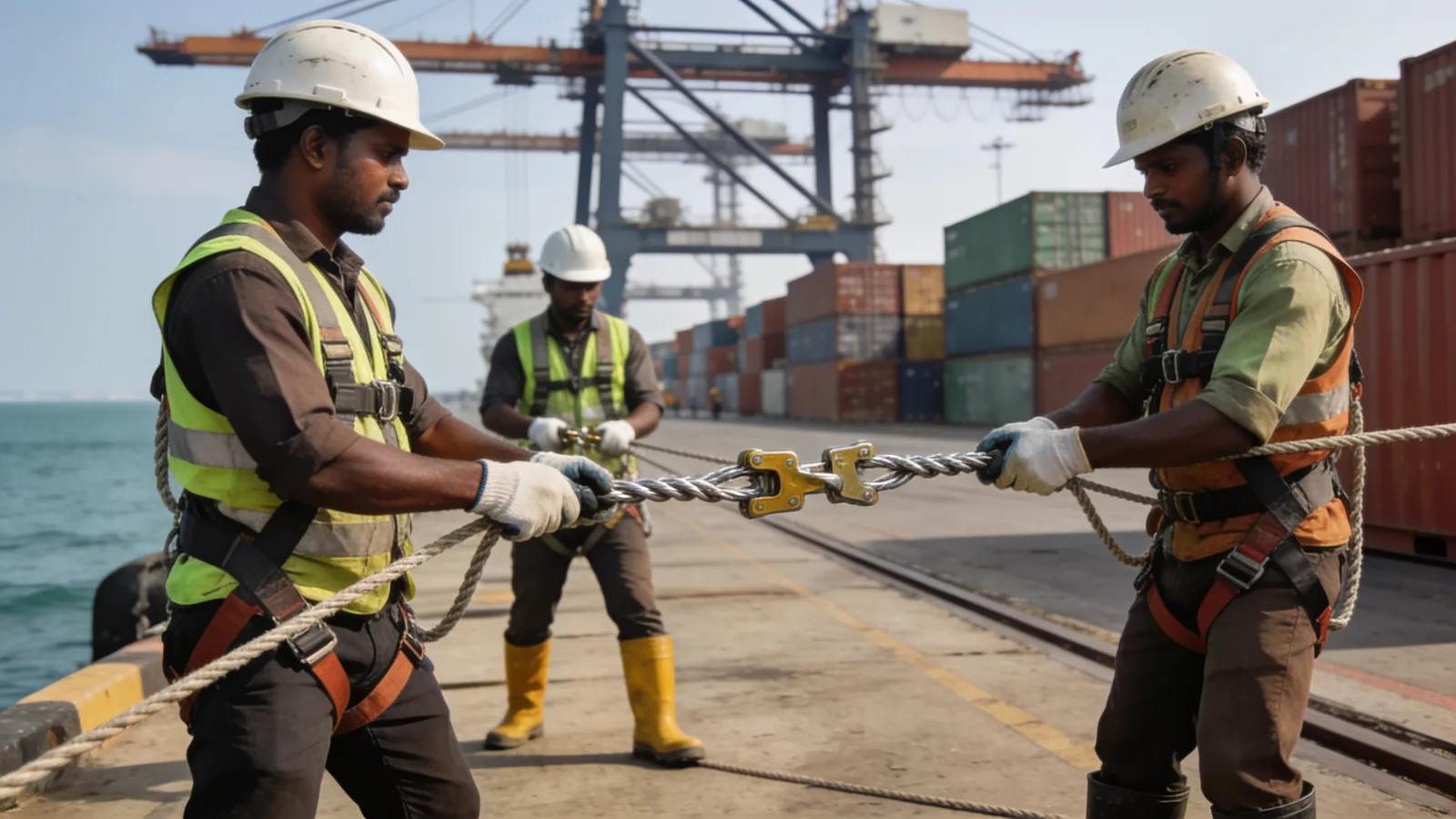
Roles across a terminal and its yards
Terminal work is gang-based and safety-critical. Equipment operators need terminal authorisation; gangs need discipline, PPE and a supervisor who can be held to a plan.
- ✓Equipment: RTG, RMG and reach stacker operators, top lift and empty handlers
- ✓Cranes: mobile harbour crane support, quay crane assistance, signal men
- ✓Gangs: lashing and unlashing, stevedoring, hatch and hold cleaning crews
- ✓Yard: container yard planning support, gate operations, seal and damage checks
- ✓CFS: stuffing and destuffing labour, palletising, tally clerks, warehouse crews
- ✓Documentation: tally, EDI and gate documentation, customs coordination support
- ✓Support: housekeeping, security with port-entry passes, canteen and transport
Demurrage and detention grow by the hour
Vessel and container detention charges accumulate by the hour and by the box, and a manpower shortfall converts directly into both.
No certification for equipment operators, no PPE discipline, no wage or PF records — and port authorities and customers audit exactly those things now.
Plus principal-employer liability for informal labour that turns up in a contract-labour inspection under the OSH Code or a compensation claim after an accident.
Equipment certification verified before deployment, safety-trained lashing gangs with PPE and insurance, 24×7 rosters with named supervisors, and a compliance file that survives a port and customer audit.
Get a quote →
Gangs, certification, rosters
Billed per gang per shift for stevedoring work, or on loaded wage plus service fee for continuous terminal and CFS deployment.
Gang composition is agreed against the operation, not improvised on the quay.
Where port and terminal work concentrates
Cargo work concentrates on a few gateway ports and the inland container depots that feed them. Each port has its own entry-pass system and its own labour history.
JNPA (Nhava Sheva) and Mumbai
The main west-coast container gateway, with CFSs clustered around Uran and Panvel.
Mundra, Kandla, Pipavav, Hazira
Private and major-port terminals handling containers, dry bulk and liquids along the Gujarat coast.
Chennai, Kamarajar, Kattupalli
Container, car-export and bulk terminals north of Chennai, with a dense CFS belt.
Thoothukudi, Kochi, Vizhinjam
V.O. Chidambaranar port, Cochin's transshipment terminal and the new deep-water transshipment port at Vizhinjam.
Visakhapatnam, Kakinada, Krishnapatnam
Bulk, container and project cargo on the Andhra coast.
Kolkata, Haldia, Paradip, Dhamra
River-port container and bulk operations and the large eastern bulk ports.
Inland container depots such as Tughlakabad and Dadri in the NCR, and ICDs near Ludhiana, Nagpur and Bengaluru, need the same gang and equipment skills without a quay.
Which rules govern port and dock labour now
Dock work used to sit under its own Act. Since 21 November 2025 it falls under the OSH Code, and at the major ports the Central Government is the appropriate government.
Dock work under the OSH Code
The Dock Workers (Safety, Health and Welfare) Act 1986 is one of the laws the OSH Code replaced. Safety, welfare, hours and accident-reporting duties for dock work now come from the Code and its rules.
Central rules at major ports
At the major ports, including their contractors' establishments, the Central Government is the appropriate government under the OSH Code, so the OSH (Central) Rules notified on 8 May 2026 apply and contractor licensing runs through the central labour machinery.
Annual health checks
The OSH (Central) Rules give dock workers aged 40 or above a free annual health examination. We track eligibility and schedule it for our workers.
Accident reporting
An accident that causes death, or an injury that keeps a worker off work for 48 hours or more, must be notified to the authorities within the time the rules prescribe. We report jointly with your safety team.
ISPS port security
Port facilities serving international ships follow the ISPS Code, so every worker needs identity verification and a port entry pass before the first shift.
Equipment operators
There is no single national licence for RTG or reach stacker operators; terminals authorise operators after training, a practical test and medical fitness, including vision. We verify prior authorisation and experience before offering a candidate.
Sizing lashing gangs from your crane plan
Gang size is set by your terminal's standard, but the planning arithmetic is always the same: gangs per working crane, per shift, plus relievers. A worked example:
| Input | Example | Your number |
|---|---|---|
| Quay cranes working a vessel | 3 | From your berth plan |
| Gang per crane (lashers plus gang leader) | 8 | Your terminal standard |
| Shifts per day | 3 | Usually 3 for 24×7 operations |
| Heads on duty per day | 3 × 8 × 3 = 72 | |
| Reliever reserve for weekly offs, leave and absence | about 15–20% → 83 to 87 heads on the roster | From your attendance history |
Illustrative only. Bunching of vessels, hatch-cover and hold-cleaning work, and yard and CFS gangs are planned on top.
The induction every gang member completes
Container terminals combine heavy moving equipment, suspended loads, work at height and night shifts. Every worker completes this before their first shift, and gang leaders re-brief it daily.
- ✓Vehicle–pedestrian separation: walkways, exclusion zones and never walking behind a reversing machine
- ✓Suspended loads: never under a spreader or hook, and signalman-only communication with operators
- ✓Lashing at height: lashing cages or platforms, fall protection and safe handling of lashing bars and twist locks
- ✓High-visibility clothing, helmet, safety shoes and gloves checked at the gate
- ✓Fatigue and hydration on night and summer shifts, with rest breaks built into the roster
- ✓Weather stop rules for high wind, lightning and cyclone warnings
- ✓Emergency muster points, first aid and incident reporting route
Questions operations and HR heads ask us
Answers we give in the first call, written down so you can compare vendors on the same terms.
Get a quote →Do you supply certified RTG and reach stacker operators?+
Yes, with prior terminal authorisation, training records and experience verified before deployment, along with medical fitness and accident cover. Uncertified equipment operation is where port safety records and insurance positions come apart.
How is stevedoring manpower billed?+
Per gang per shift for vessel operations, which matches how the work actually arrives, or on loaded wage plus service fee for continuous terminal and CFS deployment.
Can you mobilise extra gangs for a vessel bunching situation?+
We aim for 48 hours, provided entry passes can be processed in that window. Pass processing is usually the binding constraint, not worker availability.
Who is liable for compliance on port labour?+
As principal employer you carry residual liability — if a contractor fails to pay wages, the OSH Code makes you pay and recover. That is why the contractor-licence position under the OSH Code (formerly CLRA) should be confirmed before the first shift, and why we maintain wage and OT registers, PF and ESI challans and insurance schedules and hand them over monthly.
Do you staff CFS and container freight station operations?+
Yes — stuffing and destuffing labour, palletising crews, tally clerks, gate and documentation staff and warehouse teams, on continuous or shift-based deployment.
Which labour rules apply to contract workers at a major port?+
The OSH Code, which replaced the Dock Workers Act and the Contract Labour Act from 21 November 2025, together with the OSH (Central) Rules 2026, because the Central Government is the appropriate government for the major ports. Private ports and CFSs may fall under State rules; we confirm which before the contractor licence is applied for.
How long does a port entry pass take for new workers?+
It varies by port and terminal, and it is usually the slowest step in adding workers. We collect identity documents, police verification and training records up front and file pass applications as soon as names are confirmed, so the pass, not the worker, is the only thing we are waiting for.
Can a port or terminal use contract labour for cargo handling?+
Usually, yes, but check the basis. The OSH Code prohibits contract labour in an establishment's core activities. Loading and unloading is listed as a support activity only where the establishment is not set up for it, so at a terminal whose business is cargo handling that exclusion does not help. Contract labour there relies on the Code's exceptions instead, chiefly where the activity is ordinarily done through contractors in that establishment or where volumes rise suddenly. At a factory that is not set up for cargo handling, loading and unloading is support work. Contractor licensing, wage and welfare duties apply in full either way.
Staff the berth, not the average day
Send the operation profile and vessel pattern. We propose gang composition, certification checks and a 24×7 roster.