
VMC operator staffing, gated on a machining test.
A vertical machining centre running an untested operator produces scrap faster than it produces parts. VMC operator staffing fails the same way every time: hiring on claimed experience instead of a cleared test. Godstone Consultech screens for drawing reading, offset setting, tool change and inspection, employs every worker on our own payroll, and keeps the PF, ESI, wage and contract-labour records — so the person on your floor is documented, replaceable and accountable from day one.
Machine list, controls and component mix are enough to shortlist properly.
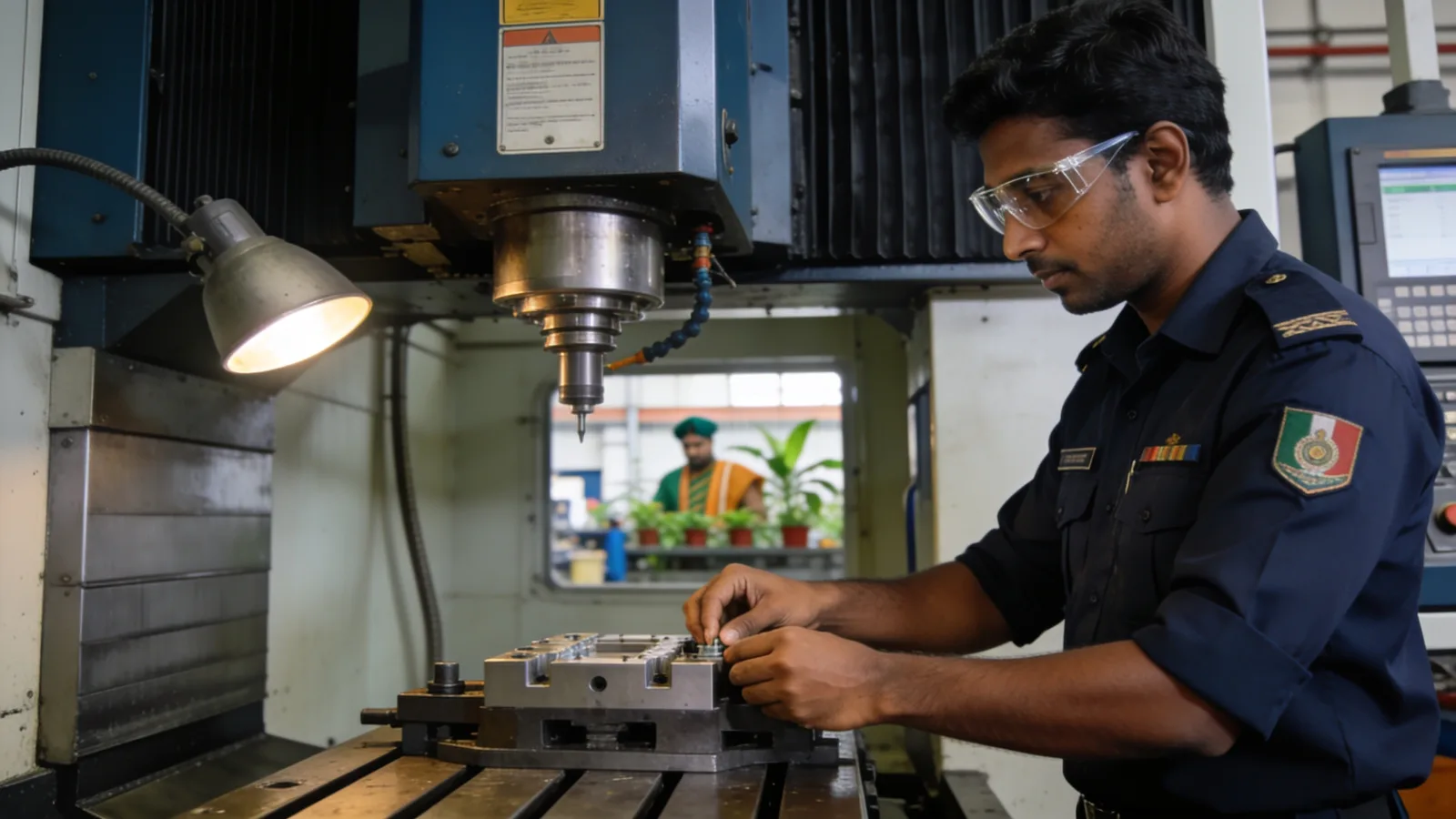
Milling, fixtures, setting and inspection.
VMC work is setup-sensitive. We screen for the actual mix your shop runs — production milling, fixture-heavy jobs, or setter-level changeover work — and test on the control family in use.
- ✓Production milling on VMC, single and multi-fixture
- ✓Tool loading, offsets and wear compensation
- ✓Fixture setup, clamping and job loading
- ✓In-process inspection with vernier and micrometer
- ✓Basic programme edits at the control
Where machining plans lose their margin
Cycle time is planned; scrap and rework are what actually consume it.
Two years of experience on paper turns into a crashed tool, a scrapped fixture-set and a first-off that will not clear inspection.
Tool cost, scrap material, an overtime shift to recover the plan, and a customer audit finding an untrained operator on a critical station.
A practical test on your control family before an offer, wave-wise mobilisation against your ramp, and a supervisor on the floor from day one.
Get a rate card →
Screening, deployment and compliance
Move the slider for an indicative monthly bill for L2 VMC operators at a ₹23,500 gross wage, statutory costs and an illustrative 12% service fee (an assumption for the estimate, not our rate; your fee is agreed in your contract). Firm rates follow your State's minimum wage for the skill category, the grade and the shift pattern.
What clears before the worker reaches your gate.
What a VMC operator does, and why it is not a lathe job
A vertical machining centre mills, drills, bores and taps prismatic parts — housings, brackets, manifolds, die-cast covers, mould plates. The VMC operator's work is setup-heavy: dialling in a vice or fixture, locating the part on datums, setting work offsets (G54 to G59), loading tools into the magazine with the right tool-length offsets, then proving the first-off on hole positions, depths and threads. Much VMC scrap comes from a wrong offset or a part clamped off-datum, not from the cutting itself.
That is why we test VMC operators separately from CNC turning operators. A good lathe hand thinks in diameters and one axis of offsets; a VMC hand thinks in datums, hole patterns and tool lengths. Related roles:
CNC turning operators
Lathes, turning centres and VTLs: diameters, wear offsets, inserts and bar feeders.
CNC operator staffing →Machine operators
Conventional milling, drilling and special-purpose machines without a CNC control.
Machine operator staffing →QC inspectors
CMM, height gauge and position checks that release the first-off independently.
QC inspector staffing →VMC grades we staff, from loader to programmer
Tell us the grade and the manning ratio. One operator tending two VMCs on long cycles needs different skills from one operator doing frequent changeovers on a single machine.
| Grade | Typical background | Works independently on | Usual minimum-wage category |
|---|---|---|---|
| L1 operator | ITI Machinist (DGT craftsmen scheme, NSQF level 4) or Operator Advanced Machine Tool; up to 1 year | Loading and unloading on a set fixture, deburring, gauge checks, cycle start | Semi-skilled or skilled, per the State schedule |
| L2 operator | ITI or diploma, 1–3 years on VMCs with the same control | Tool change and tool-length offsets, wear compensation, first-off submission, alarm recovery | Skilled |
| Setter | Diploma in mechanical or tool and die, or ITI with 4+ years | Fixture and vice setting, work offsets with edge finder or probe, programme prove-out, cycle-time trimming | Skilled or highly skilled |
| Die and mould VMC operator | Tool-room background, 3+ years | Long CAM programmes run from memory card or DNC, high-speed finishing, electrode and insert machining | Highly skilled |
| Programmer | Diploma or degree with 3-axis / 3+2 CAM | Toolpaths, post-processing, cutting data and process sheets for new parts | Highly skilled; usually paid well above the floor |
Skill categories come from each State's minimum-wage notification under the Code on Wages, 2019; the mapping is typical, not universal. ITI level from the DGT CTS 2.0 Machinist curriculum.
The VMC trade test, station by station
Run on a VMC with the control family you use. Each station has a pass mark; a failed station means no offer for that grade.
Drawing and datums
Identify datums A, B and C, relate them to the part zero, and read position, flatness and perpendicularity callouts on a hole pattern.
Vice and fixture setting
Dial a vice true along its length with a dial indicator, clamp without distorting a thin wall, and locate a part on fixture pins and rest pads.
Work and tool offsets
Set G54 with an edge finder or probe, enter tool-length offsets (G43 H) from a presetter or touch-off, and explain what happens if an H number is wrong.
Codes and cycles
Read G90/G91, cutter compensation G41/G42, G81 and G83 peck drilling, G84 tapping, M06 tool change; restart safely from the right block after an alarm.
Measurement
Check hole positions, depths and threads with height gauge, bore gauge, depth micrometer and thread plug gauges, and read a CMM report.
Safety
Door interlocks never bypassed, hands clear of the tool changer, chips cleared with a brush or hook, air gun never pointed at people, coolant-mist discipline.
Setters also dial in and prove a fixture from a setup sheet within an agreed time. Programmers produce a toolpath and simulation from a 3D model before any metal is cut.
PPE, machine rules and the compliance behind each operator
PPE issued and checked
- ✓Safety shoes
- ✓Safety glasses with side shields
- ✓Cut-resistant gloves for handling sharp castings and chips — removed before touching a running spindle
- ✓Hearing protection where your noise survey requires it
Machine rules we brief
- ✓Interlocks active at all times; no running with the door open to watch the cut
- ✓Lock-out before fixture changes or clearing the chip conveyor
- ✓Tool magazine loaded only with the spindle stopped
- ✓Safe machinery, including guarding, is an employer duty under section 6 of the OSH Code, 2020 and State factory rules
Compliance we carry as employer
- ✓EPF and ESI enrolment before day one; ESI covers gross wages up to ₹21,000 a month, and employees' compensation cover applies above that
- ✓Wages at or above the State minimum for the skill category, paid by the 7th of the following month
- ✓Overtime at twice the ordinary wage rate (OSH Code, section 27)
- ✓Contract-labour registers under the OSH Code (which replaced the CLRA Act, 1970), shared monthly
Shift patterns, manning ratios and the wage basis
Production VMC cells usually run two or three 8-hour shifts. Die and mould shops often run long unattended cycles overnight, with one operator watching several machines. The OSH Code caps ordinary hours at eight a day, with spread-over and weekly limits prescribed by the appropriate Government; hours beyond that are overtime at twice the ordinary rate, so price a 12-hour pattern before you choose it.
| Basis | Figure | Source and notes |
|---|---|---|
| Legal floor (example) | Haryana: skilled ₹18,501 a month, highly skilled ₹19,426 a month | Haryana notification effective 1 April 2026. Your State, zone and scheduled employment decide the real floor. |
| Karnataka | Skill-and-zone structure with steep increases, notified 22 May 2026 | Its legal validity is being contested; check before budgeting a Bengaluru-area site. |
| Market reference | CNC operator average ₹19,498 a month; typical range ₹11,615–₹32,730 | Indeed India, 274 reports, updated June 2026. Indeed publishes no separate VMC series, so this is the nearest benchmark; setters sit toward the top of the range. |
| Our estimator | ₹23,500 gross a month for an L2 VMC operator | Planning figure for an industrial belt. Setters, die and mould operators and programmers are quoted separately. |
Indicative only, not an offer or a legal rate. State minimum wages apply and may not be set below the national floor wage the Central Government fixes under the Code on Wages. Check your State's rate with the minimum wage calculator.
What to measure a VMC operator, and us, against
First-off approval
Setups where the first piece clears position, depth and thread checks without a re-cut.
Changeover time
Minutes from last good part to first approved part, tracked per setter against your standard.
Tool breakage and tool life
Broken taps and drills per 1,000 parts. A rising count usually means wrong offsets, worn holders or poor clamping.
Rejection by feature
Rejections split by feature — position, diameter, thread, finish — so the cause is traced to setup, tool or operator.
Our service targets
We aim to send a test plan and rate card within one working day, deploy tested operators in 7–12 working days, and replace an exit within 15 days. Targets are written into the SLA schedule.
Three VMC hiring mistakes to avoid
Treating lathe and VMC hands as one pool
A turning operator put on a VMC without a fixture and offset test is the classic first-week crash.
Ignoring the manning ratio
Two-machine tending needs someone who can recover an alarm alone. Say so up front, or the grade will be wrong.
Mixing die-and-mould with production work
Tool-room VMC work and high-volume production need different people. Staff them as separate grades.
VMC operator staffing FAQs
Testing, grades, manning ratios, cost basis and deployment speed.
Get a rate card →Are VMC operators tested before deployment?+
Yes. Datums and drawing reading, vice and fixture setting, work and tool-length offsets, drilling and tapping cycles and measurement are tested on the control family you run, before any offer is issued.
What is the difference between a VMC operator and a CNC lathe operator?+
A CNC lathe operator turns round parts and works mainly with diameters, inserts and wear offsets. A VMC operator mills prismatic parts and works with fixtures, datums, work offsets and tool lengths. We test and grade them separately.
Which controls do your VMC operators know?+
We test on Fanuc, Siemens and Mitsubishi controls. Where your shop runs another control, we test on that control or screen against your component mix and setup complexity.
What qualification should a VMC operator have?+
Typically an ITI certificate in Machinist or Operator Advanced Machine Tool, or a diploma in mechanical or tool and die engineering. The trade test, not the certificate, decides the grade.
Do you supply VMC setters and programmers?+
Yes. Setters for fixture setting and changeovers, and CAM programmers for new parts, are screened separately from production operators and priced separately on the rate card.
Can one operator run two VMCs?+
Often, on long cycles with stable processes. Tell us the manning ratio, because a two-machine operator must recover alarms and hold size without help, and we test for that.
How fast can VMC operators be deployed?+
We aim for 7–12 working days including the trade test. Larger ramps are staged in waves so testing and induction keep pace.
What does a contract VMC operator cost?+
The gross wage for the grade (at or above the State minimum for the skill category), plus employer PF, EDLI and admin charges, ESI where gross is up to ₹21,000, bonus and gratuity provisions, and the service fee. See how staffing fees are calculated.
Machining centres waiting on operators?
Send the role, headcount and site city. We aim to send an itemised rate card and deployment date within one working day.