
Leadership hiring where the shortlist is referenced before you ever meet it
At plant head and functional director level, the pool in your sector and belt is perhaps forty people, most of them not looking. Leadership hiring is a mapping and persuasion exercise, not a posting. We map the market, reference candidates through people who have worked with them, and present four names with evidence behind each.
Role, band and location. We aim to send a shortlist plan within one working day.
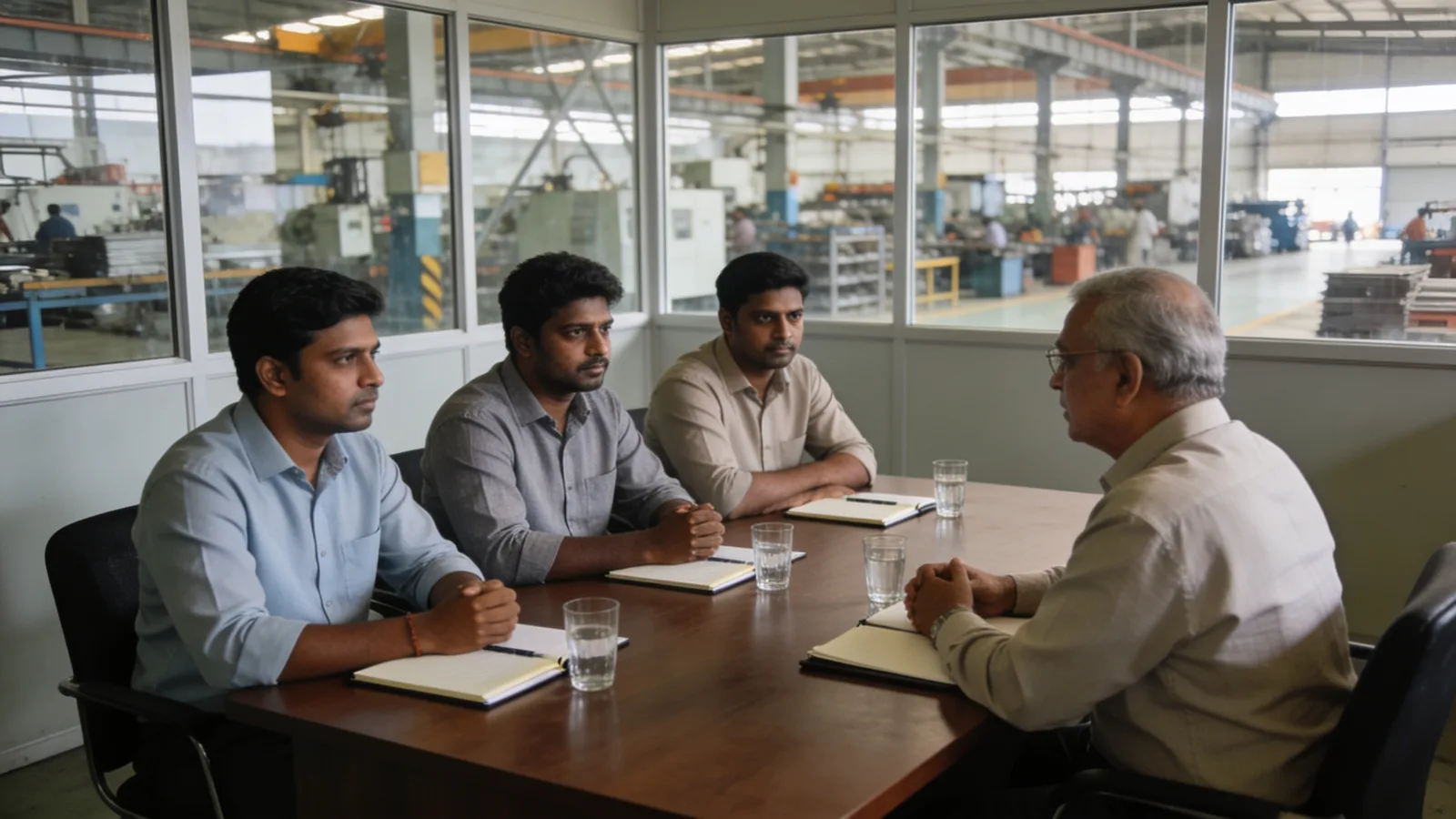
What a leadership mandate actually involves
The brief is the hardest part. What the role needs at this stage of the plant's life is rarely what the job description says.
- ✓Role brief built with the CEO or board, not copied from a JD
- ✓Sector and belt mapping: who holds this role today, where, at what scale
- ✓Discreet approach to passive candidates already in comparable roles
- ✓Structured assessment against the four or five outcomes that matter
- ✓Back-channel references through former colleagues and reports
- ✓Compensation benchmarking against the actual comparator set
- ✓Offer negotiation, notice management and 90-day landing review
A wrong leadership hire resets two years
The plant head who cannot hold a shop floor, or the operations director who has only ever run a mature line, does damage that is visible long after they leave.
Which selects for people currently unhappy or between jobs, not for the person best suited to the mandate. The strongest candidate is rarely on a portal.
Meanwhile: attrition in the layer below, stalled projects, a demoralised management team and a second search under worse conditions.
We identify everyone credible in the sector and belt, approach them discreetly, reference them independently, and hand you four candidates with evidence instead of a longlist with CVs.
Start the search →
Brief, search, close
Leadership mandates are retained: a percentage of annual CTC agreed in your engagement letter and invoiced in stages against milestones rather than on success alone. For this band, market fees in India typically run around 12–20% (an indicative range, not our rate card). The slider multiplies the number of positions by an assumed average fee of ₹14.5 lakh per position, before GST.
We write the brief you will actually hire against, including the things nobody says out loud.
Leadership roles we hire, and what we test each one for
Leadership hiring here means the layer that runs the business day to day: senior managers, GMs, heads of function and unit heads. Board-level and statutory appointments are run as CXO executive search.
| Role family | Typical titles | What we test for beyond the CV |
|---|---|---|
| Unit and plant leadership | Plant head, works manager, unit head, site director | Has held a shop floor through a crisis: a ramp-up, a union negotiation, a customer audit or a safety incident |
| Manufacturing and engineering | Head of production, maintenance, projects or industrial engineering | Measured results on output, OEE or downtime, and how they were achieved |
| Quality and EHS | Head of quality, EHS head, supplier quality lead | Customer and certification audits faced, and how a systemic problem was fixed rather than contained |
| Supply chain | Head of purchase, logistics, planning or warehousing | Cost and inventory results, supplier development, working under disruption |
| Commercial | Zonal and regional sales heads, key account and business development heads | Territory built or turned around, team retention, collections discipline |
| Enabling functions | HR head for a unit or region, finance controller, IT head below CXO level | Partnership with operations, statutory and audit exposure handled |
Hiring a whole leadership team for a new plant
A greenfield site needs five to eight leaders who have never worked together, hired in the right order so each can help hire the next. The sequence we recommend, counted back from start of production (SOP):
Unit or plant head
Hired first, so they shape the rest of the team and own the ramp-up plan.
HR and projects heads
HR builds the hiring engine and compliance set-up; projects owns construction, installation and commissioning.
Maintenance and quality heads
Present for installation and trials, and to prepare customer audits and approvals.
Production and supply chain heads
In place to recruit supervisors, plan the ramp and qualify suppliers.
Second line and supervisors
Hired by the new leaders, with our permanent staffing and bulk hiring services behind them.
How we assess a leader before you meet them
At this level the CV tells you where someone has been, not what they did there. Each shortlisted candidate goes through the same four checks, and you receive the evidence in writing.
Outcome interview
A structured interview built around the four or five outcomes the role owns in year one, asking for specific situations, numbers and what the candidate personally did.
First-90-days plan
A short written or spoken plan for your actual situation — a useful test of judgement and of how much homework the candidate did.
Reference triangulation
At least one former manager, one peer and one person who reported to the candidate, including people the candidate did not nominate, with consent.
Site and team reality check
For operations roles, a plant walk or a conversation with the team they would lead, so both sides see the real job.
Structuring a senior offer in India that survives the notice period
Senior candidates in India commonly serve 60 to 90 days of notice, and that is when counter-offers arrive. The offer has to account for what the candidate gives up, not just the new salary.
What to account for
- ✓Variable pay or bonus the candidate forfeits by leaving mid-year
- ✓Unvested stock options or long-term incentives
- ✓Notice-period buy-out, if you need them sooner
- ✓Relocation, housing and schooling for a move to a plant town
- ✓A joining bonus with a fair, pro-rated clawback
How we protect the close
- ✓Test the candidate's motivation to move before the offer, not after
- ✓Agree in advance how you will respond to a counter-offer
- ✓Keep in weekly contact through the notice period
- ✓Arrange meetings with the future team before joining
- ✓Keep the second-choice candidate warm until day one
Leadership hiring or CXO executive search?
| Leadership hiring | CXO executive search | |
|---|---|---|
| Roles | Senior managers, GMs, heads of function, unit and plant heads | CEO, MD, CFO, COO, CHRO, company secretary and other KMP |
| Decision maker | CEO, business head or HR head | Board, promoter or nomination and remuneration committee |
| Typical fee | Indicatively 12–20% of annual fixed CTC in the market, staged | Retained, commonly about 20–33% of first-year fixed CTC |
| Typical time to offer | Six to ten weeks | Twelve to sixteen weeks |
| Volume | Often several roles at once | Usually one role, highly confidential |
Questions clients ask before signing a mandate
Answers we give in the first call, written down so you can compare firms on the same terms.
Start the search →How is leadership hiring priced?+
As a retained mandate: a percentage of annual fixed CTC agreed in your engagement letter, invoiced in stages (for example on mandate start, shortlist delivery and joining), plus GST at 18%. As an indicative market range, leadership fees in India typically run around 12–20%, higher than staff-level placement fees.
What is the difference between this and executive search?+
Practically, band and scope. Our executive search practice covers CXO and board-level mandates; leadership hiring covers the layer below — plant heads, functional heads, GMs and directors — where volume is higher and speed matters more.
How long does a leadership search take?+
Typically six to ten weeks from brief to offer for a mapped market, plus the candidate's notice period, which at this level is usually two to three months. Regulated or very narrow sectors run longer.
Do you guarantee replacement?+
Replacement cover is part of a retained leadership mandate, with the period and conditions written into the engagement letter rather than left to goodwill.
Will our current employees or competitors know we are hiring?+
Not from us. Approaches are made without naming you until the candidate is genuinely interested and has agreed to confidentiality, which is standard practice for a mandate in a tight belt.
Can you hire an entire leadership team for a new plant?+
Yes. We plan the sequence back from your start-of-production date — unit head first, then HR and projects, maintenance and quality, then production and supply chain — so each leader can take part in hiring the next, and so the team is in place for trials and customer audits.
Do you use psychometric tests?+
Where you want them, as one input among several. We rely mainly on structured outcome interviews, a first-90-days plan and triangulated references, which predict leadership performance better than a personality profile on its own.
How do you handle counter-offers at senior level?+
By testing the reasons for moving early, agreeing your response to a counter-offer before the offer goes out, and staying in weekly contact through the notice period. If the candidate is using your offer only to negotiate, it is better to know before you sign.
Start with the brief, not the CVs
Give us two weeks with your board and you will get a market map and four referenced names, not a longlist.